Hello! Welcome back to our walk through thermodynamics.
In our last lesson, we dove deep into pressure. We saw that it isn't just some abstract number, but the real, physical result of countless tiny molecules slamming into the walls of a container. The key idea was that pressure comes from the force of these collisions.
Today, we're going to look at pressure's close cousin: temperature. When you touch a hot stove, the molecules in the stove are moving violently, and they transfer that violent motion to the molecules in your hand. But what exactly are we measuring when we say something is "100 degrees"? Is it the same as pressure? It turns out it's also about molecular motion, but it's measuring a different aspect of it.
Our goal for this lesson is to explain temperature as a measure of average molecular kinetic energy and describe the Zeroth Law of Thermodynamics.
Here's our plan:
- Decoding Temperature: We'll move past the subjective feeling of "hot" and "cold" to uncover what temperature truly represents at the molecular level.
- The Law of Common Sense?: We'll explore the Zeroth Law of Thermodynamics, which sounds incredibly obvious at first but is the absolute bedrock that makes all temperature measurement possible.
Let's get started.
What is Temperature, Really? From Sensation to Science
We all have an intuitive sense of temperature. You know that a cup of coffee is hot and an ice cream is cold. But our senses can be tricky.
Imagine it's a cool morning. You touch the metal frame of your bicycle and the wooden park bench it's leaning against. The metal feels much colder than the wood, right? But they've been sitting outside all night, so they must be at the same temperature.
This paradox happens because the metal is a better thermal conductor. It pulls heat away from your hand much faster than the wood does, so your brain interprets this rapid heat loss as "cold." This tells us that our personal feeling of hot or cold isn't a reliable scientific measure. We need something more objective.
To find it, we need to zoom in, way down to the level of atoms and molecules.
This video provides an excellent visual journey into the concept of temperature, starting with the very problem of subjective feeling we just discussed.
Watch the section from 0:43 to 2:20. It perfectly illustrates why our 'felt temperature' isn't a good scientific definition and sets the stage for looking at the atomic level.
The Dance of the Molecules
So, if our sense of touch is unreliable, what's really going on? The answer lies in the kinetic energy of particles.
As we discussed last lesson, particles in a gas (or a liquid or a solid) are never still. They are constantly in motion: zipping around, vibrating, rotating. This motion is a form of kinetic energy (the energy of movement).
- In a hot object, the particles are moving or vibrating vigorously. They are in a state of high agitation.
- In a cold object, the particles are moving or vibrating much more sluggishly.
Temperature is our way of measuring the intensity of this microscopic dance.
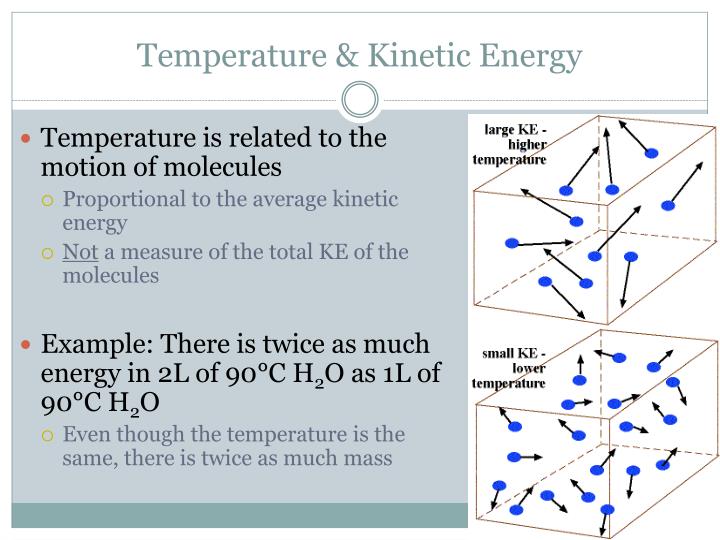
Now, here is the absolutely crucial part: Temperature is a measure of the average kinetic energy of the particles, not the total kinetic energy.
This is a vital distinction. Think about it with an example:
You have a small teacup of boiling water and a huge bathtub full of boiling water. Both are at the same temperature (100°C or 212°F). This means the average kinetic energy of a water molecule in the cup is the same as the average kinetic energy of a water molecule in the tub. The molecules in both are, on average, jiggling just as furiously.
However, the bathtub contains vastly more water molecules. So, while their average energy is the same, the total energy in the bathtub is enormous compared to the teacup.
Let's see a simulation of this in action.
Let's return to the MarbleScience video. The next segment shows a fantastic computer simulation of argon atoms. Watch how their movement changes as the temperature changes, giving you a powerful visual intuition for this concept.
Watch from 2:20 to 5:26. Observe how the atoms go from a vibrating solid, to a flowing liquid, to a chaotic gas as the temperature (and thus their kinetic energy) increases.
Putting It into an Equation
Physicists have formalized this relationship with a beautifully simple equation. To explore it, let's turn to a more formal text.
Temperature, Kinetic Theory, and the Gas Laws
The OpenStax 'College Physics' textbook clearly lays out the connection between the microscopic world of kinetic energy and the macroscopic property of temperature we can measure.
Read the section titled '13.4 Kinetic Theory: Atomic and Molecular Explanation of Pressure and Temperature.' Focus on the part that leads to and explains the equation relating average kinetic energy to temperature. You're looking for the equation that looks like KE = (3/2)kT. Don't worry about the full derivation, but understand what the final equation tells us.
As you read, the key equation you found is:
Let's break this down:
- is the average translational kinetic energy of a molecule. The bar over the top means "average".
- is the absolute temperature of the substance. (We'll dig into what "absolute" means and the Kelvin scale in our next lesson, but for now, just think of it as the proper scientific scale for temperature).
- is the Boltzmann constant ( J/K). Don't let the fancy name scare you. It's just a fundamental conversion factor, like the number of inches in a foot. It connects the microscopic world of energy (measured in Joules) to the macroscopic world of temperature (measured in Kelvin).
This equation is one of the cornerstones of thermodynamics. It is the dictionary that translates the language of molecular motion into the language of temperature.
Quick Recap
Let's pause. We've established that temperature isn't some vague feeling of hotness. It's a direct, physical measure of the average kinetic energy of the atoms or molecules in a substance. When you measure something's temperature, you are taking the statistical average of a frantic, microscopic dance.
The Zeroth Law: The Right to Measure Temperature
Okay, so temperature is average molecular kinetic energy. Great. But how do we measure it? We can't stick a probe into a glass of water and measure the speed of every single molecule. That's impossible.
We use a thermometer. But why does a thermometer work? Why can we trust that when a thermometer reads 20°C, it's actually telling us the temperature of the thing it's touching? The answer is so fundamental that it's called the Zeroth Law of Thermodynamics.
Thermal Equilibrium
First, we need one more concept: thermal equilibrium.
When you place a thermometer into hot coffee, energy flows from the coffee to the thermometer. The molecules in the coffee are jiggling violently, and through collisions, they make the molecules in the thermometer's liquid (like alcohol or mercury) jiggle more violently too. This causes the liquid to expand and rise up the tube. This transfer of energy continues until the thermometer's molecules are jiggling, on average, just as violently as the coffee's molecules.
At this point, energy transfer doesn't stop, but the flow of energy from the coffee to the thermometer is perfectly balanced by the flow from the thermometer to the coffee. There is no net flow of energy. The reading on the thermometer becomes stable.
When this happens, we say the coffee and the thermometer are in thermal equilibrium. They have reached the same temperature.
The Law Itself
Now for the law. It states:
If object A is in thermal equilibrium with object B, and object B is in thermal equilibrium with object C, then object A is also in thermal equilibrium with object C.
When you first hear it, you might think, "Well... duh! Of course!" It seems as obvious as saying if A=B and B=C, then A=C.
But this "obvious" fact is not a mathematical certainty; it's a fundamental rule about how our universe works. Without this law, you couldn't trust a thermometer.
Let's see this explained with a great analogy.
Zeroth law of thermodynamics | Chemical Processes | MCAT | Khan Academy
Khan Academy does a fantastic job of explaining why this seemingly trivial law is actually profound. It uses a simple story with a pie, a steel sphere, and some water.
Please watch from the beginning to 5:34. Pay close attention to the argument about why this law is necessary to have a single, universal definition of temperature.
As the video explained, let's map this onto our thermometer example:
- Object A = A cup of coffee
- Object B = A thermometer
- Object C = A bowl of soup
If you put the thermometer (B) in the coffee (A) and it reads 80°C, they are in thermal equilibrium. If you then put the same thermometer (B) in the soup (C) and it also reads 80°C, they are also in thermal equilibrium.
The Zeroth Law guarantees that if you then poured the coffee (A) and the soup (C) together, no net heat would flow between them. They are already at the same temperature. This law is the logical foundation that allows a thermometer (object B) to be a reliable go-between to compare the temperatures of any two other objects. It's what makes a "degree" a universal unit.
Why "Zeroth"?
As a final piece of trivia, why is it called the "Zeroth" Law? As you heard in the last part of the video, it's because scientists had already established and named the First and Second Laws of Thermodynamics. Only later did they realize that this principle of thermal equilibrium was even more fundamental and logically came before the others. Since "First Law" was already taken, they humorously named it the "Zeroth Law."
Let's Practice: Problems and Questions
Let's test our understanding with a few questions. The math is light here; the focus is on the concepts.
(Remember, J/K)
Worked Problems
Problem 1: Energy of a Gas Molecule
Room temperature is approximately 293 K. What is the average translational kinetic energy of a single nitrogen molecule in the air in this room?
Solution:
- Identify the Goal: We need to find the average kinetic energy, .
- Identify the Formula: The connection between temperature and kinetic energy is .
- Plug in the values:
- J/K
- K
Problem 2: Comparing Molecules
A container holds a mix of very light helium (He) gas and much heavier argon (Ar) gas. The entire container is at a uniform temperature of 400 K. Which atoms have a higher average kinetic energy?
Solution:
This is a trick question! According to the formula , the average kinetic energy depends only on the absolute temperature, not the type of molecule or its mass.
Therefore, both the helium and argon atoms have the same average kinetic energy.
What does this imply? Since , if the is the same for both, but the mass () of argon is much larger than helium, the average speed () of the helium atoms must be much, much higher than the argon atoms to compensate. Lighter particles have to move faster to have the same energy as heavier ones.
Conceptual Questions
Test your understanding!
Question 1: You have a swimming pool and a teacup, both filled with water at 25°C. Which one has a higher temperature? Which one contains more total internal energy?
Show answer
- Temperature: They have the same temperature. Since temperature is the average kinetic energy of the molecules, and both are at 25°C, the average water molecule in the pool is moving with the same energy as the average water molecule in the cup.
- Internal Energy: The swimming pool has vastly more total internal energy. Internal energy is the sum of the kinetic energies of all the molecules. Since the pool has immensely more water molecules than the cup, its total energy is much greater.
Test your understanding!
Question 2: You use a digital meat thermometer to check if a chicken is cooked. It eventually reads a steady 75°C. In the language of thermodynamics, what does the Zeroth Law tell you is happening at that moment?
Show answer
The Zeroth Law tells us that the thermometer, having reached thermal equilibrium with the chicken, is now at the same temperature as the chicken. Because the thermometer is a calibrated device (calibrated to be in equilibrium with other known standards), we can confidently say the chicken's internal temperature is 75°C. The law validates the thermometer as a reliable intermediary.
Test your understanding!
Question 3: When you mix hot water and cold water, the mixture ends up at a warm temperature. Describe what is happening on a molecular level during the mixing process.
Show answer
At the molecular level, the fast-moving molecules of the hot water are colliding with the slower-moving molecules of the cold water. In these collisions, energy is transferred from the faster molecules to the slower ones. The hot water molecules slow down (losing kinetic energy) and the cold water molecules speed up (gaining kinetic energy). This process continues until, on average, all the molecules are moving at roughly the same speed. This new, intermediate average kinetic energy is what we measure as the final "warm" temperature.
Lesson Summary
Fantastic work today. We've peeled back the everyday notion of "hot" and "cold" to find a precise, scientific meaning underneath.
Here are the core takeaways:
- Temperature is a direct measure of the average translational kinetic energy of the molecules in a substance. It's a measure of the intensity of the microscopic "dance" of atoms.
- Temperature is an average, not a total. A large cold object can have more total energy than a small hot one.
- The Zeroth Law of Thermodynamics gives us the logical green light to measure temperature. It states that if two objects are in thermal equilibrium with a third (like a thermometer), they are in thermal equilibrium with each other. This makes temperature a universal, consistent property.
Preview of the Next Lesson
We now know what temperature is (average molecular KE) and why we can measure it (the Zeroth Law). The next logical step is to explore how we measure it.
In our next lesson, we will get practical and dive into the different temperature scales engineers and scientists use every day: Celsius, Fahrenheit, Kelvin, and Rankine. We'll learn how to convert between them and discuss the profound concept of absolute zero, the coldest possible temperature in the universe. See you then