Hello!
In our last few lessons, we've been building a toolkit for understanding the fundamental properties of functions. We learned how to combine them, how to find their domain and range, and how to determine if they have an inverse. Today, we're adding another powerful analytical tool: symmetry.
This lesson addresses the learning outcome: Analyse (analyze) the symmetry of a function to determine if it is even, odd, or neither.
Just as symmetry is a key concept in art and science, it is also a fundamental property in mathematics that can reveal deep structural information about a function. Understanding a function's symmetry makes it much easier to visualise and sketch its graph. We will explore two main types of symmetry: symmetry about the y-axis and symmetry about the origin.
1. The Two Types of Function Symmetry
A function's symmetry is determined by how its output behaves when you compare an input, , with its opposite, . This leads to two specific classifications: even and odd. Of course, many functions fall into neither category.
- An even function is symmetric with respect to the y-axis.
- An odd function is symmetric with respect to the origin.
The image below provides a perfect visual summary.
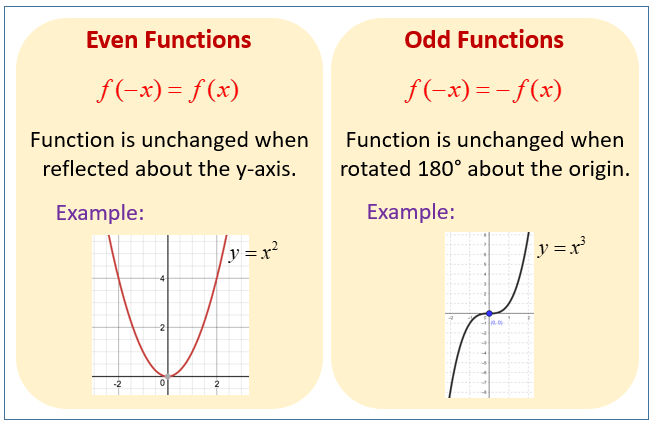
Let's formalise these definitions.
Formal Definitions
The key to analysing symmetry is to replace with in the function's expression and simplify the result.
- A function is even if for every in its domain.
- This means that opposite inputs give the same output.
- A function is odd if for every in its domain.
- This means that opposite inputs give opposite outputs.
- If neither of these conditions is met, the function is neither even nor odd.
A prerequisite for a function to be even or odd is that its domain must be symmetric about 0. For example, the domain is symmetric, but is not. If the domain is not symmetric, the function is automatically classified as neither even nor odd, because the very act of comparing and is not possible for all values. The resource from Nagwa explains this well.
Lesson Explainer: Even and Odd Functions
The lesson explainer 'Even and Odd Functions' from Nagwa provides concise definitions and clear examples. We'll start by reading the introduction to formalise these concepts.
Read the introductory parts of this explainer. Start from the top and read down to just before the first example. Focus on the formal definitions for even (f(-x) = f(x)) and odd (f(-x) = -f(x)) functions, and how they relate to y-axis and origin symmetry.
2. How to Test for Symmetry Algebraically
The algebraic test is the most reliable way to determine a function's symmetry. The process is straightforward: substitute for , simplify, and compare the result to the original function and its negative .
The following video from The Organic Chemistry Tutor provides a very clear, step-by-step guide on how to perform this test for polynomials.
Even, Odd, or Neither Functions The Easy Way! - Graphs & Algebraically, Properties & Symmetry
This video, 'Even, Odd, or Neither Functions The Easy Way!', demonstrates the algebraic method for classifying functions. It also provides a useful shortcut related to the powers (indices) of the terms.
Watch the sections from 01:47 to 10:41. The video will walk you through: Even functions (01:47 - 03:43): Notice how terms with even powers remain unchanged. Odd functions (03:43 - 05:47): See how you must factor out a -1 to compare with -f(x). The role of constants (05:47 - 07:10): A constant term like '+6' is considered an even component. 'Neither' functions (08:19 - 10:41): Observe what happens when you have a mix of even and odd powered terms.
As the video highlights, for polynomial functions, you can often predict the symmetry by looking at the exponents (or indices):
- If all terms have even exponents (including any constant term, which you can think of as ), the function is even. Example: .
- If all terms have odd exponents (and there is no constant term), the function is odd. Example: .
- If there is a mix of even and odd exponents, the function is neither. Example: .
Test your understanding!
Use the algebraic method to determine if the function is even, odd, or neither.
Show answer
- Start with the function:
- Substitute for :
- Simplify:
Remember that .
- Compare the result:
- Is equal to ? No. . So, the function is not even.
- Is equal to ? Let's find .
Yes, is exactly equal to .
- Conclusion: Since , the function is odd.
3. How to Identify Symmetry from a Graph
While the algebraic test is definitive, being able to spot symmetry visually is a valuable skill for quickly understanding a function's behaviour.
- Even (y-axis symmetry): Can you fold the graph along the y-axis so the two halves match up perfectly?
- Odd (origin symmetry): If you pick a point on the graph, is the point also on the graph? This is equivalent to a 180° rotation around the origin.
Let's return to the video from The Organic Chemistry Tutor, which provides some excellent graphical examples.
Even, Odd, or Neither Functions The Easy Way! - Graphs & Algebraically, Properties & Symmetry
We'll now watch the second half of the same video, which focuses on identifying symmetry from graphs.
Watch from 10:41 to 16:09. The narrator will show you several graphs and talk through how to determine if they represent even, odd, or neither functions by looking for y-axis or origin symmetry.
4. A Deeper Connection
To solidify your understanding, it's helpful to hear these concepts explained in a slightly different way. Professor Leonard provides a great conceptual explanation, really focusing on the idea of what happens to the outputs when you plug in opposite inputs. This reinforces why the algebraic rules create the graphical symmetries we observe.
Properties of Functions - Even vs Odd (Precalculus - College Algebra 8)
Professor Leonard's video, 'Properties of Functions - Even vs Odd', gives a fantastic conceptual breakdown. It's a great way to ensure you've got a robust mental model of these ideas.
Watch from 01:12 to 15:12. Pay close attention to his explanation of how 'opposite inputs' lead to 'same outputs' (even) or 'opposite outputs' (odd), and how this directly creates the graphical symmetry.
Conclusion
In this lesson, we have added function symmetry to our analytical toolkit. This concept allows us to classify functions based on their reflective or rotational properties, which is a powerful aid in understanding their behaviour and graphing them.
Key Takeaways:
- Even functions are symmetric with respect to the y-axis. Algebraically, they satisfy the condition .
- Odd functions are symmetric with respect to the origin. Algebraically, they satisfy the condition .
- Functions that meet neither condition are classified as neither even nor odd.
- A function's domain must be symmetric about 0 to be considered even or odd.
- For polynomials, the exponents (indices) of the terms are a strong clue: all even powers suggests an even function, all odd powers suggests an odd function, and a mix suggests neither.
Preview of the Next Lesson:
With this lesson, we conclude our module on the fundamental properties of functions. We are now well-equipped to begin the next module, Graphing and Transforming Functions. Our first lesson will be: "Graph linear functions using the gradient (slope) and y-intercept." We'll start with the basics of graphing straight lines, a foundational skill for all future work with function graphs. The concepts of symmetry we've learned today will become increasingly useful as we move on to graph more complex function families like quadratics and polynomials.