Hello!
In our last lesson, we mastered a specific skill: graphing linear functions using the gradient-intercept form y = mx + c. This gave us a way to create a graph from a particular type of equation. Today, we're going to zoom out and learn a more general and powerful concept: how to take the graph of any function and move it around the coordinate plane.
This lesson covers the learning outcome: Perform transformations of functions, including vertical and horizontal translations (shifts).
Instead of building a graph from scratch, we'll start with a known graph, like y = x^2 or even just a general curve y = f(x), and learn the rules for shifting it up, down, left, and right. This is a fundamental concept in understanding the relationship between a function's equation and its visual representation.
Let's look at what these transformations look like. The image below shows the basic parabola f(x) = x^2 and what happens when we shift it.

1. Vertical Translations (Up and Down)
A vertical translation, or shift, moves every point on a graph up or down by the same amount. The shape of the graph remains identical.
This is the more intuitive of the two translations we'll study today. Let's say we have a function f(x). To shift its graph vertically, we simply add a constant to the entire function's output.
The rule is: y = f(x) + c
- If
cis positive, the graph shifts up bycunits. - If
cis negative, the graph shifts down bycunits.
Think of it this way: for any given x value, you calculate f(x) and then simply add c to the final y-coordinate. This moves the point vertically.
To see this in action, let's watch a short video that uses dynamic graphing software to make the concept very clear.
Core Maths: Transformations of Functions 1
The video 'Core Maths: Transformations of Functions 1' from MrArnoldsMaths provides an excellent visual introduction. We'll start with the section on vertical translations.
Watch from the beginning (00:21) to 03:14. Pay attention to how adding or subtracting a value 'a' outside the function f(x) moves the entire graph up and down the y-axis without changing its shape.
For a text-based summary, the following resource is useful. It also introduces the concept of describing translations using vectors, which is a neat way to formalise the movement. A shift of c units up is represented by the vector (0, c).
Graph Transformations - GCSE Maths - Steps & Examples
The article 'Graph Transformations' from Third Space Learning clearly outlines the rules. We'll look at the section for vertical translations first.
Read the section titled 'Transformations of functions', focusing on the first bullet point: 'Translating the graph in a vertical direction.' Notice how it connects the transformation f(x) + a to the vector notation.
Test your understanding!
The graph of y = x^2 has its lowest point (the vertex) at (0, 0). If this graph is transformed to y = x^2 - 5, where will the new vertex be located?
Show answer
The transformation is f(x) - 5, which is a vertical shift down by 5 units. The original vertex at (0, 0) will move down 5 units to the new coordinate (0, -5).
2. Horizontal Translations (Left and Right)
A horizontal translation shifts a graph left or right. The rule for this can seem a bit counter-intuitive at first, so it's important to pay close attention.
The rule is: y = f(x + c)
- If
cis positive (e.g.,f(x + 2)), the graph shifts to the left bycunits. - If
cis negative (e.g.,f(x - 2)), the graph shifts to the right bycunits.
Why is this counter-intuitive?
We naturally associate + with moving right and - with moving left. The key is to remember that the change is happening inside the function, to the x input itself.
Consider f(x - 2). To get the same y-value that f(x) produced at x=0 (i.e., f(0)), we now need to plug in x=2 into our new function: f(2 - 2) = f(0). So the point that was at x=0 has moved to x=2—a shift to the right.
Let's continue with the same video, as it does a great job of explaining and visualising this "backwards" behaviour.
Core Maths: Transformations of Functions 1
We'll return to the 'Core Maths: Transformations of Functions 1' video to see how horizontal shifts work.
Watch from 03:14 to 06:17. The presenter demonstrates f(x + a) and explicitly points out that a positive a moves the graph left and a negative a moves it right.
The "Common misconceptions" section in the Graph Transformations article also provides a good written explanation for why this happens. I recommend reviewing it to solidify your understanding.
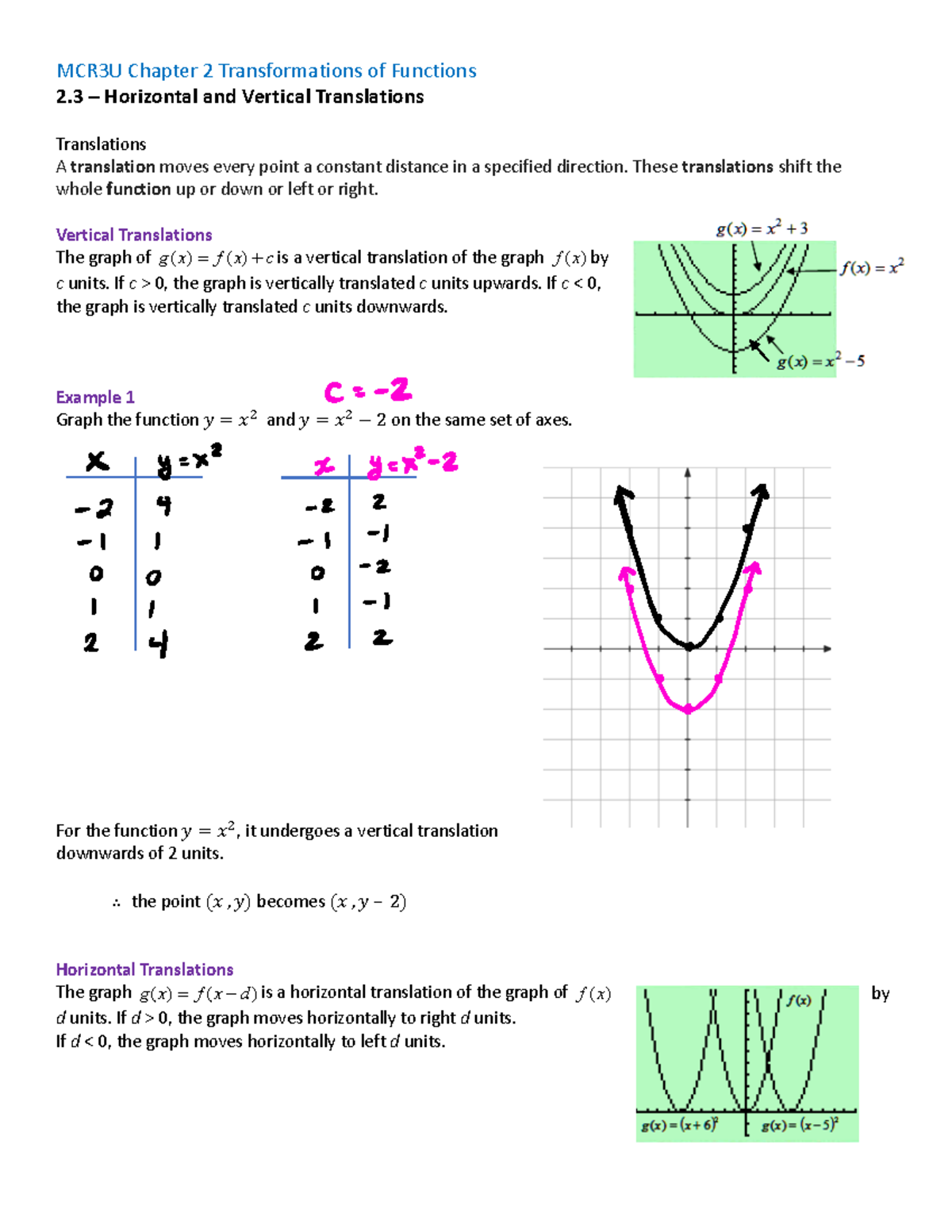
This image provides a fantastic summary of the rules for both vertical and horizontal translations. It's a great reference to keep in mind.
Test your understanding!
A function y = f(x) is transformed to y = f(x + 4). Describe the transformation that has occurred.
Show answer
The graph has been translated (shifted) 4 units to the left. Remember that for horizontal shifts, a positive value inside the brackets indicates a movement in the negative direction on the x-axis.
3. Combining Translations and Applying to Points
Now, we can put both types of translation together. A function can be transformed both horizontally and vertically in the same step. The general form for this is:
- The
+ koutside the function causes a vertical shift (up for+k, down for-k). - The
- hinside the function causes a horizontal shift (right for+h, left for-h).
This means the entire graph of f(x) is shifted so that the point that was at (0,0) on the original graph moves to (h, k).
A common way to test this knowledge is to ask what happens to a single point on the graph after a transformation. This is often simpler than sketching the whole new graph.
This next video is perfect for seeing how to handle combined transformations and how to apply them to a single point.
Transformations of Graphs - GCSE Higher Maths
The video 'Transformations of Graphs' from the 1st Class Maths channel has clear, worked examples of combining transformations and applying them to a single coordinate.
Watch the following two segments: Combining Translations (10:11 - 11:16): Watch how the transformation f(x + 1) - 3 is broken down into a horizontal shift (left 1) and a vertical shift (down 3). Applying to a Point (16:44 - 17:51): See how to apply the transformation f(x+1)+2 to the single point A=(-1,3) without needing to see the whole graph.
Let's work through an example using these rules.
Suppose the point P(3, 7) is on the graph of y = f(x). We want to find where P moves to on the graph of y = f(x - 2) + 4.
- Analyse the transformation:
x - 2inside the brackets means a horizontal shift 2 units to the right.+ 4outside the brackets means a vertical shift 4 units up.
- Apply to the coordinates:
- The x-coordinate moves 2 to the right:
3 + 2 = 5. - The y-coordinate moves 4 up:
7 + 4 = 11.
- The x-coordinate moves 2 to the right:
- The new point is
(5, 11).
Conclusion
In this lesson, we've developed a set of rules for translating the graph of any function. This is a powerful tool that allows us to understand a whole family of graphs based on a single "parent" function.
Key Takeaways:
- Vertical Translations:
y = f(x) + cshifts the graph. It moves up ifcis positive and down ifcis negative. This is intuitive. - Horizontal Translations:
y = f(x + c)shifts the graph. It moves left ifcis positive and right ifcis negative. This is counter-intuitive and a key point to remember. - Combined Translations: A transformation
y = f(x - h) + kshifts the graphhunits horizontally andkunits vertically. - These rules can be applied to an entire graph or to a single point on the graph.
Preview of the Next Lesson:
Translations are just one way to transform a function. What if we want to stretch, compress, or flip a graph? In our next lesson, we will cover these other transformations: vertical and horizontal stretches/compressions and reflections. These will complete our toolkit for manipulating function graphs.