Introduction
Welcome to your lesson on cloud privacy principles. In our last session, we discussed the core security design principles of Least Privilege and Defense in Depth. These principles are about building technical barriers to protect data from unauthorized access. Today, we shift our focus from preventing attacks to governing the authorized handling of data. When you entrust your data to a cloud provider, what rules govern how they use, store, and protect it?
This lesson directly addresses your syllabus requirement by focusing on two cornerstones of this governance: data ownership and transparency. For your exams, having clear, precise definitions and understanding the legal and contractual basis for these principles is essential.
Your learning outcome for this lesson is to: Explain cloud privacy principles, including data ownership and transparency.
We will cover the foundational frameworks that define privacy, and then take a deep dive into what data ownership and transparency mean in a cloud context.
1. Foundational Privacy Principles
Before focusing on ownership and transparency, it's crucial to understand the broader set of principles that form the basis of modern privacy laws and regulations. These are frequently asked about in exams and provide the context for our main topic. Two major frameworks are the Fair Information Practice Principles (FIPPs) and the General Data Protection Regulation (GDPR).
Fair Information Practice Principles (FIPPs)
The FIPPs are a set of internationally recognized principles that were first formulated by the Organisation for Economic Co-operation and Development (OECD). They are the conceptual foundation for most privacy laws around the world. The official NIST guidelines on cloud computing security reference these principles as essential for organizations to understand.
[PDF] Guidelines on Security and Privacy in Public Cloud Computing
To get an authoritative, exam-level overview of these foundational principles, please read the section on 'Fair Information Practice Principles' from the NIST Special Publication on cloud security.
In the PDF, navigate to the section titled 'Fair Information Practice Principles' (it's on page 44). Read this section carefully to understand the eight OECD principles. It also covers the five similar FTC principles, which is good for supplementary knowledge.
As you read, note these eight key principles from the OECD guidelines. They are a perfect list to memorize for an exam question on privacy frameworks:
- Collection Limitation: Data collection should be limited, lawful, fair, and transparent.
- Data Quality: Data should be relevant, accurate, complete, and up-to-date for its intended purpose.
- Purpose Specification: The purpose for collecting data must be specified at the time of collection.
- Use Limitation: Data should not be used or disclosed for purposes other than those specified, except with consent or by legal authority.
- Security Safeguards: Data must be protected by reasonable security measures against loss, unauthorized access, or disclosure.
- Openness: There must be transparency about the policies and practices related to personal data. (This is the Transparency principle we will explore further).
- Individual Participation: Individuals should have the right to access, challenge, and correct their data.
- Accountability: The data controller (the organization collecting the data) is responsible for complying with these principles.
General Data Protection Regulation (GDPR)
GDPR is a legal framework from the European Union that puts the FIPPs into enforceable law. Given its global impact, its principles are highly relevant.
This video provides a concise breakdown of the seven core principles of GDPR.
What are the 7 principles of GDPR?
This video from Privacy Kitchen clearly explains the seven principles of GDPR. These are concrete, legally-defined principles that are excellent to cite in an exam.
Watch the video from 01:09 to 06:26. The speaker covers one principle in about a minute, making it easy to follow. Pay attention to the keywords for each principle.
The principles discussed in the video are visually summarized below, which is a helpful memory aid.

These principles directly map to the FIPPs and provide the modern vocabulary for discussing cloud privacy. Now, let's zoom in on two of the most critical aspects for cloud contracts: Data Ownership and Transparency.
2. Data Ownership: You Control Your Data
When you upload data to a cloud service, who owns it? This is arguably the most important privacy question in cloud computing.
Definition: Data Ownership is the principle that the cloud customer retains full legal ownership and control over the data they create and store in the cloud. The cloud service provider (CSP) is merely a data custodian or data processor acting on behalf of the customer. The CSP does not acquire any rights to sell, analyze, or otherwise use the customer's data for its own purposes.
The NIST document you reviewed earlier emphasizes that ownership rights must be formally established.
[PDF] Guidelines on Security and Privacy in Public Cloud Computing
For a precise, authoritative statement on data ownership, let's refer back to the NIST guidelines. This section is very direct and useful for exam answers.
Find the subsection titled 'Data Ownership' within the 'Trust' section (page 20). Read this short paragraph. It clearly states what a service contract should ideally include regarding ownership.
Key Aspects of Data Ownership in Practice
To ensure data ownership is maintained, organizations must look for specific provisions in their cloud service agreements. The guide from the Privacy Commissioner of Canada offers a clear, practical checklist.
Cloud computing for small and medium-sized enterprises
This guide frames data ownership in terms of 'maintaining control'. It provides excellent, easy-to-understand points about what this means in practice, including data portability.
Read the sections titled 'It’s important to maintain control. Are you in the driver’s seat?' and the checklist under 'Control, Accessibility and Portability'. These sections give you a list of practical rights that stem from ownership.
Based on these resources, here are the key contractual rights that establish data ownership. You should be able to list these in an exam:
- Exclusive Ownership: The contract must state that the customer retains exclusive ownership of all data.
- No Secondary Use: The provider is prohibited from using the data for any purpose not explicitly instructed by the customer (e.g., no data mining for advertising). This is sometimes called preventing "function creep."
- Right to Access and Modify: The customer must be able to access, modify, and delete their data at any time.
- Right to Retrieve (Data Portability): Upon contract termination, the customer must be able to retrieve all their data in a usable, non-proprietary format. This prevents vendor lock-in.
- Guaranteed Deletion: The provider must attest that all copies of the customer's data have been permanently deleted from all its systems (including backups) after the contract ends.
3. Transparency: Verifying the Provider's Practices
If data ownership gives you control, transparency gives you the visibility needed to ensure that control is real. You can't manage risks you can't see.
Definition: Transparency is the principle that a CSP must be open and clear about its operations, security practices, and data handling procedures. This enables the customer to verify that the provider is complying with its contractual and legal obligations and to make informed risk assessments.
This principle is directly linked to the "Openness" principle from the FIPPs. The Canadian Privacy Commissioner's guide provides a succinct definition.
Cloud computing for small and medium-sized enterprises
This resource provides a direct and clear explanation of what transparency means in a cloud context, especially regarding data location.
Read the section titled 'Transparency is key. What will your customers expect?'.
Key Aspects of Transparency in Practice
Transparency isn't just a vague promise; it's delivered through specific mechanisms and information sharing.
- Data Location (Jurisdiction): The provider must be transparent about the geographic locations where customer data is stored and processed. This is critical because data is subject to the laws of the country where it resides.
- Use of Subcontractors: The provider must disclose if it uses other third parties (sub-processors) to deliver its service and where they operate.
- Security & Compliance Reports: A key mechanism for transparency is providing access to third-party audit reports, such as:
- SOC 2 (Service Organization Control 2): Reports on security, availability, processing integrity, confidentiality, and privacy.
- ISO/IEC 27001: Certification for information security management systems.
- ISO/IEC 27018: A specific standard for the protection of Personally Identifiable Information (PII) in public clouds.
- Breach Notification: The service agreement must clearly define the process and timeline for notifying the customer in the event of a data breach.
- Visibility into Metadata: Transparency should also extend to "ancillary data"—the data the provider collects about your usage (e.g., logs, performance metrics). The NIST document highlights this as a key area for clarity in a service contract to prevent this metadata from being sold or used in ways that compromise the customer's privacy.
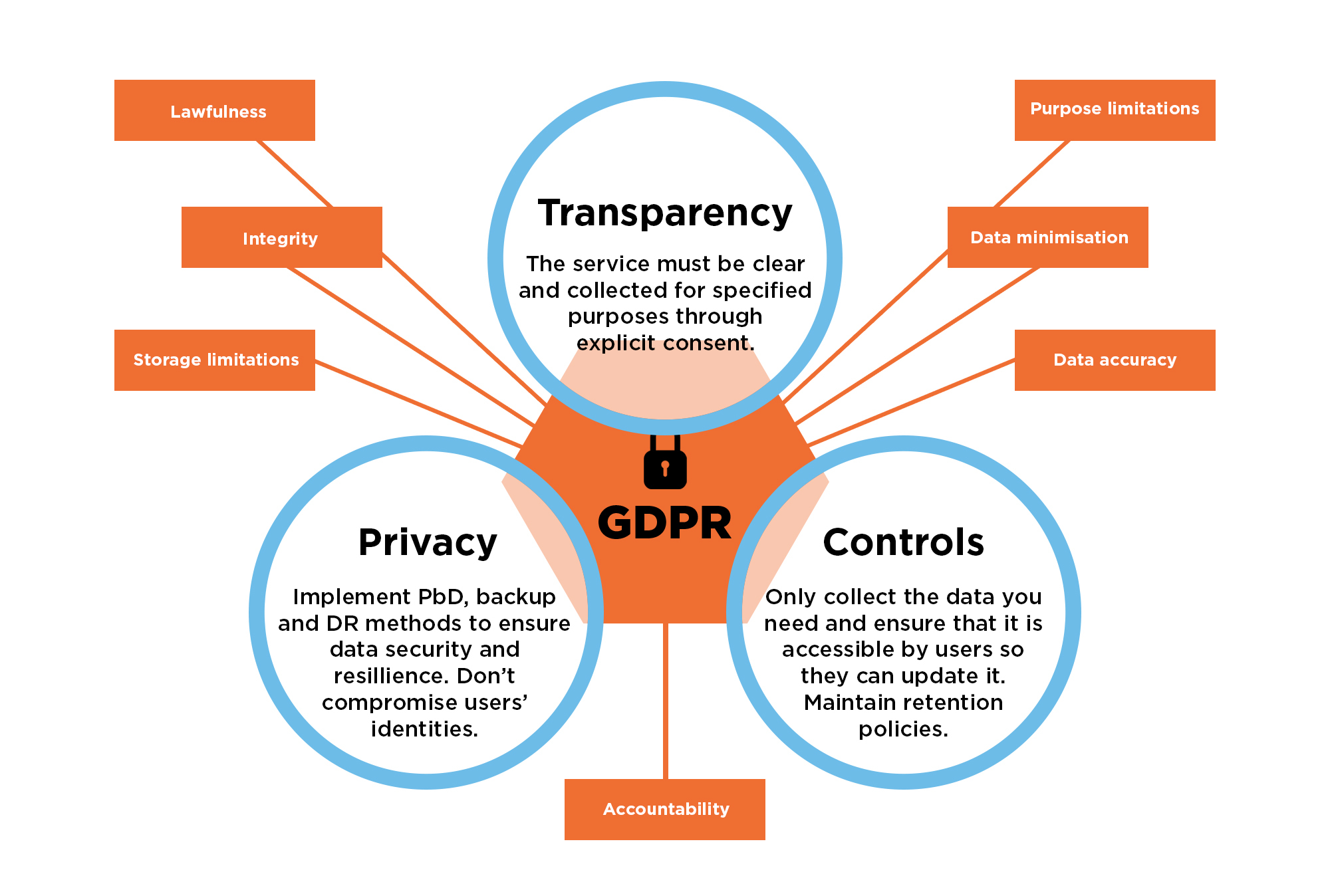
This diagram helps visualize how principles like transparency, control, and privacy all contribute to a trustworthy GDPR-compliant system.
Conclusion
In this lesson, we established the foundational principles that govern data privacy in the cloud and then focused on the two most critical aspects for any cloud agreement: data ownership and transparency.
Key Takeaways:
- Privacy Principles: Frameworks like the FIPPs and laws like GDPR provide the rules for handling personal data, focusing on purpose limitation, data minimization, security, and accountability.
- Data Ownership: This is the non-negotiable right of the cloud customer to maintain full control and legal ownership of their data. It is a contractual guarantee that the provider is only a custodian. Key elements are the rights to access, modify, retrieve, and demand permanent deletion of data.
- Transparency: This is the provider's obligation to be open about its practices. It allows the customer to verify compliance and manage risk. Key elements include disclosing data location, providing audit reports (SOC 2, ISO), and having clear breach notification procedures.
Preview of the Next Lesson:
Now that we understand the principles that should be in place to protect data privacy, we can explore how these principles contribute to building a relationship of trust between a cloud customer and a provider. Our final lesson in this module, "Explain the different trust models in cloud computing," will examine how the level of trust can vary and what it means to operate under a user-trust, provider-trust, or mutual-trust model.