Introduction
In our last lesson, we established the symbiotic relationship between IoT and Cloud Computing, where the cloud acts as the powerful "brain" for processing the vast data collected by IoT "sensors." We concluded by noting that for time-sensitive applications, sending all data to a distant cloud can introduce delays (latency).
This lesson directly addresses that challenge by exploring two computing paradigms that bring processing closer to the data source. We will focus on the learning outcome: Define Edge and Fog computing, and compare them against centralized cloud computing in a tabular format.
We'll start by defining Edge and Fog computing, illustrating how they fit between the IoT devices and the centralized cloud. Then, we will construct a detailed comparison table—a key format for your exams—to clearly outline the differences between Cloud, Fog, and Edge computing across several critical characteristics.
1. From Centralized Cloud to the Edge
Before diving into Edge and Fog, let's briefly recap the standard model.
- Centralized Cloud Computing: In this model, data is generated at the network's edge (e.g., by your phone or an IoT sensor) and is then sent over the internet to a large, centralized data center for storage and processing. This is powerful for big data analytics but can be slow for tasks requiring immediate action.
The limitations of this model, primarily latency and bandwidth consumption, led to the development of Edge and Fog computing.
To understand these concepts, let's watch a short video that introduces the key ideas.
Edge vs Fog: Cloud Computing Layers Explained
This video from OnLogic provides a clear, high-level explanation of Edge and Fog computing and how they relate to the cloud. It uses a helpful example to illustrate the role of a Fog layer.
Please watch from 01:21 to 03:37. Focus on: The definition of Edge computing (where it happens). The definition of Fog computing (where it fits). The temperature sensor example, noting how the Fog layer helps reduce data traffic and latency.
Now, let's formalize these definitions for your exam notes.
Edge Computing
Definition: Edge computing is a distributed computing paradigm where computation is performed at or near the physical location of the data source (the "edge" of the network). Instead of sending raw data to the cloud, the processing happens on the device itself or on a local server.
The core principle is to process data where it is generated. This is crucial for applications that cannot tolerate the delay of sending data to a remote cloud and waiting for a response.
A useful mnemonic for exams comes from the CISSPrep video "Edge Computing vs Fog computing": "Edge is embedded." This helps remember that the processing is embedded within or very close to the device generating the data.
Key Characteristics:
- Location: At the data source (e.g., inside a smart camera, an autonomous vehicle, or an industrial robot).
- Goal: Minimize latency for real-time decision-making.
- Data Flow: Processes data locally and only sends necessary results or summaries to the cloud.
Example: An autonomous car needs to make split-second decisions like braking to avoid a collision. It cannot afford to send sensor data to the cloud and wait for instructions. The car's onboard computers (the edge) must process this data in real-time.
Fog Computing
Definition: Fog computing is a layer of computing infrastructure that sits between the edge devices and the centralized cloud. It acts as an intermediate bridge, extending cloud-like services closer to the edge. The term "Fog" was chosen because fog is like a "cloud that is closer to the ground."
The CISSPrep video provides another helpful mnemonic: "Fog is further." This signifies that while it's closer than the cloud, it's further away from the device than the edge.
Key Characteristics:
- Location: In the Local Area Network (LAN), often on a dedicated gateway or local server that aggregates data from multiple edge devices.
- Goal: To filter, aggregate, and pre-process data from edge devices before sending it to the cloud. It balances latency and computational power.
- Data Flow: Edge devices send data to a local Fog node. The Fog node performs analysis and can either act on the data locally or send a reduced, more meaningful dataset to the cloud for long-term storage and heavy-duty analysis.
Example: In a "smart factory," thousands of sensors on a production line generate temperature and vibration data every second.
- Edge: Each sensor might have a simple processor to format the data.
- Fog: A "Fog node" (a server on the factory floor) collects this data. It can analyze trends in real-time to detect an imminent machine failure and shut down the line immediately. It then sends only a daily summary of performance metrics to the cloud, instead of terabytes of raw data.
2. Visualizing the Three-Tier Architecture
To make the relationship between Cloud, Fog, and Edge clear, it's helpful to visualize them as layers in a data processing stack.
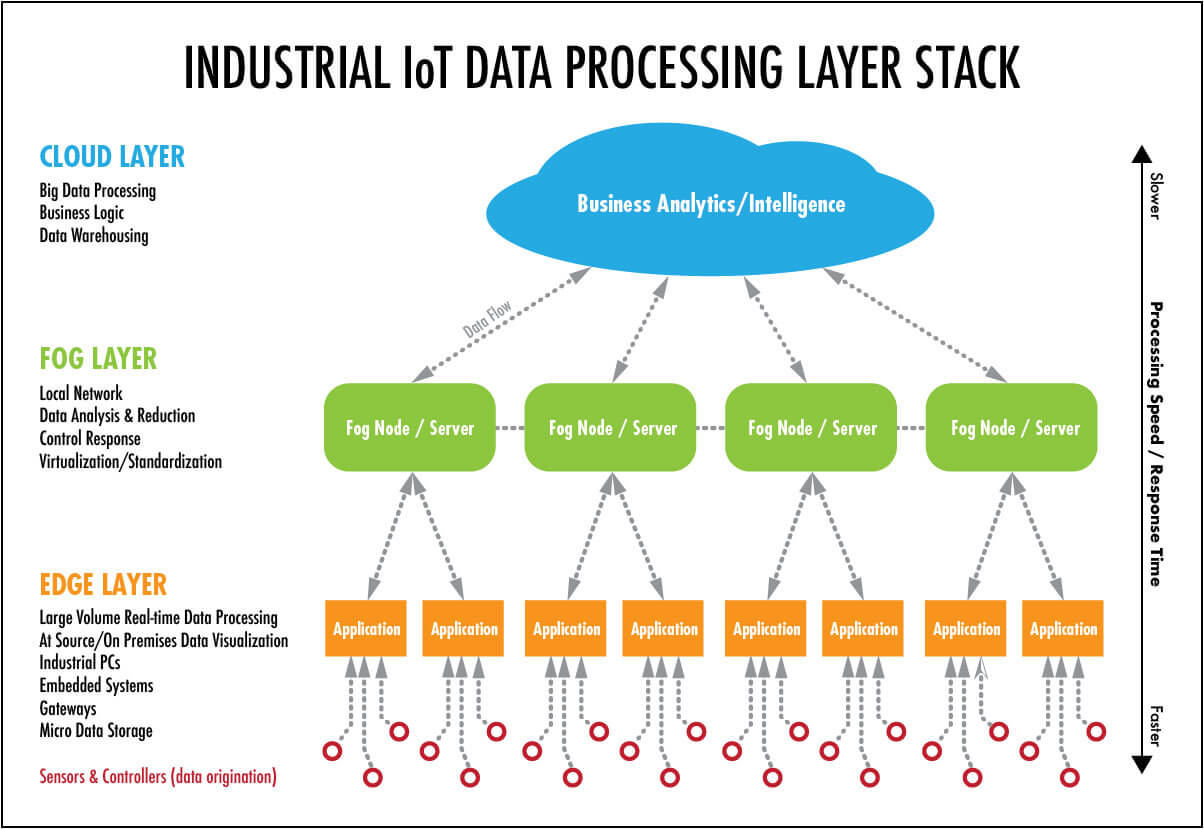
This three-tier model is a standard way to represent how these paradigms work together to efficiently handle IoT data.
3. Comparative Analysis: Cloud vs. Fog vs. Edge
For your exams, a tabular comparison is the most effective way to summarize the key differences. The table below synthesizes information from the provided resources to give you a comprehensive overview.
To build a solid understanding before reviewing the table, please read through the comparison provided in the following article.
Difference Between Cloud, Edge, and Fog Computing
The article 'Difference Between Cloud, Edge, and Fog Computing' from Servodynamics provides an excellent, detailed comparison table. Reading this will prepare you for the summary table below.
Navigate to the section titled 'Cloud vs. Edge vs. Fog Computing: A Comparative Table'. Read through the table to see how the three models are contrasted across features like latency, bandwidth, and use cases.
Here is a comprehensive summary table for your notes, incorporating the most critical points for your exams.
| Feature | Cloud Computing | Fog Computing | Edge Computing |
|---|---|---|---|
| Data Processing Location | In large, centralized, remote data centers. | In a local area network (LAN), between the edge and the cloud (e.g., on a gateway or local server). | At or very near the source of data generation (e.g., on the IoT device itself). |
| Latency | High (milliseconds to seconds), due to distance data must travel. | Low, but higher than Edge. Suitable for "near real-time" responses. | Very Low (microseconds to milliseconds), enabling real-time responses. |
| Bandwidth Usage | High, as all raw data is transmitted to the cloud. | Reduced, as Fog nodes pre-process and filter data, sending only summaries to the cloud. | Minimal, as most data is processed locally, and only essential information is sent out. |
| Scalability | Very High ("unlimited" resources available on demand). | Medium. More scalable than a single edge device; can manage a cluster of devices. | Low. Limited by the processing power and storage of the individual edge device. |
| Network Dependence | High. Requires a constant and reliable internet connection to function. | Medium. Can operate locally if the cloud connection is lost, providing some resilience. | Low. Can operate autonomously without any external network connection. |
| Security | Centralized security, but data is vulnerable during transit over the public internet. | Improved, as sensitive data can be kept within the local network, reducing external exposure. | Highest for data privacy, as data doesn't leave the local device or premises unless specified. |
| Architecture | Centralized, client-server model. | Distributed; acts as a middle layer in a three-tier architecture. | Highly distributed; computation is at the endpoints. |
| Key Use Cases | Big data analytics, web hosting, large-scale data storage, SaaS applications. | Smart cities, smart factories, connected vehicles, large-scale IoT data aggregation. | Autonomous vehicles, industrial automation (robotics), real-time monitoring, smart home devices. |
Conclusion
In this lesson, we moved beyond the centralized cloud model to explore architectures that better serve the needs of time-sensitive applications like IoT. Understanding the distinct roles and characteristics of Cloud, Fog, and Edge computing is crucial for designing efficient and responsive systems.
Key Takeaways:
- Edge Computing performs processing directly at the data source, offering the lowest latency for real-time actions. Think: "Edge is embedded."
- Fog Computing acts as an intermediate layer between Edge and Cloud, performing pre-processing and aggregation to reduce bandwidth usage and provide a balance of speed and power. Think: "Fog is further."
- Cloud Computing remains the ultimate destination for heavy-duty analytics, long-term storage, and large-scale computation, but it has the highest latency.
- These three paradigms are not competitors but collaborators in a tiered architecture, each handling the tasks for which it is best suited.
Preview of the Next Lesson:
Now that we have a clear view of the high-level computing architectures, our next lesson will zoom in on a fundamental component mentioned throughout our course: storage. We will compare object, file, and block storage, explaining the typical use cases for each type within a cloud environment.