Hello! Welcome to the fifth lesson in our module on the pre-Islamic Arabian worldview.
In our last two lessons, we explored the diverse spiritual landscape of ancient Arabia. We first defined the jinn as a broad category of desert spirits and tribal protectors, and then we distinguished between the different, often fearsome, types of supernatural beings: the purely evil shaytan, the mighty ifrit, the rebellious marid, and the predatory ghul.
Today, we will build on that foundation to address the learning outcome: Analyze the relationship between jinn and poets or soothsayers (kahin) in pre-Islamic tradition. We will shift our focus from fearing these spirits to understanding how certain humans sought to actively channel them for inspiration, knowledge, and power. This relationship was not just a piece of folklore; it was a cornerstone of social and cultural life.
The Poet and the Jinn-Muse
In pre-Islamic Arabia, poetry (shi'r) was the highest form of art and a powerful social weapon. A great poet was a celebrity, a historian, and a propagandist all in one. A powerful poem could elevate a tribe's honor or destroy an enemy's reputation. This extraordinary power of language was not considered a purely human talent. It was believed to be a gift from the unseen world.
The core belief was that every great poet was inspired by a personal jinn, a spiritual muse. Let's explore this concept further.
A Study of Greek and Arab Thoughts on Poetry
The academic paper 'A Study of Greek and Arab Thoughts on Poetry' provides a focused look at this belief. It explains the high status of poets and introduces the specific terms used for these jinn-muses.
Please read the following sections from this paper (available on page 122 in the PDF). Start at the paragraph beginning 'These poets were famous for writing satires...' and read through to the end of the page, including the 'Conclusion' section. Focus on the concept of the 'Shayṭān al-Sh’ir' and the belief that jinn literally spoke through poets.
As the paper details, the pre-Islamic Arabs believed that a poet’s genius came from a supernatural companion, which could be called a Djinniyatu al-Sh’ir (genie of poetry) or, more commonly, a Shayṭān al-Sh’ir (demon of poetry). This doesn't necessarily mean "evil" in the modern sense, but rather refers to a powerful, non-human spirit.
Key aspects of this relationship include:
- Supernatural Eloquence: The jinn was thought to transform ordinary language into captivating, magical verse. Some traditions even held that the jinn had their own poetic meters, far beyond human capability.
- Hidden Knowledge: The jinn provided the poet with knowledge inaccessible to ordinary people, allowing them to compose insightful praise or devastatingly accurate satires.
- Named Spirits: This belief was so concrete that famous poets were associated with specific named jinn. The paper mentions how the poet Imru' Al-Qais was said to be inspired by a jinn named Lâfiz.
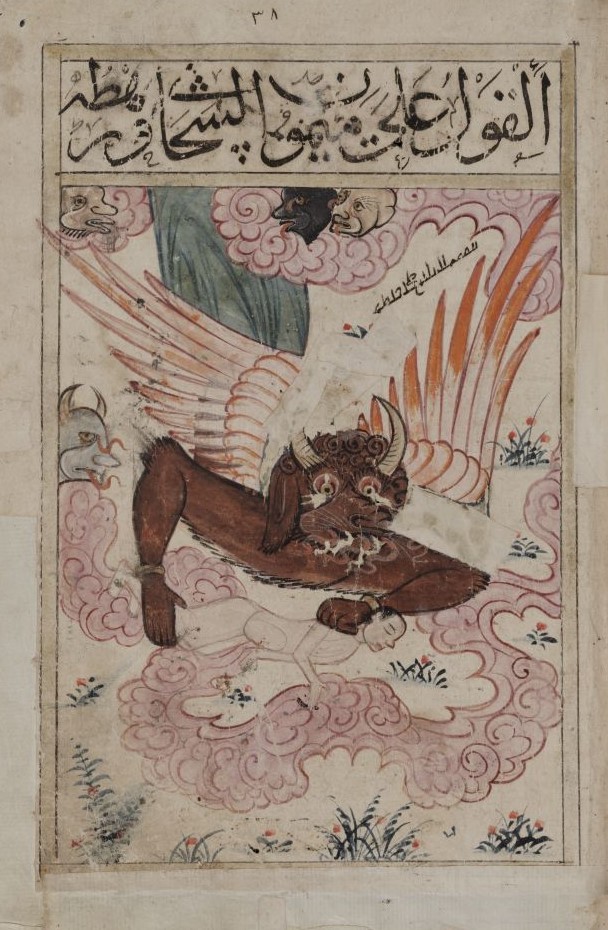
- The Poet as a Channel: The poet was seen as a vessel for this supernatural power. The famous pre-Islamic poet Ta’abbata Sharran’s name literally means “he carried an evil one under his arm,” a direct reference to his jinn companion.
To see how this concept fits into the broader understanding of jinn, let's watch a short video segment.
The video 'What are the Jinn?' from Let's Talk Religion concisely summarizes this connection and draws an interesting parallel to another ancient culture.
Watch the clip from 05:38 to 06:53. Note the comparison made to the Greek concept of 'daimons' as sources of inspiration.
This connection between poets and jinn was so ingrained that poetry itself was sometimes seen as a form of sorcery enacted through language.
The Soothsayer (Kahin) and the Familiar Spirit
While the poet channeled jinn for art, another important figure, the kahin (pl. kuhhan), communed with spirits for knowledge and divination. The kahin was a shaman, soothsayer, and oracle who held a position of immense authority.
For a detailed breakdown of the kahin's role and methods, we will turn to a comprehensive text on the Qur'anic worldview, which begins by explaining the pre-Islamic background.
The Qur'anic Conception of Man's Relationship to God and ...
The chapter 'The Perceptible and the Unseen' by S. H. Nasr gives a detailed account of the pre-Islamic religious landscape. The section on shamans is particularly relevant.
Please read the section titled 'Shamans and Oracular Speakers'. Pay close attention to the social functions of the kahin, the name of their familiar spirit, and the style in which they delivered their prophecies.
The kahin was far more than a simple fortune-teller. As the text explains, their functions were vital to tribal society:
- Arbitrator: In a society without a formal legal system, the kahin served as a judge, settling disputes over everything from inheritance to murder.
- Advisor: Tribal leaders consulted their kahin before making major decisions, such as going to war or forging an alliance.
- Diviner: They could predict future events, find lost objects or animals, and interpret omens.
The kahin's power stemmed from their direct contact with a familiar spirit, most often a jinn. This spirit was known as a tabi' ("follower") or ra'i ("one who is seen"). Through a close personal bond, the kahin would receive information from their tabi' about the unseen world (al-ghayb).
Interestingly, the kahin would often pronounce these divinations in a distinct form of rhymed, rhythmic prose called saj'. This elevated, mysterious style of speech lent their words an aura of supernatural authority and intentionally blurred the lines between prophecy and poetry.
Distinguishing Roles: Poet, Kahin, and Sorcerer
It is crucial to distinguish between these roles, even though they all involve interaction with jinn.
- The Poet (Sha'ir): Their goal was art and influence. They channeled a jinn to create powerful poetry for praise, satire, or commemoration. Their medium was shi'r (poetry).
- The Soothsayer (Kahin): Their goal was information and judgment. They communicated with a familiar jinn to learn about the past, future, or hidden truths. Their medium was often saj' (rhymed prose).
- The Sorcerer (Sahir): Their goal was to cause an effect. They would command a jinn to perform an action, such as inflicting sickness, causing someone to fall in love, or creating a visual illusion. Their medium was sihr (magic/sorcery).
While their functions were different, the underlying belief was the same: certain individuals could bridge the gap to the unseen world and harness the power of the jinn.
Test your understanding!
A tribal chief is faced with two problems. First, his prized camel has been stolen, and he needs to know who took it and where it is. Second, he is about to host a great feast and wants a magnificent ode composed to celebrate his lineage and generosity.
Based on what you've learned, which specialists would he consult for each problem, and what would be the nature of their interaction with the jinn?
Show answer
-
To find the stolen camel, the chief would consult a kahin (soothsayer). The kahin would communicate with his familiar spirit (tabi') to gain knowledge of the unseen—specifically, the location of the camel and the identity of the thief. The product would be information.
-
To have an ode composed, he would seek out a renowned poet (sha'ir). The poet would call upon his jinn-muse (Shayṭān al-Sh’ir) for eloquence and inspiration to craft a powerful and memorable poem. The product would be a work of art.
From Kahin to Prophet: The Islamic Transition
This deep-rooted belief in jinn-inspired figures directly shaped the initial reception of Islam. Because the Prophet Muhammad's revelations (the Qur'an) were delivered in an exquisitely powerful Arabic that surpassed all known poetry and prose, his opponents fell back on the only explanation they knew: they accused him of being either a "mad poet" or a kahin inspired by a jinn.
The Qur'an itself documents and vehemently refutes this charge:
"And We have not taught him (Muhammad) poetry, nor is it suitable for him. This is not but a message and a clear Qur'an." (Qur'an 36:69)
"It is not the word of a poet; little it is that you believe! Nor is it the word of a soothsayer; little it is that you remember. It is a revelation from the Lord of the worlds." (Qur'an 69:41-43)
This rejection was a fundamental theological shift. Islam replaced the pre-Islamic model of fallible humans communicating with jinn for worldly knowledge with the concept of infallible prophets receiving direct, pure revelation from the one God.
Conclusion
In this lesson, we have analyzed the pivotal role that jinn played in the intellectual and cultural life of pre-Islamic Arabia, not as monsters to be feared, but as sources of power to be channeled.
Key Takeaways:
- Pre-Islamic culture believed that extraordinary human talents, especially poetry and divination, were not purely human but stemmed from a partnership with the jinn.
- Poets were believed to be inspired by a personal jinn-muse (Shayṭān al-Sh’ir), which granted them eloquence and hidden knowledge.
- Soothsayers (kuhhan) acted as judges and oracles, deriving their knowledge from a familiar spirit (tabi') with whom they had a close bond.
- The distinction between these roles was crucial, as was the later Islamic refutation of these models in favor of direct divine revelation to a prophet.
This exploration shows a world where the veil between the seen and unseen was permeable, and where jinn were not just inhabitants of the desert, but active participants in human creativity and society.
In our next and final lesson of this module, we will turn to the other side of this relationship: the common person's fear of malevolent spirits and the protective practices and talismans they used to ward them off.