Welcome to your third lesson. In our previous session, we tuned our ears and mouths to the specific sounds of German, from the "flipped" w and v to the distinctive ch and ei/ie pairs. Now, we'll put that pronunciation practice to immediate use by learning how to start and end a conversation.
Today's lesson focuses on one of the most important cultural and grammatical concepts in German: the distinction between formal (Sie) and informal (du) address. You will learn the essential phrases for greeting people and saying goodbye in various situations. Mastering this is not just about vocabulary; it's about navigating social contexts correctly, a critical skill for both the A1 exam and for your goal of living and working in Germany.
1. The Most Important Rule: du or Sie?
Unlike in modern English, German requires you to make a constant choice about which word to use for 'you'. This choice reflects the relationship and social distance between you and the person you are addressing.
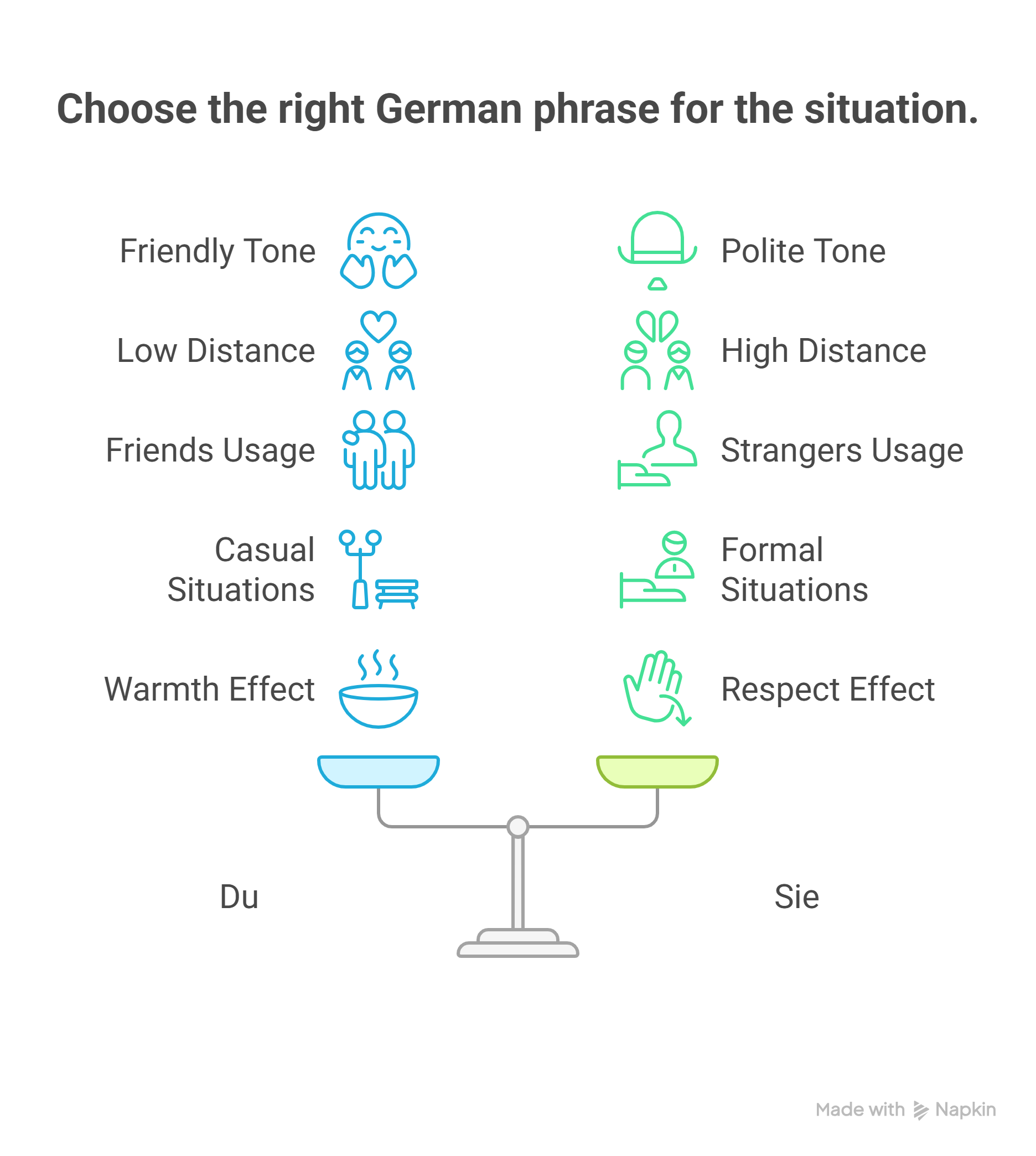
Sieis the formal 'you'. It's used with strangers, in professional or business settings, with people in positions of authority (like police officers or government officials), and generally with people significantly older than you. It is always capitalized. UsingSiesignals respect and maintains a polite distance.duis the informal 'you'. It's used with family, friends, children, pets, and people your own age in casual settings. Usingdusignals familiarity and closeness.
As a project manager, you understand the importance of tailoring your communication style to your audience, whether it's a key stakeholder or a close colleague. The Sie/du distinction is the linguistic equivalent of that professional awareness. When in doubt, always start with Sie. It's polite and safe. A German speaker will offer the switch to du if and when they feel it's appropriate.
The following article explains this crucial concept in detail.
Formal vs. Informal German Phrases: How to Speak ...
This blog post from Entri gives a clear and practical overview of the cultural significance of 'du' vs. 'Sie'.
Please read the first three main sections. Start with Understanding “Du” vs. “Sie”, which introduces the core difference. Then, read the section When to Use Formal German to understand the contexts for Sie. Finally, read When to Use Informal German to see the contexts for du.
This image provides a great visual summary of the factors that weigh into choosing du or Sie.
To hear this explained with real-world examples, watch this short video from DW News.
Du or Sie? How to say 'you' to a German | DW English
This video provides practical advice from native speakers on when to use 'du' and 'Sie' and how the transition between them happens.
Watch the entire video. Pay attention to the situations described for using the formal 'Sie' (in a shop, business meetings) and the situations for using the informal 'du' (at a party, with younger people). Also, notice the social rule about who offers the switch to 'du'.
2. Greetings (Begrüßungen)
Now that we understand the du/Sie rule, let's learn the actual words. The following video will introduce you to the most common ways to greet someone. As you watch, repeat the phrases out loud to practice the pronunciation we covered in the last lesson.
A1 - Lesson 1 | Begrüßungen | Greetings | German for beginners | Learn German
This "Learn German" video clearly pronounces and explains the most important greetings, including time-of-day specific and regional variations.
Watch from the beginning until the end of the explanation of servus. Focus on these key phrases: Hallo: The all-purpose, neutral-to-informal greeting. Guten Tag: The standard formal greeting for "Good day". Guten Morgen / Guten Abend / Gute Nacht: Greetings for morning, evening, and "good night" (used when leaving or going to bed). Grüß Gott / Grüß dich / Servus: Common regional greetings, especially in Southern Germany and Austria. Notice the distinction the speaker makes between the formal Grüß Sie and informal Grüß dich.
Here is a summary table of the most important greetings:
| Greeting | Pronunciation | Context |
|---|---|---|
| Hallo | ha-LOH | Neutral/Informal. Safe in most casual situations. |
| Guten Morgen | GOO-ten MOR-gen | "Good morning." Used until about 11 a.m. |
| Guten Tag | GOO-ten TAHK | "Good day." The standard formal greeting. |
| Guten Abend | GOO-ten AH-bent | "Good evening." Used from about 6 p.m. onwards. |
3. Farewells (Verabschiedungen)
Just as with greetings, your choice of farewell depends on the formality of the situation.
A1 - Lesson 1 | Begrüßungen | Greetings | German for beginners | Learn German
Let's continue with the same video to learn how to say goodbye.
Watch the remainder of the video, from the start of the 'Tschüss' explanation to the end. Focus on these key phrases: Tschüss: The most common informal "Bye". Auf Wiedersehen: The standard formal "Goodbye". Literally "Until we see again". Auf Wiederhören: The formal "Goodbye" used only on the telephone. Literally "Until we hear again". Bis bald / Bis später: Informal phrases for "See you soon" / "See you later".
Here's a summary table for farewells:
| Farewell | Pronunciation | Context |
|---|---|---|
| Tschüss | CHÜSS | Informal. The most common way to say "bye". |
| Auf Wiedersehen | auf VEE-der-zay-en | Formal. "Goodbye." |
| Auf Wiederhören | auf VEE-der-h-ERN | Formal, but only on the phone. |
| Bis bald | bis BALT | Informal. "See you soon." |
4. Greetings in Action
Let's see how these phrases work in context. The resource below provides excellent examples of a formal and an informal conversation. Pay attention to how not only the greetings change, but the entire tone of the interaction.
Formal vs. Informal German Phrases: How to Speak ...
This resource offers a great side-by-side comparison and two dialogues that perfectly illustrate the difference in tone.
First, review the Side-by-Side Comparison Table and the explanations that follow it. This clearly contrasts formal and informal versions of "Hello", "Goodbye", and other key phrases. Next, study the two dialogues under the "Practice Exercises" heading. Read through Dialogue 1 to see formal language in action, then compare it with the relaxed language in Dialogue 2.
5. A Handy Reference
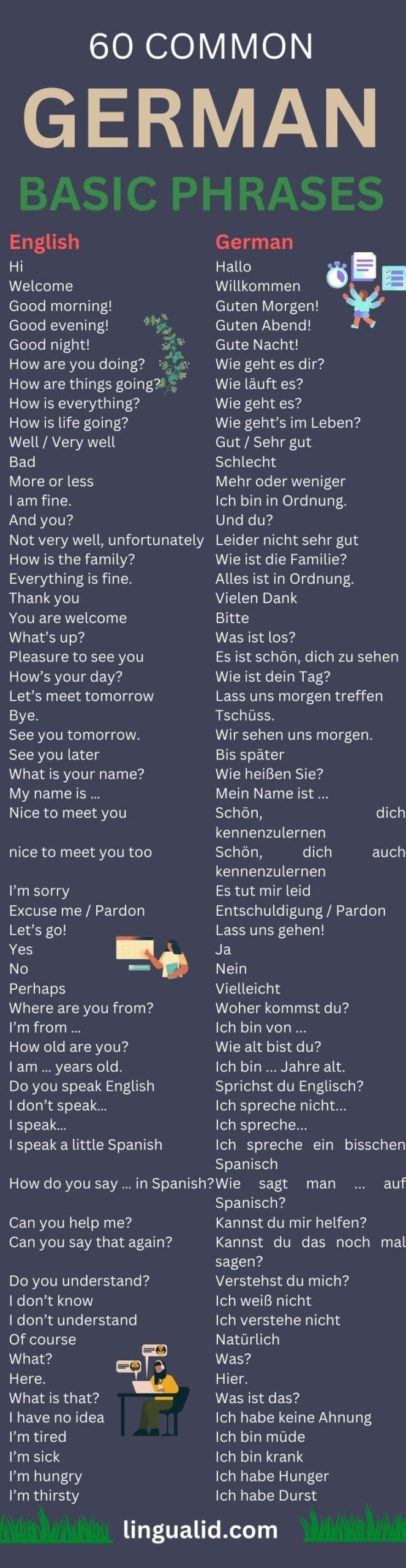
To help you remember these essential phrases, you can refer to the following infographic. It contains many of the greetings and farewells we've learned today, plus other useful beginner phrases we will cover in upcoming lessons.
Conclusion
In this lesson, you've taken your first and most important step into German social etiquette. You now have the tools to begin and end a simple conversation politely and appropriately in different contexts.
Here are the key takeaways:
- The choice between the formal
Sieand informalduis fundamental in German and depends on your relationship with the person you are addressing. When in doubt, always useSie. - Standard formal greetings include
Guten TagandGuten Abend, with the corresponding farewell beingAuf Wiedersehen. - Common informal greetings include
Hallo, with the most typical farewell beingTschüss. - The context (work, a shop, with friends) dictates the level of formality you should use.
In our next lesson, we will build directly on this foundation. You'll learn how to take the next step after greeting someone: introducing yourself by stating your name, where you come from, and what languages you speak.