In our previous lesson, you learned how to present key facts about yourself: your name, where you come from, and the languages you speak. This is an excellent foundation for any introduction. Now, we'll equip you to turn that one-way introduction into a genuine conversation.
This lesson focuses on asking the very questions you learned to answer. We will cover the essential German question words, known as W-Fragen, and see how they are used to ask for someone's name, origin, and location. Mastering this will allow you to engage in a basic back-and-forth exchange, a vital skill for both the A1 exam and your future life in Germany or Austria.
By the end of this lesson, you will be able to confidently ask and answer basic personal questions, transforming a monologue into a dialogue.
1. The Key Question Words: W-Fragen
In German, most questions that aren't simple yes/no questions begin with a "W-word," much like the "Wh-" words in English (Who, What, Where). These are called W-Fragen. For today's lesson, we need to master three of them: Wie? (How?), Wo? (Where?), and Woher? (Where from?).
Understanding their specific function is like knowing the right command to query a system for a specific piece of data.
Basic German Question Words | All A1 Question Words You Need to Know
The video "Basic German Question Words" from the YourGermanTeacher channel provides a clear and concise introduction to these words.
Watch the following short segments to familiarize yourself with the pronunciation and meaning of each key question word: Wie? (How?): Watch from this example. Although Wie translates to "how," in the context of asking for a name, it functions like "what" in English ("How are you called?"). Wo? (Where?): Watch the segment from this explanation. This word asks about a static location. Woher? (Where from?): Watch from this part. The -her suffix indicates origin or movement from a place.
Now that you have the tools, let's put them to use.
2. Asking Personal Questions: du and Sie
In the last two lessons, we've touched upon the difference between the informal du and the formal Sie. When asking questions, this distinction becomes even more critical as it changes the verb form. As a project manager, you know the importance of addressing stakeholders appropriately; in German, this starts with du versus Sie.
The following video from the "Learn German" channel clearly demonstrates how to form the questions for name, origin, and location using both the informal du and formal Sie.
25 Questions for absolute beginners | 25 Fragen für Anfänger | Learn German
This video presents questions for absolute beginners and directly contrasts the formal and informal versions.
Please watch these three segments. Pay close attention to how the question is asked and how the speaker differentiates between the informal and formal address. Asking for a name: Wie heißt du? / Wie heißen Sie? Asking for origin: Woher kommst du? / Woher kommen Sie? Asking for location: Wo wohnst du? / Wo wohnen Sie? Notice the pattern: in formal questions with Sie, the verb often ends in -en (heißen, kommen, wohnen). In informal questions with du, it ends in -st (heißt, kommst, wohnst). We will study this verb conjugation in detail in Module 2.
To reinforce this, let's review these question-and-answer pairs in written form.
Learn Basic German Phrases for Conversation
This article from Busuu provides a clear list of common questions and their typical answers.
Please read the section under the heading "German questions". Focus on the first two questions listed: Wo wohnst du? and Woher kommst du?. Observe the structure: W-Wort + Verb + Pronomen (du/Sie)?
3. A Deeper Look: The du vs. Sie Distinction
Choosing between du and Sie is one of the most important social skills to learn in German. Using the wrong one can be perceived as either rude or overly stiff. The image below provides an excellent visual summary of the social contexts for each.
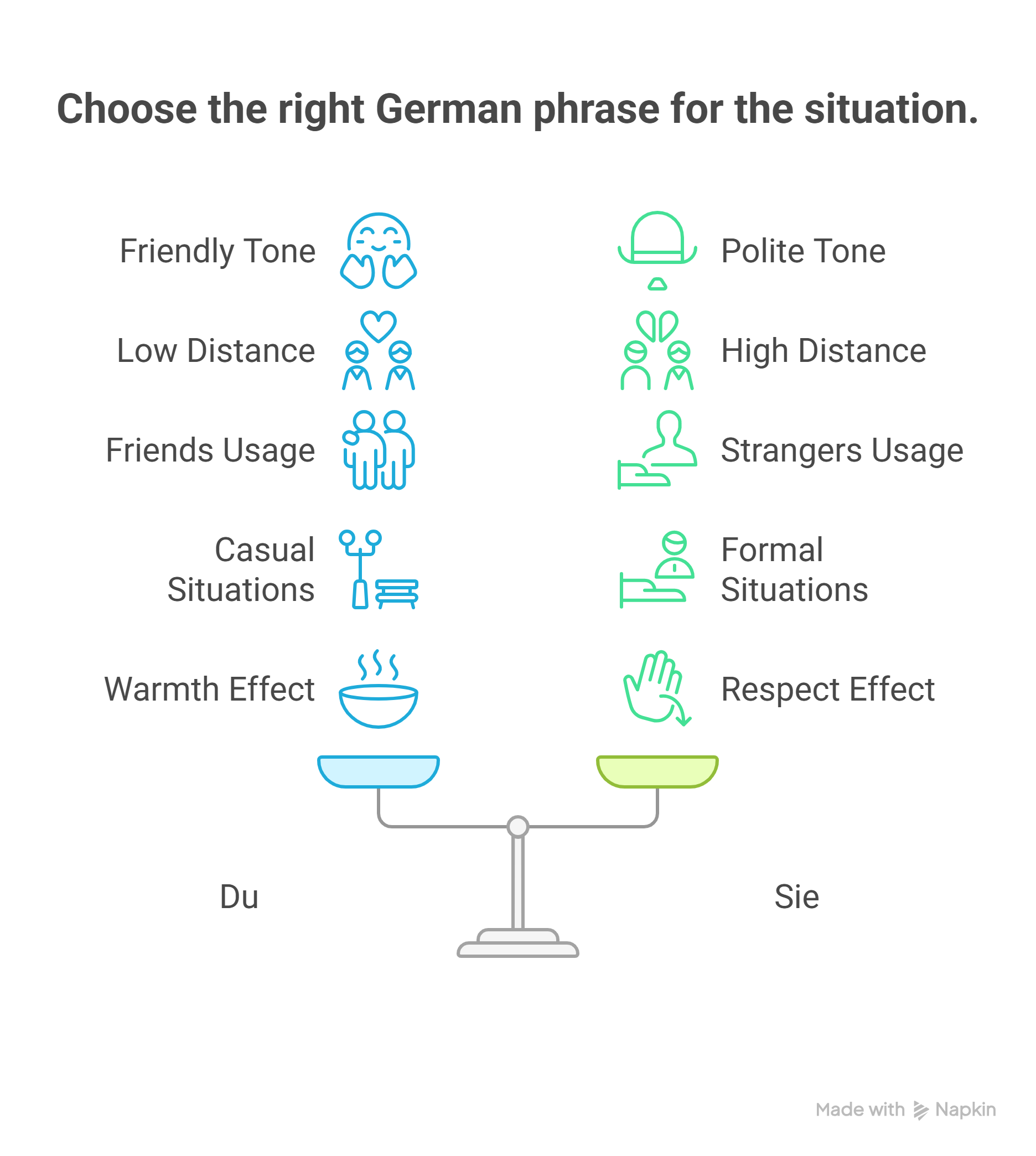
As the image shows:
- Use
duwith friends, family, children, and people your own age in casual settings (like at a university or a casual tech company). It conveys warmth and familiarity. - Use
Siewith strangers, in most professional contexts (especially in traditional finance or government settings), with people significantly older than you, and in any situation where you want to show respect and maintain a professional distance.
When in doubt, always start with Sie. It is much more polite to be invited to use du ("Wir können uns duzen.") than to be corrected for using du too soon.
For a detailed explanation, let's turn back to the Busuu article.
Learn Basic German Phrases for Conversation
This section explicitly breaks down the rules and provides clear comparative examples.
Read the section titled Formal and informal German. The examples Woher kommst du? vs. Woher kommen Sie? and Sprichst du Englisch? vs. Sprechen Sie Englisch? perfectly illustrate the grammatical change we are focusing on today.
4. Putting It All Together: A Sample Conversation
You now have all the components to both introduce yourself and ask about the other person. Let's see how this works in a short dialogue.
First, a quick review of how to state your own information.
Bite 1: How to introduce yourself in German
This article from the INNES Institute Vienna gives a step-by-step guide to formulating your answers.
Review the first three steps in the guide: Greeting and Name, Origin, and Residence. This reinforces the material from our previous lesson, preparing you to answer the questions you just learned.
Now, imagine two scenarios.
Scenario 1: Formal (e.g., at a business conference)
- Person A: Guten Tag. Mein Name ist Schmidt. Wie heißen Sie?
- Good day. My name is Schmidt. What is your name?
- Person B: Guten Tag. Ich heiße [Your Last Name].
- Good day. My name is [Your Last Name].
- Person A: Freut mich. Woher kommen Sie, Herr/Frau [Your Last Name]?
- Nice to meet you. Where do you come from, Mr./Ms. [Your Last Name]?
- Person B: Ich komme aus [Your Country]. Und Sie?
- I come from [Your Country]. And you?
- Person A: Ich komme aus Deutschland. Ich wohne in Berlin.
- I come from Germany. I live in Berlin.
Notice the phrase Und Sie? ("And you?"). This is a highly efficient and natural way to return the same question in a formal context.
Scenario 2: Informal (e.g., meeting a fellow student)
- Person A: Hallo! Ich bin Alex. Wie heißt du?
- Hello! I'm Alex. What's your name?
- Person B: Hi, ich bin [Your First Name].
- Hi, I'm [Your First Name].
- Person A: Cool. Woher kommst du?
- Cool. Where are you from?
- Person B: Ich komme aus [Your Country]. Und du?
- I come from [Your Country]. And you?
- Person A: Ich komme aus Österreich, aber ich wohne hier in München.
- I come from Austria, but I live here in Munich.
Here, you use the informal equivalent: Und du?. Using this shortcut will make your German sound much more natural.
Conclusion
In this lesson, you've made the crucial transition from making statements to asking questions, effectively learning how to initiate a simple conversation.
Here are the key takeaways:
- The primary question words for personal information are
Wie?(How/What?),Wo?(Where?), andWoher?(Where from?). - Questions follow a predictable structure: W-Wort + Verb + Pronomen?
- The choice between formal
Sieand informalduis essential for politeness and affects verb endings. When in doubt, start withSie. - You can efficiently return a question using
Und Sie?(formal) orUnd du?(informal).
In our next lesson, we will add another layer of politeness to your conversational skills by learning basic courtesy phrases like 'bitte' (please/you're welcome), 'danke' (thank you), and 'Entschuldigung' (excuse me). These small words make a big difference in daily interactions.