Welcome back! In our last lesson, we delved into the world of generics and trait bounds, discovering how Rust allows us to write abstract, reusable code that is still remarkably type-safe. We saw how this paradigm is the cornerstone of libraries in the Rust ecosystem, including the embedded-hal you're keen to master.
Today, we'll focus on one of the most important generic types in the entire standard library: Option<T>. This lesson is all about handling the potential absence of a value—a common scenario in any program. You'll learn how Rust's approach eliminates an entire class of bugs common in languages like C and C++, namely null pointer errors. We'll move from basic pattern matching to using powerful methods called combinators, which allow you to write expressive, safe, and concise code. For your goal in embedded systems, mastering Option is non-negotiable, as it's a key tool for building reliable and fault-tolerant software.
The Problem with Null
In languages like C, C++, and Python, it's common to use a special NULL, nullptr, or None value to signify the absence of data. However, this approach is notoriously error-prone. If you forget to check for a null value before using it, your program will crash at runtime. Tony Hoare, the inventor of null references, famously called it his "billion-dollar mistake."
Rust tackles this problem at the type-system level. Instead of a universal null value that can sneak into any variable, Rust provides a dedicated generic enum, Option<T>, to explicitly encode the possibility of absence.

Option<T> is surprisingly simple. It is an enum with just two possible variants:
Some(T): The value exists and is of typeT.None: The value is absent.
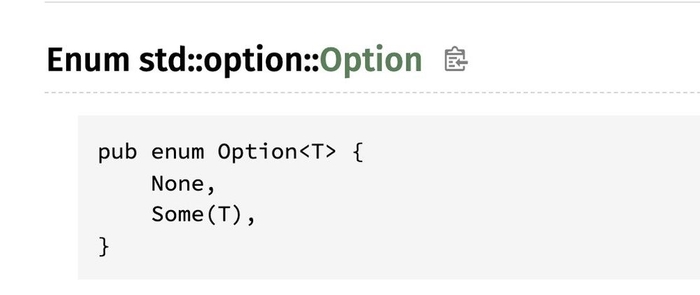
Because Option<i32> and i32 are different types, the compiler will stop you from using an optional value as if it were always present. This forces you to handle the None case, turning a potential runtime crash into a compile-time error.
This segment from "The Dev Method" provides a great introduction to the Option enum and demonstrates why the compiler's strictness is such a powerful feature for safety.
Please watch the section from the introduction of Option. Pay close attention to the explanation of why you can't simply add a number to an Option<i32>. This compile-time check is the core of Rust's safety promise.
Accessing the Value Inside an Option
So, if the compiler prevents us from using an Option<T> directly, how do we get the value out? There are several ways, ranging from unsafe to idiomatic.
The Unsafe Way: unwrap() and expect()
The quickest, but most dangerous, way is to use the unwrap() method. It returns the value inside a Some. If you call it on a None, your program will panic and crash. This is no better than a null pointer exception. expect() is similar but lets you provide a custom panic message.
You should use unwrap() and expect() very sparingly, typically only in tests or when a None value truly represents a logical impossibility that should crash the program.
The same video clearly demonstrates the dangerous behavior of unwrap().
Watch the short clip from "getting the sum", which shows unwrap() working correctly on a Some and then causing a panic when called on a None.
The Safer Way: Providing Defaults
A much safer approach is to provide a default value to use in case of None.
unwrap_or(default_value): Returns the value insideSomeor thedefault_valueifNone.unwrap_or_else(closure): Similar, but the default value is computed by a closure (a small, anonymous function). This is more efficient if creating the default value is computationally expensive, as the closure is only executed if theOptionisNone.
This next segment introduces unwrap_or as the safe and simple solution for providing default values.
Watch from "provide some sort of value". This shows how to avoid a panic by supplying a fallback.
The Exhaustive Way: Pattern Matching
Since Option is an enum, you can use the match and if let expressions we've covered before. This is the most explicit way to handle both variants and is what the compiler encourages.
The "The Dev Method" video also shows how match and if let are used with Option.
First, watch the section on using match with Option. This ensures you handle both Some and None cases. Then, watch the following section on if let, which is a more concise way to handle the Some case when you don't care about None.
The Idiomatic Way: Combinators
While match is powerful, it can be verbose. For chaining operations, Rust provides a set of methods on Option known as combinators. These methods operate on the Option itself, letting you transform the value inside without ever explicitly unwrapping it. This functional style often leads to more readable and less error-prone code.
Let's explore the most important ones.
How to Handle Errors with Result and Option in Rust
This article from OneUptime provides an excellent overview of the most common combinators. We will focus on the ones for Option.
Please read section 6, "Combinators". As you read, focus on understanding the fundamental difference between these key methods: map: Use this to apply a function to the value inside a Some. It takes a T and returns a U, wrapping the result in a new Some(U). It leaves None untouched. and_then: Use this when your function itself returns an Option. This is crucial for chaining operations that can each fail (i.e., return None). If you used map here, you'd end up with a nested Option<Option<T>>. and_then avoids this by "flattening" the result. The unwrap_or family: We've already seen unwrap_or and unwrap_or_else. This section will reinforce how they provide a final default value at the end of a chain.
Let's see this in action. The following video refactors a piece of code from a verbose, imperative style using if checks to a clean, functional style using combinators.
Improving Rust code with combinators
This "Let's Get Rusty" video is a fantastic demonstration of why combinators are so powerful.
First, watch the "before" code, from "a vector of good students". Notice the nested if statements checking for Some and Ok variants. This is the kind of code we want to avoid. Next, watch the "after" refactoring, from "the map method". Pay close attention to how map is used to transform the data, the ? operator is used for early exit on None, and flatten is used to discard the None values from the collection.
Practical Use Cases and Conversions
Option is used everywhere in Rust. It's perfect for things like optional configuration values or functions that might not find what they're looking for.
Option and Result - Rust Tutorial - OneCompiler
The OneCompiler tutorial has some clear, practical examples of where Option is used.
Please read the section titled "Practical Option Examples". The find_user function and the Config struct are canonical use cases you will encounter frequently.
Finally, it's often useful to convert between Option and Result (which we briefly met in the first module). If you have an Option and need a Result, you can use ok_or(error_value) to convert a None into an Err. This is useful when None isn't just an absence, but an actual error condition in your function's context.
How to Handle Errors with Result and Option in Rust
The OneUptime article also covers this conversion.
Briefly review section 7, "Converting Between Types", focusing specifically on the ok_or and ok_or_else examples.
Conclusion
In this lesson, you've learned how Rust addresses the "billion-dollar mistake" of null references with the Option<T> enum. This is a fundamental building block for writing the kind of robust, reliable code that is essential for embedded systems.
Here are the key takeaways:
Option<T>explicitly encodes the possibility of an absent value in the type system, preventing null-related runtime errors.- You can handle
Optionvariants explicitly using pattern matching (match,if let). - Unsafe methods like
unwrap()should be avoided in production code in favor of safer alternatives likeunwrap_or(). - Combinators like
map()andand_then()allow you to write elegant, chainable, and safe code by operating on the value within theOptionwithout unwrapping it. maptransforms the value inside, whileand_thenis for chaining functions that return anOptionthemselves.
You may have noticed that methods like unwrap_or_else and the combinators often take a small, on-the-fly function as an argument, written like |s| s.len(). These are called closures. In our next lesson, we will dive deep into closures and their close relatives, iterators, to unlock even more of Rust's expressive power.