Welcome to Module 3. In the previous module, we established a solid foundation in your development environment and the principles of web communication, culminating in understanding RESTful API design. Now, we shift our focus from the "what" and "how" of client-server interaction back to the "how" of building powerful, flexible, and maintainable logic within the server itself.
This lesson introduces a concept that is fundamental to modern Python: functions as first-class citizens. This seemingly abstract idea is the key that unlocks some of Python's most powerful features. Our goal is to explain and utilize functions as first-class citizens, including the related concepts of higher-order functions and closures. Mastering this will not only make your code more expressive and professional but is also a direct prerequisite for understanding decorators, a cornerstone of frameworks like Django and Django REST Framework.
The Big Picture: A Conceptual Map
Before we dive into code, let's look at a high-level map of the concepts we'll cover today and how they relate to each other.
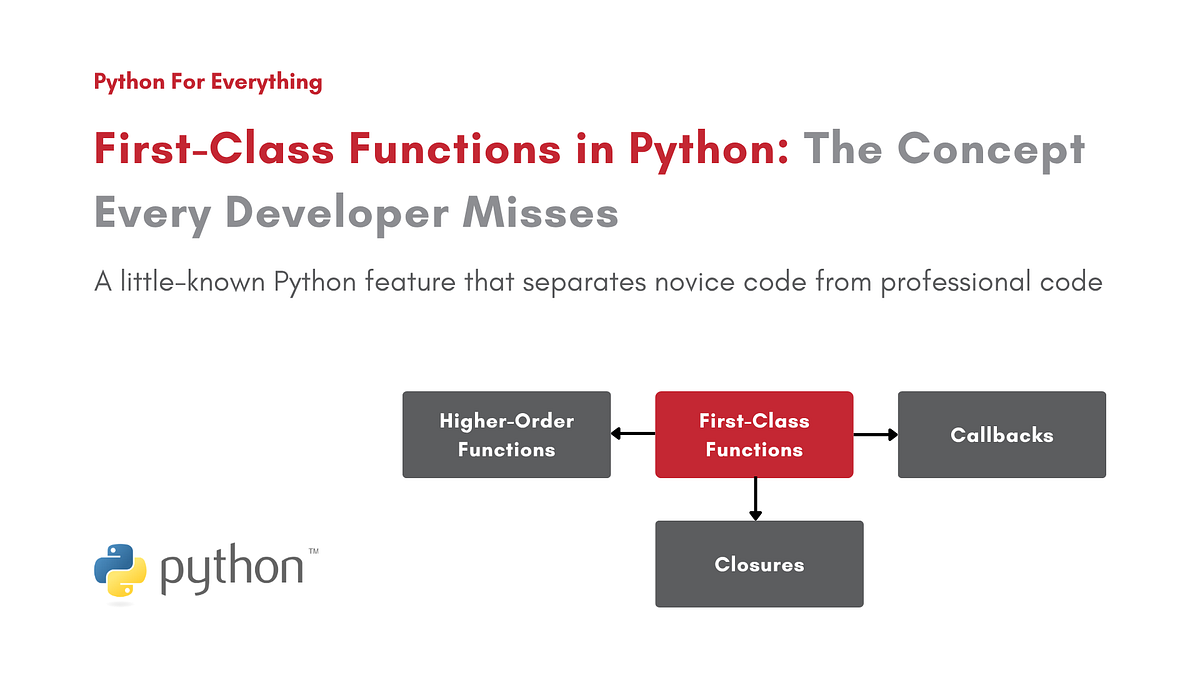
As you can see, everything starts with the principle of "First-Class Functions." Let's explore what that means.
1. Functions as First-Class Citizens
In Python, everything is an object—integers, strings, lists, and, crucially, functions too. A programming language is said to have "first-class functions" if it treats functions as first-class citizens. This simply means that a function is just another value, and you can do anything with it that you can do with other values like numbers or strings.
Specifically, this means you can:
- Assign a function to a variable.
- Pass a function as an argument to another function.
- Return a function from another function.
This is a paradigm shift from thinking of functions only as something to be called. The following video from Corey Schafer provides an excellent visual demonstration of these three properties.
Programming Terms: First-Class Functions
This video clearly explains what first-class functions are and demonstrates each of the three core properties with simple, easy-to-follow Python code.
Watch the following segments: The definition of a first-class function. Assigning functions to variables. Note the critical difference between square and square(). Passing functions as arguments to a custom my_map function. Returning functions from other functions, which gives a first look at the concept of a closure.
To solidify these ideas, let's turn to a well-written article from freeCodeCamp that we will use throughout this lesson. It covers the same ground with clear code examples you can read at your own pace.
First-Class Functions, Higher-Order Functions, and ...
This article provides a comprehensive overview of the topics for today's lesson. We'll start with the section on first-class functions to reinforce what you saw in the video.
Please read the section titled First-Class Functions. Pay close attention to the three subsections: Assigning Functions to Variables: Notice how sum_function becomes another name for the add function object. Passing Functions as Arguments: The map_function example shows how you can pass behavior (double) into another function. Returning Functions from Other Functions: The create_multiplier example is key. It's a function that builds and returns other functions.
2. Higher-Order Functions
The second and third properties of first-class functions—passing them as arguments and returning them as results—give rise to a new category of functions called higher-order functions (HOFs).
A higher-order function is any function that either:
- Takes one or more functions as arguments, OR
- Returns a function as its result.
You've already seen examples of both: map_function from the article was a HOF because it took double as an argument, and create_multiplier was a HOF because it returned the multiplier function.
This ability to abstract and pass around behavior is incredibly powerful. Python's built-in sorted() function, for example, is a HOF. You can pass it a key function to change how it sorts elements.
# A list of dictionaries
users = [
    {'name': 'Alice', 'age': 25},
    {'name': 'Bob', 'age': 30},
    {'name': 'Charlie', 'age': 20}
]


# Define a function to get the age
def get_age(user):
    return user['age']


# Pass the get_age function to sorted() as the key
sorted_users = sorted(users, key=get_age)
print(sorted_users)


# Output: [{'name': 'Charlie', 'age': 20}, {'name': 'Alice', 'age': 25}, {'name': 'Bob', 'age': 30}]
Often, the function you need to pass is simple and used only once. For this, Python provides lambda functions, which are small, anonymous functions defined without a def statement.
Let's continue with our reading to formally define HOFs and see how lambda functions make them even more convenient.
First-Class Functions, Higher-Order Functions, and ...
This section connects the dots between first-class and higher-order functions and introduces lambdas.
Read the section on Higher-Order Functions. As you read, focus on: How the previous examples (map_function and create_multiplier) fit the definition of a HOF. The syntax of a lambda function and how it provides a more concise way to define the double or multiplier functions inline. The final examples (apply_operation and discount_applier) that explicitly highlight the interdependence of first-class and higher-order functions.
3. Closures: Functions that Remember
Now we come to the most powerful and initially mind-bending concept: closures. A closure is an inner function that remembers and has access to variables from its enclosing (outer) function's scope, even after the outer function has finished executing.
Let's break this down with the create_multiplier example from the article.
def create_multiplier(factor):


    # This is the enclosing scope. The variable 'factor' lives here.
    def multiplier(x):


        # This inner function can access 'factor' from its enclosing scope.
        return x * factor


    # We return the inner function object itself, not its result.
    return multiplier


# When we call create_multiplier(2), the outer function runs and then finishes.
# The 'factor' variable (with a value of 2) should be gone.
double = create_multiplier(2)


# ...but it's not! The 'double' function (which is the returned 'multiplier' function)
# "remembers" that 'factor' was 2. This is a closure.
print(double(5)) # Output: 10


# We can create another closure with a different remembered state.
triple = create_multiplier(3)
print(triple(5)) # Output: 15
This "memory" is what makes closures so useful. They allow us to create "function factories"—functions that generate new, pre-configured functions for later use. This is a common pattern for creating things like validators, formatters, and handlers in backend applications.
Let's complete our reading by focusing on the detailed explanation of closures.
First-Class Functions, Higher-Order Functions, and ...
This final section explains closures step-by-step.
Read the section on Closures until the end of the article. This will walk you through: A basic nested function. The key step of returning the inner function. The more powerful pattern of using parameters in the outer function to create customized closures (greet_priyanshu, greet_sam).
Hands-On Task: Building a Validator Factory
Now it's time to put these concepts into practice. Your task is to build a function factory that creates simple string length validators. This is a very practical application of closures in backend development, where you constantly need to validate incoming data.
- Create a file named
main.py. - Define a higher-order function
create_validator(min_len, max_len). - Inside
create_validator, define a nested functionvalidate(text).- This inner function should use the
min_lenandmax_lenvariables from its enclosing scope (this is the closure!). - It should check if
len(text)is betweenmin_lenandmax_len(inclusive). - It should return
Trueif the text is valid andFalseotherwise.
- This inner function should use the
- The
create_validatorfunction should return thevalidateinner function. - Use your factory to create two different validators:
username_validator = create_validator(3, 15)password_validator = create_validator(8, 30)
- Test your new validator functions with a few different strings and print the results to see them in action. For example:
print(f"Is 'user' a valid username? {username_validator('user')}")print(f"Is 'us' a valid username? {username_validator('us')}")print(f"Is 'short' a valid password? {password_validator('short')}")print(f"Is 'a-good-password' a valid password? {password_validator('a-good-password')}")
Click here for a solution to check your work.
def create_validator(min_len, max_len):
    """
    A higher-order function that creates and returns a string length validator.
    """
    def validate(text):
        """
        An inner function (closure) that validates the length of a given text.
        It "remembers" min_len and max_len from its enclosing scope.
        """


        # Ensure the input is a string before checking its length
        if not isinstance(text, str):
            return False

        length = len(text)
        return min_len <= length <= max_len

    return validate


# --- Using the factory to create specific validators ---
username_validator = create_validator(3, 15)
password_validator = create_validator(8, 30)


# --- Testing the validators ---


# Test username validator
print("--- Testing Username Validator (min: 3, max: 15) ---")
print(f"Is 'user123' a valid username? {username_validator('user123')}")  # Expected: True
print(f"Is 'us' a valid username? {username_validator('us')}")           # Expected: False
print(f"Is 'thisusernameistoolong' a valid username? {username_validator('thisusernameistoolong')}") # Expected: False

print("\n--- Testing Password Validator (min: 8, max: 30) ---")


# Test password validator
print(f"Is 'securepass' a valid password? {password_validator('securepass')}") # Expected: True
print(f"Is 'short' a valid password? {password_validator('short')}")         # Expected: False
Conclusion
In this lesson, you've unlocked a deeper level of understanding of how Python functions work. This is a significant step in moving from writing basic scripts to engineering robust backend systems.
Key Takeaways:
- First-Class Functions: In Python, functions are objects. They can be assigned to variables, passed to other functions, and returned from them.
- Higher-Order Functions (HOFs): These are functions that operate on other functions (either by taking them as input or returning them as output). They allow you to abstract and pass around behavior.
- Closures: A closure is an inner function that remembers the state of its enclosing scope. This allows you to create "function factories" that produce pre-configured functions.
These concepts are not just academic; they are the engine behind one of Python's most elegant features. In our next lesson, we will see how they all come together to create decorators, which you'll use constantly to add functionality like authentication, logging, and caching to your Django and DRF views.