Introduction
In our previous lesson, we established the server's first line of defense against overload: adaptive rate limiting and load shedding. These mechanisms allow a service to protect itself by rejecting traffic it cannot handle. However, treating all incoming requests as disposable is a blunt instrument. A sophisticated, large-scale system must make more intelligent choices under pressure. As a prospective Principal Engineer, your designs must not only be resilient but also business-aware, capable of prioritizing what truly matters when resources are scarce.
This lesson builds directly on that foundation, moving from the binary decision of accepting or rejecting a request to the more nuanced strategy of graceful degradation. We will explore how to design systems that, instead of failing completely, can shed non-essential work and maintain core functionality during an overload event. You will learn two key patterns that enable this: load shedding based on priority, and serving degraded responses. Mastering these techniques is crucial for building services that are perceived as reliable and available even when operating under significant stress.
The Graceful Degradation Spectrum
A system shouldn't have just two states: "fully working" and "completely failed." Graceful degradation is the principle of designing a system to operate along a spectrum of functionality. As load increases or dependencies fail, the system intelligently reduces its capabilities to preserve its most critical functions, rather than collapsing entirely.

This controlled reduction of service quality is fundamental to reliability at scale. Instead of every user seeing an error, perhaps some users get a slightly slower response, or a response with less information, while the most critical operations proceed unaffected.
Priority-Based Serving: The Foundation of Intelligent Degradation
To degrade gracefully, a system must first understand the relative importance of the work it's performing. Not all requests are created equal. A request to complete a purchase is far more critical than a request to load user profile recommendations. This is where the concept of priority-based serving comes in.
At Google, this is formalized through the notion of criticality, which is a first-class property of a request within the RPC system.
Load Balancing with Client Side Throttling
The Google SRE book chapter on "Handling Overload" provides an excellent overview of how request criticality is used as a core mechanism for managing overload.
Please read the section titled Criticality. Pay close attention to the four distinct levels used at Google and, crucially, the principle of automatic criticality propagation through the RPC stack.
As you read, note these key ideas:
- Standardized Tiers: Having a small, well-defined set of criticality levels (e.g.,
CRITICAL_PLUS,CRITICAL,SHEDDABLE_PLUS,SHEDDABLE) provides a common language for all services. - Orthogonality to Latency: A request can be highly sheddable but still require very low latency (e.g., autocomplete suggestions). Priority is about importance, not speed.
- Automatic Propagation: This is a vital architectural feature. When a frontend service receives a
CRITICALrequest, any downstream RPCs it makes on behalf of that request automatically inherit theCRITICALtag. This ensures that the entire request path honors the initial priority without requiring every developer to manually pass it along.
As an architect, your role is to work with product and business stakeholders to map business operations to these criticality levels. This classification becomes the basis for all subsequent decisions about what to save and what to sacrifice under load.
Executing Degradation: Shedding Load and Reducing Work
Once requests are classified by priority, the system needs mechanisms to act on that information. There are two primary strategies for this.
1. Priority-Based Load Shedding
In the last lesson, we discussed load shedding as rejecting traffic based on signals like CPU utilization. Priority-based serving refines this by making the rejection decision dependent on the request's criticality. Instead of a single overload threshold, the system has multiple thresholds.
Load Balancing with Client Side Throttling
The same SRE book chapter explains how utilization signals are combined with criticality to make intelligent load-shedding decisions.
Now, read the section on Utilization Signals. Focus on how utilization thresholds are tied to criticality levels. For instance, the system might start shedding SHEDDABLE traffic at 80% CPU, SHEDDABLE_PLUS at 85%, and only begin to drop CRITICAL traffic at 95%.
This tiered approach ensures that as load increases, the least important work is dropped first, preserving resources for the transactions that matter most.
The following diagram illustrates a complete load management system that incorporates these ideas.
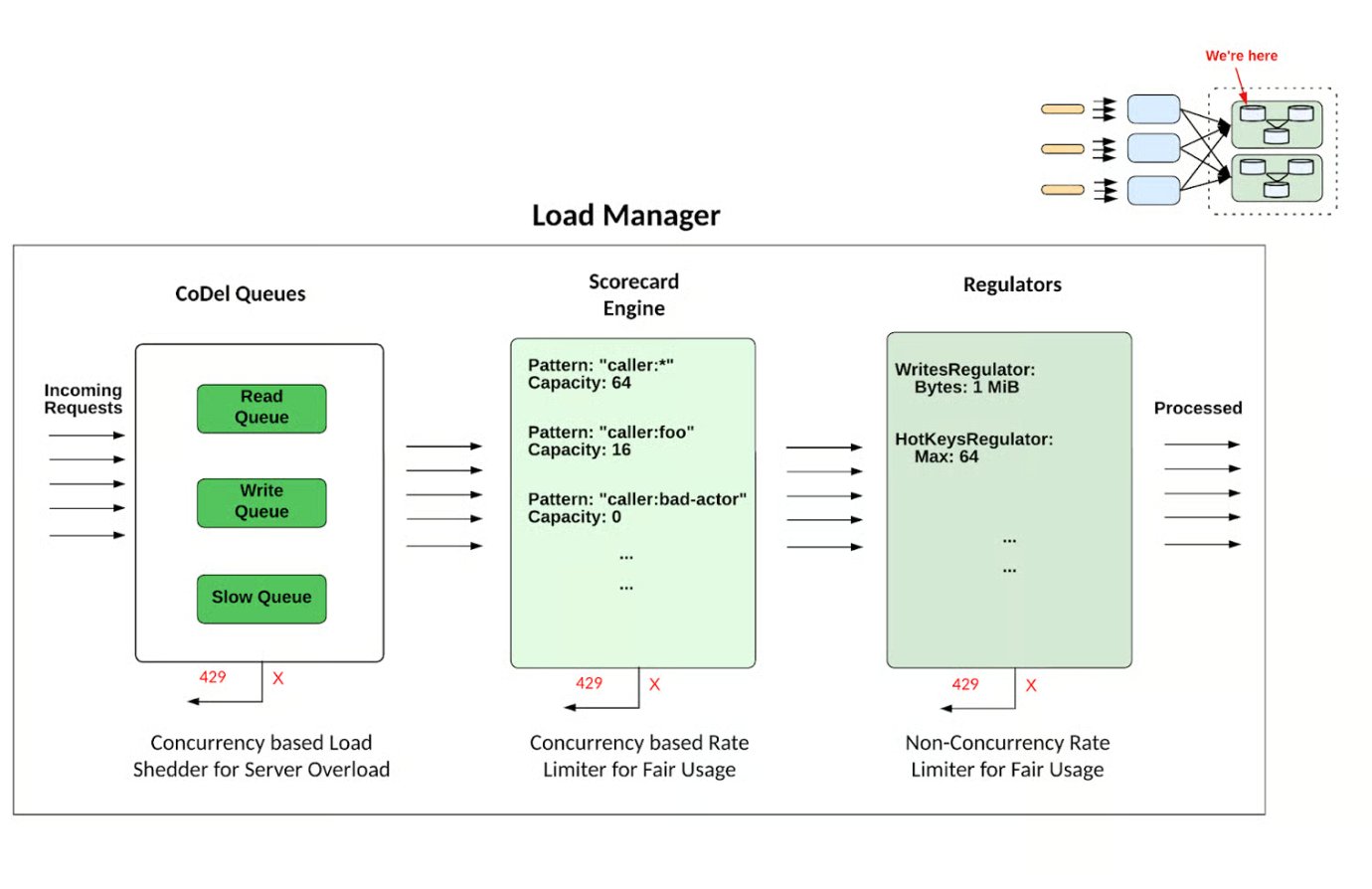
Let's interpret this architecture using the concepts we've learned:
- CoDel Queues: CoDel (Controlled Delay) is an advanced queue management algorithm. Unlike simple FIFO queues that can lead to long wait times for requests that will eventually time out anyway (a problem called bufferbloat), CoDel proactively drops packets from the queue if they've been waiting too long. This is a form of load shedding that prioritizes fresh requests over stale ones.
- Scorecard Engine: This is the heart of the priority-based logic. It evaluates incoming requests against configured patterns and capacities. A rule like
"caller:bad-actor"withCapacity: 0is a form of hard denial, while different capacities for"caller:*"versus"caller:foo"implement tiered service levels. This directly maps to the idea of assigning different quotas or priorities to different types of work or clients. - Regulators: These components enforce the final decisions made by the scorecard engine, applying rate limits and returning an
HTTP 429error for shed requests.
This architecture provides a practical blueprint for how to implement priority-aware load shedding in a real-world system.
2. Serving Degraded Responses (Doing Less Work)
Dropping requests is effective, but sometimes a better user experience is to return a partial or lower-quality response rather than a complete failure. This is the other major graceful degradation pattern: doing less work for a given request.
Cascading Failures: Reducing System Outage - Google SRE
The SRE book chapter on "Addressing Cascading Failures" clearly defines this pattern and provides excellent examples.
Please read these three parts: The definition in the section Graceful degradation. The brief mention of it as a recovery strategy under Enter Degraded Modes. The concrete Shakespeare example, which illustrates how a service stops returning non-essential data like pictures when capacity is scarce.
The core idea is to identify non-essential computations or data within a response and make them optional. When the service detects it's under load, it can skip these expensive, non-critical steps. Examples include:
- Search: Return results from an in-memory index only, instead of hitting a larger, slower disk-based index.
- E-commerce Product Page: Serve the main product details, price, and "add to cart" button, but skip loading personalized recommendations or user reviews.
- Social Media Feed: Load the main posts but temporarily disable generating image previews or calculating interaction counts.
Implementing this requires conscious architectural design. You must build "switches" or flags into your code that allow these features to be dynamically disabled based on the system's health or the request's criticality.
Client Cooperation
Finally, a robust system encourages its clients to participate in managing overload. While the server is the ultimate authority, well-behaved clients can reduce unnecessary traffic by throttling themselves when they detect the server is struggling. This creates a negative feedback loop that helps stabilize the system.
The "adaptive throttling" mechanism described in the Google SRE book is a powerful example. A client monitors the ratio of its successful requests (accepts) to its total attempts (requests).
The rejection probability is calculated as:
Here, is a multiplier (typically 2). When the server starts rejecting requests, accepts decreases relative to requests. Once requests becomes more than K times accepts, the client starts rejecting some of its own requests locally, before they are even sent over the network. This prevents a flood of rejected requests from consuming server resources and allows the client to quickly back off, giving the server room to recover.
Conclusion
In this lesson, we elevated our approach to fault tolerance from simple overload protection to intelligent, graceful degradation. By designing systems that can make nuanced choices under pressure, you ensure they remain valuable to the business even when they cannot operate at full capacity.
Here are the key takeaways for your Principal Engineer toolkit:
- Graceful Degradation: This is the goal. Systems should operate on a spectrum of functionality, not a binary of on/off.
- Priority-Based Serving: This is the core mechanism. Classifying work by its
criticalityis the prerequisite for any intelligent degradation strategy. - Selective Load Shedding: Under load, drop the least critical requests first, based on a combination of request priority and real-time system utilization signals.
- Degraded Responses: As an alternative to dropping requests, serve a successful but lower-quality response by skipping non-essential, expensive computations. This requires building "degraded modes" into your architecture.
You now have a robust set of patterns for making a single service or datacenter resilient. However, some failures are too large to be handled within one location. In our next lesson, we will zoom out to the global scale and explore active-active, active-passive, and active-standby multi-region deployment topologies, the ultimate defense against large-scale outages.