Introduction
In our previous lesson, we developed a data-driven strategy for managing technical debt, framing it as an investment decision that balances engineering health against business velocity. This often creates a natural tension: prioritizing refactoring versus shipping new features. This is a specific instance of a much broader challenge you will face as a Principal Engineer.
This lesson expands on that theme to address the learning outcome: Deconstruct competing requirements from multiple stakeholders into a clear set of engineering trade-offs. At Google's scale, you are constantly mediating between the desires of Product Management (velocity, features), SRE (reliability, stability), Finance (cost efficiency), and others. Your role is not simply to provide the "right" technical answer, but to illuminate the consequences of different paths and guide the organization toward a decision that best aligns with its strategic goals. We will explore the mindset, communication tactics, and structured frameworks required to translate these competing demands into a clear, actionable set of engineering choices.
The Principal Engineer as Facilitator
A common misconception is that a Principal Engineer's authority comes from being the ultimate technical arbiter who makes the final call. In reality, your power is rooted in influence, credibility, and the ability to bring clarity to complex situations. You lead without direct reports, which means your primary tools are persuasion and well-reasoned arguments.
Principal Engineer Decision Authority Without Line Management
This article provides an excellent overview of the Principal Engineer's role, emphasizing leadership through influence rather than formal authority. It sets the stage for the frameworks we will discuss.
Focus on two key areas: First, read the section defining the role. Pay close attention to the table comparing the authority of a Principal Engineer to an Engineering Manager. This highlights how your accountability is tied to technical outcomes, not team delivery. Next, review the section on strategic influence. Note the techniques listed, such as using ADRs, asking clarifying questions in design reviews, and quantifying tech debt. These are all methods for surfacing and documenting trade-offs.
As the article implies, your primary function in these multi-stakeholder discussions is to act as a facilitator and translator. You translate ambiguous business needs into concrete engineering principles and, conversely, explain the business impact of technical decisions to non-technical stakeholders.
A Powerful Opening Move: The "Qualified Yes"
When faced with a new, seemingly disruptive request from a stakeholder, the instinct of many engineers is to say "no," citing existing priorities and resource constraints. This shuts down the conversation. A more effective approach, and a hallmark of a senior technical leader, is to offer a "qualified yes."
The "qualified yes" reframes the request not as a binary choice, but as the beginning of a trade-off discussion. It takes the form of "Yes, we can do that, and here is what it will cost," where "cost" might mean slipping a different deadline, reallocating resources, or accepting a different kind of risk.
Why Principal Engineers Shouldn't Say "No"
John Miller, a former Principal Engineer at Google, Microsoft, and Amazon, provides a concise and powerful explanation of this technique in his video, "Why Principal Engineers Shouldn't Say 'No'."
Watch the core of his argument: Start with his introduction to the "qualified yes" concept. Listen to his practical example of handling a new request from another group under tight deadlines. Finally, understand the process he outlines for investigating the request and presenting options. Notice how he frames the discussion around prioritization and resources, in neutral, non-defensive terms.
This approach immediately deconstructs the situation. The stakeholder is forced to consider if their request is important enough to justify the stated cost. You are no longer a blocker; you are a partner helping them understand the consequences of their request. This positions you to guide the conversation toward a strategic decision.
A Data-Driven Framework for Trade-offs: SLOs
The "qualified yes" is an effective conversational tool, but to manage trade-offs at scale, you need a more systematic, data-driven framework. At Google, the canonical framework for balancing the competing requirements of feature velocity and system reliability is built around Service Level Objectives (SLOs).
SLOs provide a shared, quantitative language that all stakeholders—Product, SRE, and Development—can use to make rational decisions. The SRE hierarchy is typically defined as follows:
- SLI (Service Level Indicator): A quantitative measure of some aspect of the service. This is the raw measurement. For example, the proportion of successful HTTP requests.
- SLO (Service Level Objective): A target value or range for an SLI over a period of time. For example, 99.9% of HTTP requests will be successful over a rolling 28-day window. This is the engineering target.
- SLA (Service Level Agreement): A business contract with a customer that includes consequences for not meeting an SLO. This is the business promise.

The brilliant insight of the SLO framework is the error budget, which is simply 1 - SLO. An SLO of 99.9% availability implies an error budget of 0.1%. This budget is a quantifiable resource representing the acceptable level of unreliability. It's the explicit, pre-negotiated trade-off.
- When you have a positive error budget: You are meeting your reliability goals, so you can afford to take risks. This is the time to ship new features, perform risky migrations, or conduct experiments.
- When you have a negative error budget: You are failing to meet your reliability goals. The error budget policy dictates that you must freeze risky changes and prioritize work that improves stability until the budget is restored.
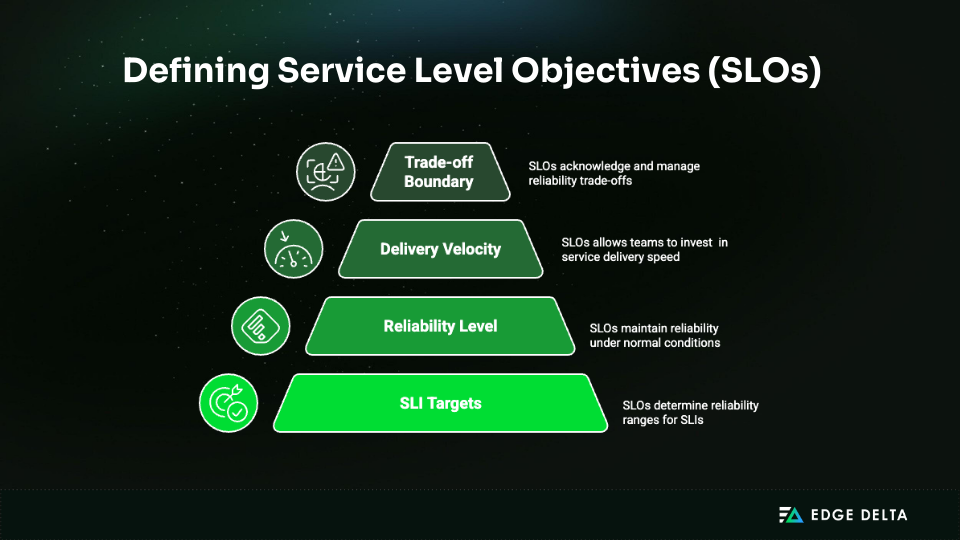
This framework turns a subjective, emotional debate ("Should we launch the new feature?" "But the system is unstable!") into a data-driven business decision.
Chapter 2 - Implementing SLOs - Google SRE
The Google SRE Workbook chapter on "Implementing SLOs" is the definitive guide to this process. It details not just the "what" but the "how" and "why."
As you read, focus on the stakeholder management aspect: Start with the introduction to understand the core motivation: making data-informed decisions about prioritizing scarce engineering time. Jump to the section on stakeholder agreement. This is critical. It outlines how Product Managers, Developers, and SREs must all agree on the SLO, ensuring everyone buys into the trade-off. Next, read about establishing the policy. An error budget without a policy is just a number. The policy is the enforcement mechanism that makes the trade-off real. Finally, study the section on decision making. The table "SLO decision matrix" is a powerful tool that summarizes how to react in different scenarios based on SLO performance, operational toil, and customer satisfaction.
The process of defining and agreeing upon an SLO is the very act of deconstructing competing requirements. It forces all parties to have an explicit conversation about what level of reliability is "good enough" and to codify the consequences of deviating from that target.
From Business Drivers to Architectural Trade-offs
Once SLOs help you clarify the high-level business drivers (e.g., is the priority time-to-market, or is it extreme reliability?), you can use those drivers to analyze concrete architectural decisions. Every architectural choice is a trade-off, and your job is to make those trade-offs explicit.
Modern Trade-off Analysis for Software Architecture - Neal Ford - DDD Europe
Neal Ford's talk, "Modern Trade-off Analysis for Software Architecture," provides an excellent set of tools for this kind of analysis. It demonstrates how to move from qualitative discussion to structured evaluation.
Focus on these two key segments: First, watch the introduction to understand the core premise: everything in software architecture is a trade-off. The job is not to find a perfect solution but to choose the "least worst" option for a given context. Then, watch the detailed example of performing a trade-off analysis. Pay close attention to how he compares a "hydrated contract" versus a "key-only" approach. He uses a matrix to analyze technical characteristics (scalability, contract management, etc.) and then—most importantly—reconciles the analysis back to the business driver (e.g., time to market).
Let's walk through Ford's example as a template for your own work:
- Identify the Architectural Decision: Should an event publisher send a full, hydrated data object, or just a key?
- Define Evaluation Criteria: What are the important "-ilities"? The video identifies scalability, performance, contract management, and data consistency.
- Analyze the Options:
- Hydrated Contract: Better performance (fewer DB lookups), but introduces "stamp coupling" (brittle contracts) and potential data consistency issues.
- Key-Only: Worse performance (more DB lookups), but guarantees a single system of record and avoids contract coupling.
- Connect to Business Drivers: This is the crucial step.
- If the primary business driver is extreme scalability, you might choose the hydrated contract and accept the work of mitigating its downsides (e.g., complex versioning).
- If the primary business driver is simplicity and data integrity, you would likely choose the key-only approach and accept the performance hit.
This structured analysis allows you to present your recommendation with a clear rationale that connects directly to the goals of the business, as surfaced by your earlier stakeholder discussions.
Conclusion
Deconstructing competing requirements is a fundamental skill for a Principal Engineer. It requires a shift in mindset from being a purely technical problem-solver to being a strategic facilitator who guides the organization through complex decisions.
The key takeaways from this lesson are:
- Lead Through Influence: Your authority comes from credibility and the ability to clarify, not from command.
- Start with a "Qualified Yes": Use this conversational technique to transform requests from demands into negotiations about trade-offs.
- Establish a Shared Language: Frameworks like SLOs and error budgets are invaluable for turning subjective stakeholder desires into objective, data-driven conversations. The process of setting an SLO is the process of deconstructing requirements.
- Analyze Trade-offs Structurally: Use tools like trade-off matrices to evaluate architectural options against business drivers, making your recommendations transparent and defensible.
In our next lesson, we will build directly on this foundation. Having learned how to deconstruct requirements and analyze trade-offs, we will focus on how to communicate complex technical trade-offs and their business implications to non-technical stakeholders. This is the crucial final step in ensuring your technical strategy is understood, adopted, and supported by the entire organization.