Welcome back. In our previous lesson, we established a precise understanding of several core consistency models, culminating with linearizability—the gold standard that provides the illusion of a single, real-time copy of data. This foundation is essential as we now move to one of the most famous, and frequently misinterpreted, principles in distributed systems: the CAP theorem.
This lesson will dissect the CAP theorem, which formalizes a fundamental trade-off that every large-scale distributed system must confront. Our goal is not just to understand the theorem itself, but to critically analyze its practical limitations as a design guide. For a Principal Engineer, simply reciting "two out of three" is insufficient; the real value lies in understanding the nuances, the scenarios where the theorem applies, and, just as importantly, where its simplified model falls short of capturing the complexity of real-world systems.
The Core Idea of the CAP Theorem
The CAP theorem was first proposed as a conjecture by Eric Brewer in 2000 and later formally proven by Seth Gilbert and Nancy Lynch. It states that in a distributed data store, it is impossible to simultaneously provide more than two of the following three guarantees:
- Consistency (C): Every read receives the most recent write or an error.
- Availability (A): Every request receives a (non-error) response, without the guarantee that it contains the most recent write.
- Partition Tolerance (P): The system continues to operate despite an arbitrary number of messages being dropped (or delayed) by the network between nodes.
To build an initial intuition, the following short video uses a simple ATM analogy to illustrate the core dilemma.
This video from the "Distributed Systems Course" channel provides a clear, high-level introduction to the CAP theorem and its core trade-off.
Please watch from the beginning to understand the definitions of C, A, and P, and see how a network partition in a simple ATM system forces a choice between consistency and availability (The CAP Dilemma).
The key insight is that network partitions are a fact of life in distributed systems. You cannot choose to forfeit partition tolerance. As such, the theorem forces a difficult choice when a partition does occur: do you sacrifice consistency for availability, or vice versa?
The diagram below illustrates a typical scenario where a network partition occurs between two datacenters. Clients can still connect to their local datacenter, but the replication link between them is severed.
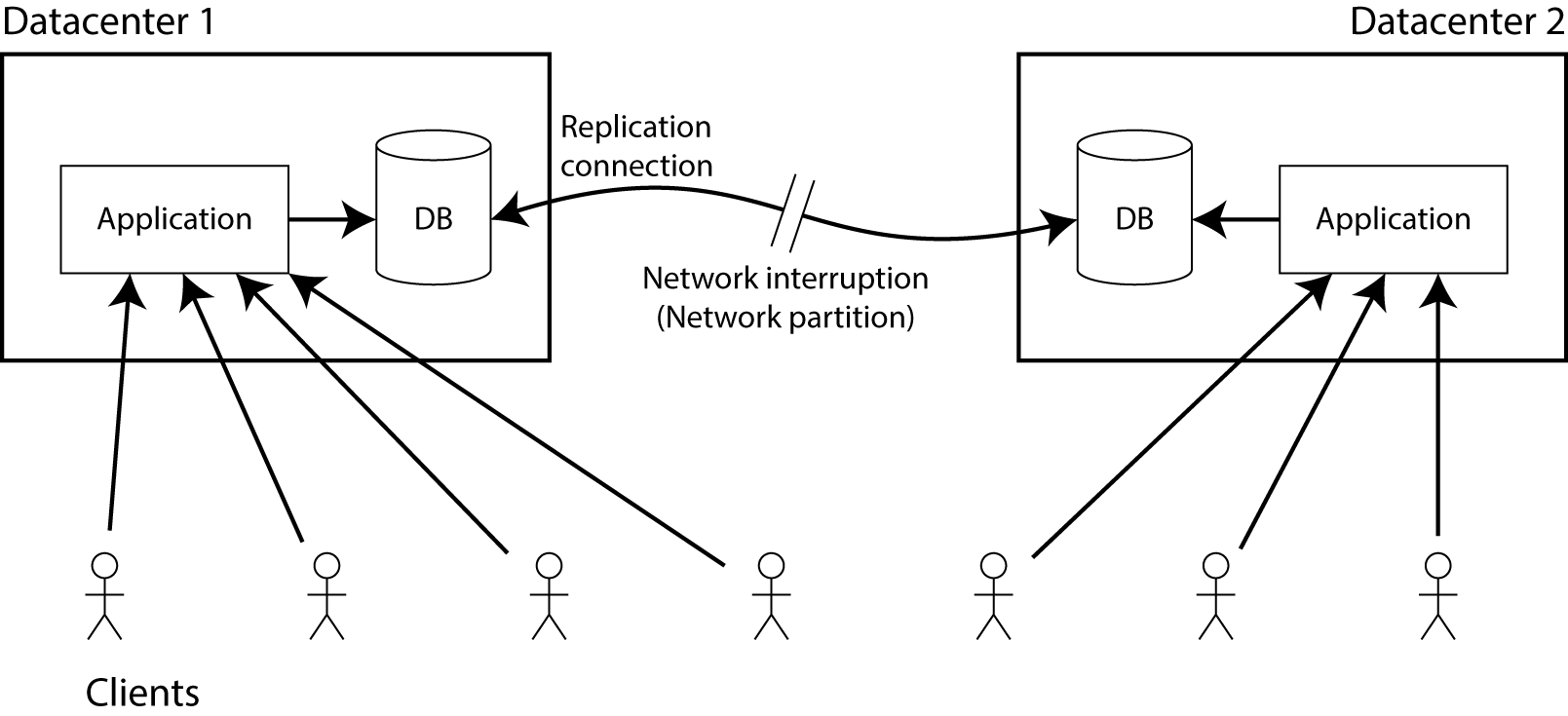
In this scenario:
- To remain Available, both Datacenter 1 and Datacenter 2 must continue to serve read and write requests from their local clients. However, since they cannot communicate, their states will inevitably diverge, violating consistency.
- To remain Consistent, the system must prevent this divergence. It could, for example, designate one datacenter as the leader and force the other to stop accepting writes (or all requests), thereby becoming unavailable.
The Precise Meaning of "CAP"
The simplicity of the "2 of 3" rule is appealing, but it hides crucial details. At the Principal Engineer level, precision is paramount. The terms used in the formal proof of CAP have very specific, narrow meanings that differ from their colloquial usage.
-
Consistency (C) refers specifically to linearizability, which we discussed in the last lesson. It means all operations appear to have executed atomically at some single point in time, respecting real-time ordering. This is much stronger than the 'C' in ACID (which refers to preserving database invariants) or the general notion of eventual consistency.
-
Availability (A) is defined as "every request received by a non-failing node in the system must result in a (non-error) response." This is a very strict definition. If a network partition leaves a minority of nodes unable to form a quorum, and those nodes start rejecting requests, the system is not CAP-Available, even though the service as a whole might still be considered highly available by its users (who are connected to the majority partition).
-
Partition Tolerance (P) means the system works over an asynchronous network that can lose or delay messages. As virtually all wide-area distributed systems run on such networks, P is not an option but a reality you must design for.
The following video does an excellent job of clarifying these precise definitions and explaining why the colloquial understanding of CAP can be misleading.
Siddhartha Reddy - CAP Theorem: You don’t need CP, you don’t want AP, and you can’t have CA
This talk by Siddhartha Reddy at Hasgeek TV dives into the specific definitions of C and A used in the CAP theorem's proof.
First, watch the segment that defines CAP Consistency as linearizability and highlights how few real-world systems actually provide it by default. Then, watch the explanation of CAP Availability and how it differs from the business concept of "high availability."
Practical Limitations: Moving Beyond "CP vs. AP"
The critique that CAP is oversimplified isn't new. In fact, Eric Brewer himself revisited the theorem in a 2012 paper to clarify its nuances and guide designers toward a more sophisticated approach. Classifying systems into rigid "CP" or "AP" buckets loses a tremendous amount of detail and is often inaccurate.
Let's explore why the simple "pick two" mantra is a poor design guide by consulting two critical resources: Brewer's retrospective paper and a sharp analysis by Martin Kleppmann.
CAP Twelve Years Later: How the “Rules” Have Changed
This paper by Eric Brewer, the originator of the CAP theorem, is essential reading. It reframes the theorem not as a binary choice, but as a starting point for managing partitions.
First, read the introduction and the section Why "2 of 3" is Misleading. This explains that the choice only exists during a rare partition. Next, read the "CAP Confusion" sidebar and the surrounding text, which starts with this paragraph. It highlights that the properties are continuous, not binary, and choices can be granular. Finally, read the section CAP-Latency Connection, which introduces the crucial role of latency and timeouts in forcing the CAP decision.
As Brewer points out, the trade-off is not constant. When the network is healthy, there is no need to sacrifice either C or A. The decision only manifests during a partition, which is typically a rare event. Furthermore, the choice can be made on a per-operation basis, and the properties themselves exist on a spectrum.
Martin Kleppmann's influential blog post builds on this, arguing that we should stop using the CP/AP labels altogether because they fail to describe most real-world systems accurately.
Please stop calling databases CP or AP
This article provides concrete examples of how major distributed systems defy simple CP/AP classification.
Start by reading the section Many systems are neither..., which shows how standard single-leader databases and even NoSQL systems like MongoDB and Dynamo-derivatives don't cleanly fit the "CP" or "AP" model. Next, read the ZooKeeper case study. This is a fascinating deep dive into a system often labeled "CP" that, by default, is neither CAP-consistent nor fully CAP-available. Finally, read the conclusion, CP/AP: a false dichotomy, which summarizes why these labels are misleading and hide critical subtlety.
The key takeaway is that most systems are more complex than the CAP theorem's model. They might offer different guarantees for reads versus writes, or their behavior might depend on specific configurations. A system isn't just "CP" or "AP"; it's a collection of design choices that result in a unique profile of trade-offs.
A Modern Approach: Explicit Partition Management
If CAP is not a complete design guide, what should we use instead? The modern approach, advocated by Brewer and others, is to plan for partitions explicitly. Instead of a binary choice, you design a strategy with three phases:
- Detect the partition. This usually happens when a network operation times out.
- Enter a "partition mode." During the partition, the system makes a deliberate choice to limit some operations to prevent violating critical invariants, while allowing others to proceed.
- Recover after the partition. When communication is restored, the system initiates a recovery process to merge any divergent states and compensate for any "mistakes" made during the partition.
The following diagram from Brewer's paper illustrates this lifecycle.

The most critical—and most difficult—part of this strategy is deciding which operations to allow during a partition. This is rarely a purely technical decision. It is a business decision.
For example, an e-commerce site might decide that during a partition, it's better to risk showing a slightly stale inventory count (choosing A over C) than to stop taking orders altogether. The cost of unavailability (lost sales) is higher than the cost of inconsistency (having to cancel an order later for an out-of-stock item).
The following segment of a talk provides an excellent real-world example of this business-driven trade-off.
Siddhartha Reddy - CAP Theorem: You don’t need CP, you don’t want AP, and you can’t have CA
The speaker discusses how the trade-off between consistency and availability is ultimately a business decision, using powerful examples from finance and e-commerce.
Watch the segment from "It's not an engineering decision" to the end. Pay close attention to the Flipkart flash sale example, where the business cost of inconsistency (overselling by 40,000 units) was far higher than the cost of unavailability, leading to a deliberate choice for consistency.
This perspective is fundamental to a Principal Engineer's role: translating business risk into system design trade-offs.
Conclusion
In this lesson, we have moved from a textbook definition of the CAP theorem to a nuanced, practical understanding essential for designing systems at scale.
Here are the key takeaways:
- The CAP theorem states that during a network partition, a distributed system must choose between Consistency (specifically, linearizability) and Availability (every non-failing node responds).
- The "2 out of 3" framing is an oversimplification. Partition Tolerance is not a choice for most systems, and the real trade-off between C and A only occurs during rare partition events.
- The formal definitions of C and A are narrow. Many real-world systems, including those labeled "high-availability" or "ACID," do not fit cleanly into the "CP" or "AP" buckets.
- A mature design approach involves explicitly managing partitions: detecting them, entering a managed state with limited operations, and planning for state reconciliation and compensation after recovery.
- Ultimately, the choice between consistency and availability is a business decision about the relative costs of being unavailable versus being inconsistent.
You are now equipped to look past the simple labels and analyze the deeper trade-offs a system makes. In our next lesson, we will build directly on this by exploring the PACELC theorem, an extension of CAP that adds another critical dimension to the analysis: latency. This will provide an even more comprehensive framework for evaluating real-world system designs.