Welcome to the final lesson in our module on consistency models. Over the past several lessons, we have built a detailed map of the consistency landscape, starting from the strict guarantees of linearizability and sequential consistency, moving through the pragmatic trade-offs of the CAP and PACELC theorems, and finally exploring the nuanced, user-centric models of eventual consistency and session guarantees.
Today, we will synthesize all of these concepts into a practical framework for making design decisions. Your goal for this lesson is to learn how to evaluate consistency model trade-offs for a given distributed system scenario. This is a quintessential task for a principal engineer, moving beyond simply knowing the definitions to strategically applying them to solve business problems. We will use the PACELC theorem as our primary lens and analyze how architectural choices and consistency guarantees are deeply intertwined.
From Theory to Practice: Applying the CAP and PACELC Frameworks
As a system designer, your first step in analyzing requirements is often to frame the problem using foundational theorems. The CAP theorem provides the initial fork in the road, but as we've discussed, its focus on behavior during a network partition can be limiting. The real-world trade-offs are often more subtle.
This video from the "Hello Interview" channel offers a great, practical walkthrough of applying CAP theorem in a system design context. It provides clear examples that help distinguish when to prioritize consistency over availability, and vice-versa.
CAP Theorem in System Design Interviews
This video frames the consistency vs. availability decision through the lens of a system design interview, which aligns well with your goals.
Please watch the following segments: The basic definition of CAP theorem. The core trade-off, which explains how to decide between prioritizing consistency (CP) or availability (AP) using concrete examples like ticket booking and financial systems versus social media. Pay close attention to the framing of the question: "would it be catastrophic if data was inconsistent?"
The video rightly points out that for any distributed system, partition tolerance (P) is a given. You don't get to choose it; you have to plan for it. The real decision is between C and A when a partition occurs.
However, what about the 99.9% of the time the system is operating normally, without partitions? Answering a request might involve waiting for multiple replicas across a wide-area network to coordinate. This introduces a fundamental tension not between consistency and availability, but between consistency and latency. This is where the PACELC theorem provides a more complete picture.

The Seminal Idea: The Primacy of the Latency/Consistency Trade-off
The PACELC theorem was formally proposed by Daniel Abadi in a 2012 paper that argued the systems community had over-indexed on CAP while the latency/consistency trade-off was often the more influential factor in real-world designs. Given your interest in foundational papers, we will engage directly with his argument.
Consistency Tradeoffs in Modern Distributed Database ...
This paper is the origin of the PACELC framework. Reading Abadi's original argument provides deep insight into the "why" behind modern database design choices.
Please read the following sections from the paper: Start with the section titled here. This section sets up the core argument: latency is a critical factor for online services, and replication, which is necessary for availability, introduces an inherent consistency/latency trade-off. Next, read the section on data replication. This part is crucial as it breaks down how different replication strategies (e.g., synchronous vs. asynchronous, master-based) directly create different consistency/latency profiles. As you read, connect these patterns to systems you've worked on. Finally, read the section that introduces the PACELC framework and then skim the examples that follow, where Abadi classifies systems like Dynamo (PA/EL), traditional ACID databases (PC/EC), and PNUTS (PC/EL).
Abadi's core insight is that as soon as you replicate data—a prerequisite for high availability—you are forced to make a choice. To maintain strong consistency, a write must wait for acknowledgement from some number of replicas. This waiting period is latency. If you want to reduce that latency, you can relax the waiting requirement, but this opens the door to replicas having different versions of the data, thereby reducing consistency. This trade-off exists all the time, not just during failures.
A Tale of Two Systems: Applying the PACELC Framework
Let's make this concrete by evaluating two contrasting scenarios.
Scenario 1: A Global E-commerce Shopping Cart
A user adds items to their shopping cart. They might access this cart from their phone while on the bus, and later from their laptop at home. The business wants a fast, responsive user experience and must not lose cart data.
- During a Partition (P): If the data center the user is connected to gets partitioned from the primary, should we still allow them to add items to their cart? Yes. Denying the action would be a poor user experience and could lead to a lost sale. We prioritize Availability (A). The system can resolve the cart contents later.
- During Normal Operation (E): When the user adds an item, should we wait for that write to be confirmed by replicas in three different continents before telling the user the item is in their cart? No. That would make the UI feel sluggish. We prioritize Latency (L).
- Classification: This is a classic PA/EL system. It prioritizes availability and low latency, accepting weaker consistency.
- Architectural Choice: This points towards a Dynamo-style, leaderless architecture. It would likely use eventual consistency, perhaps with session guarantees to ensure the user sees their own cart additions immediately (read-your-writes).
Scenario 2: A Stock Trading Platform's Order Matching Engine
A user submits an order to buy 100 shares of a stock at a specific price. This order must be matched against available sell orders with absolute correctness.
- During a Partition (P): If the order-matching service is partitioned and cannot confirm the global state of the order book, should it still accept the trade? Absolutely not. This could lead to the same shares being sold twice or a trade executing at the wrong price. The system must fail the request and guarantee data integrity. We prioritize Consistency (C).
- During Normal Operation (E): When an order is submitted, must the system guarantee that it is processed in a globally agreed-upon serial order? Yes. The integrity of the market depends on it. We are willing to accept slightly higher Latency (L) to ensure this correctness. We prioritize Consistency (C).
- Classification: This is a PC/EC system. It will not sacrifice consistency, either for availability during a partition or for lower latency during normal operation.
- Architectural Choice: This points towards a system using a consensus algorithm like Paxos or Raft to establish a single, linearizable history of events. Google's Spanner, which provides external consistency for transactions, is a prime example of a PC/EC system.
The Principal-Level Nuance: Tunable Consistency and Hybrid Systems
A key mark of a senior engineer is moving beyond black-and-white choices. A single application is rarely monolithic in its consistency needs.
The Hello Interview video makes this point well by discussing how an application like Ticketmaster needs strong consistency for the booking flow but can use weaker consistency for displaying event descriptions.
CAP Theorem in System Design Interviews
This segment introduces the critical idea that different parts of a single system can have different consistency requirements.
Please watch the section on advanced considerations, focusing on the Ticketmaster and Tinder examples.
Modern distributed databases are designed with this reality in mind. They don't just offer one consistency model; they offer a spectrum and allow the application to choose the right trade-off per operation. This is called tunable consistency.
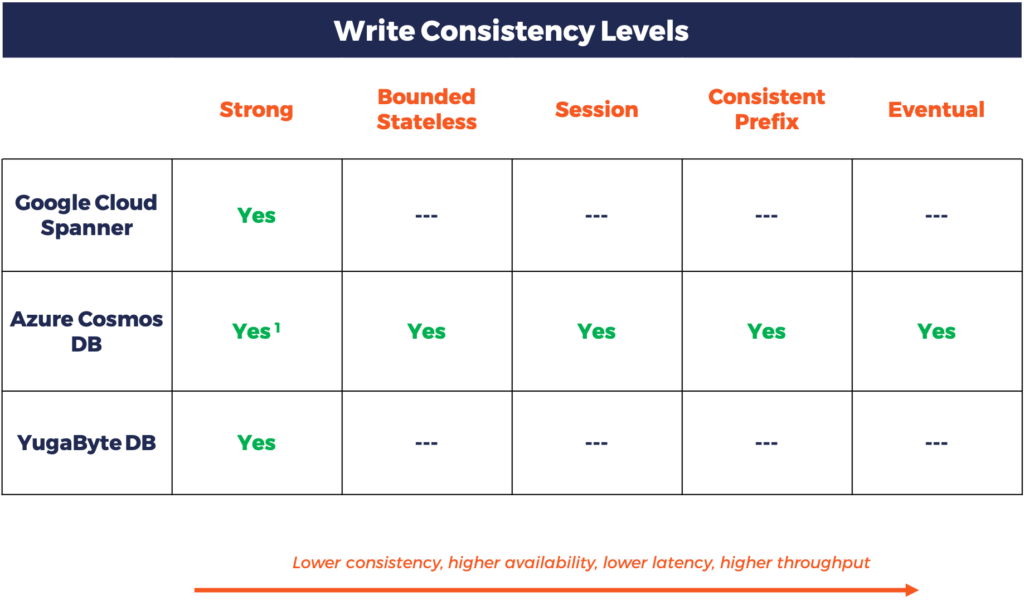
This ability to tune consistency is a powerful tool. For example, in our e-commerce application, the read request that populates the product catalog can use a very weak consistency level for low latency, while the write request that finalizes an order would demand a much stronger one.
The following paper provides a good high-level overview of these architectural patterns and mentions tunable consistency as a key design principle.
[PDF] Architecting Data Consistency in Distributed Cloud Systems
This paper summarizes many of the concepts we've discussed and provides a high-level view of how they fit together in modern architectures.
Please skim these sections to see how the concepts fit together: The section on Architectural Models contrasts centralized (leader-based, strong consistency) with decentralized (leaderless, weaker consistency) and hybrid models. The Case Studies section explicitly contrasts Spanner (strong) with Dynamo/Cassandra (tunable). The Discussion section concludes that "no single consistency model is universally optimal" and highlights the value of adaptive, hybrid models.
Conclusion
This lesson completes our foundational module on consistency. You have moved from defining individual models to building a strategic framework for applying them.
Here are your key takeaways:
- PACELC is a more comprehensive model than CAP for real-world system design because it accounts for the critical trade-off between latency and consistency during normal operation.
- The choice of a consistency model is a business decision driven by user experience, performance needs, and correctness requirements. A PA/EL system prioritizes responsiveness, while a PC/EC system prioritizes correctness.
- The consistency model dictates the underlying architecture. PC/EC systems typically rely on centralized coordination and consensus algorithms (like Paxos/Raft), whereas PA/EL systems favor decentralized, leaderless designs.
- Modern systems are often hybrid, allowing for tunable consistency. A principal engineer must analyze an application's different workflows and choose the appropriate consistency level for each, rather than applying one model to the entire system.
You now have a robust framework for reasoning about one of the most fundamental challenges in distributed systems. When you chose the "PC/EC" path for our stock trading example, you implicitly decided that you need a mechanism for a group of servers to come to an ironclad agreement. This mechanism is consensus.
In our next module, we will dive deep into this topic, starting with the most foundational consensus protocol of all. Our next lesson will be to trace the execution of single-decree Paxos, the algorithm that started it all and serves as the theoretical underpinning for many of the strongly consistent systems you will encounter and build.