Introduction
Welcome to the final lesson of our module on Advanced Distributed Transactions. Over the last few lessons, we have explored the machinery of strong consistency, from the blocking nature of Two-Phase Commit (2PC) to the safety guarantees of distributed locks and fencing tokens as implemented in Google's Chubby. We've seen that achieving strong guarantees in a distributed environment is complex and costly.
In this lesson, we will synthesize this knowledge to address a fundamental question in distributed systems design: for a given business process, should you use a distributed transaction, or is an eventually consistent approach sufficient? This is not just a technical question; it's a strategic one that directly impacts a system's architecture, performance, user experience, and operational complexity. As a Principal Engineer, your ability to navigate these trade-offs and justify your choices based on business requirements is a critical skill. Our goal today is to build a robust mental framework for making these crucial architectural decisions.
1. The Consistency-Availability Trade-off Revisited
The choice between strong and eventual consistency is fundamentally a trade-off. At one end, we have strong consistency models like linearizability, which provide the illusion of a single, up-to-date copy of the data. At the other, we have eventual consistency, which prioritizes availability and performance by allowing replicas to be temporarily out of sync.
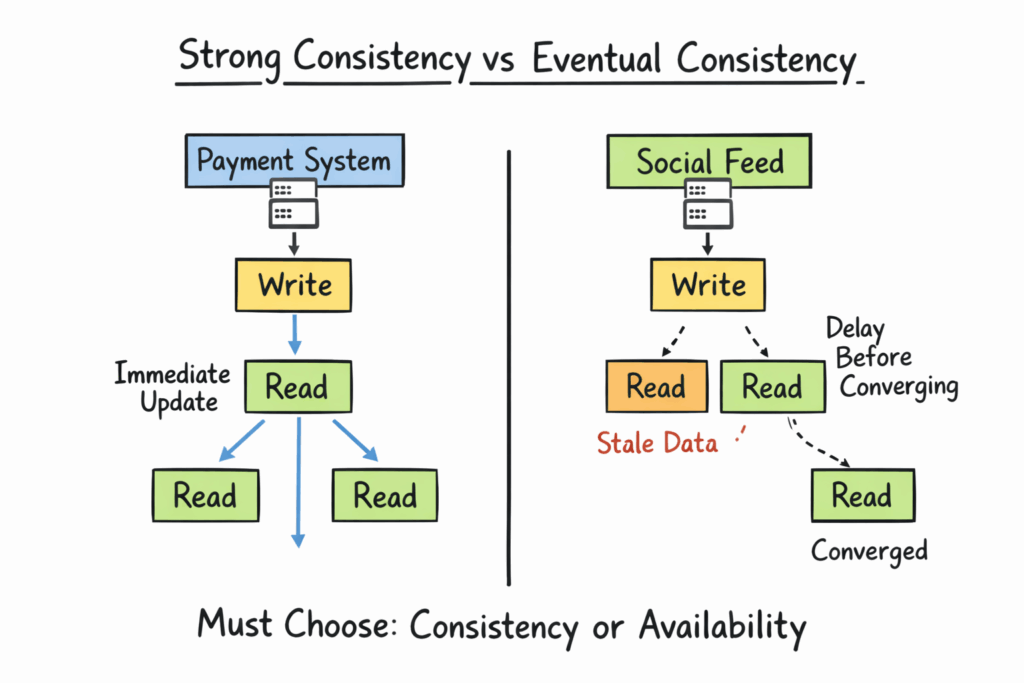
This choice is dictated by the constraints of the CAP and PACELC theorems. As a brief refresher from our first module:
- CAP Theorem: In the presence of a network Partition, a system must choose between Availability and Consistency. Since network partitions are a fact of life in distributed systems, the real choice is between CP (consistent but potentially unavailable during a partition) and AP (available but potentially inconsistent).
- PACELC Theorem: This extends CAP by considering normal operation. It states that if there is a Partition, a system chooses between Availability and Consistency; Else (during normal operation), it chooses between Latency and Consistency.
A database like Google's Spanner is a PC/EC system: it prioritizes consistency over availability during partitions and over latency during normal operation. In contrast, Amazon's Dynamo is a PA/EL system: it prioritizes availability and low latency, accepting eventual consistency.
To dive deeper into how these theoretical constraints manifest in real systems, the following article provides an excellent analysis.
Consistency Models Deep Dive: From ACID to Eventual Consistency ...
This article provides concrete examples of how major companies make CAP and PACELC trade-offs based on their business priorities.
Please read the following two sections: CAP Theorem: Focus on the examples of Amazon (choosing Availability) versus Banks (choosing Consistency). Notice how the choice isn't system-wide but depends on the specific service (e.g., e-commerce payment vs. product catalog). PACELC Theorem: Then, read the section on PACELC, paying attention to how it analyzes a system's behavior during both partitions and normal operation.
This reading reinforces a key principle: the choice of consistency model is not monolithic. A single product like an e-commerce platform will make different choices for different business processes. The payment and inventory systems may require strong consistency, while product recommendations and user reviews can thrive with an eventually consistent model.
2. A Framework for Decision-Making
To make an informed choice, you must analyze the business process through several lenses. Here is a framework of questions to guide your evaluation.
Question 1: What is the impact of temporary inconsistency?
This is the most critical question. Analyze the consequences of a user or another system observing stale data or an intermediate state. Consider the impact on three key areas: functional correctness, system reliability, and user experience.
The following video provides excellent, concise examples that illustrate this line of questioning.
Eventual Consistency vs. Strong Consistency | How to decide between the two in System Design
This video by the "Think Software" channel walks through several system design scenarios to analyze the impact of choosing eventual consistency.
Please watch the following segments: Initial Framework: Start with the introduction from the core idea, which frames the decision around reliability, functional correctness, and user experience. TinyURL: Watch the analysis of the TinyURL service from this example. Why would eventual consistency be a functional failure here? Twitter Likes: Now, consider the Twitter likes count example from this segment. Why is eventual consistency acceptable, and what performance problems does strong consistency introduce? Amazon Inventory: Finally, watch the inventory management example from this case. What is the severe business impact of eventual consistency in this scenario?
As the video demonstrates:
- High Impact (Requires Strong Consistency): For a payment system, inventory management, or a URL shortener, inconsistency leads to direct failures. A URL that returns a 404 right after creation is a broken feature. Selling an item that is out of stock creates a significant customer service problem and breaks business logic. In these cases, the cost of inconsistency is high, mandating a strongly consistent approach (e.g., using transactions).
- Low Impact (Allows Eventual Consistency): For a social media likes counter, view counter, or recommendation engine, the impact of temporary staleness is negligible. Seeing 99 likes instead of 100 for a few seconds does not break the feature or degrade the user experience in a meaningful way. Here, the benefits of higher availability and lower latency from an eventually consistent approach outweigh the need for perfect real-time accuracy.
Question 2: Can the business process tolerate compensating actions?
In a microservices architecture, implementing serializable distributed transactions with protocols like 2PC is often avoided. As you've seen in your own work and as we've discussed, these protocols create tight coupling and are brittle; the failure of one service can halt progress across the entire transaction.
Martin Kleppmann explains this challenge and the common alternative: eventual consistency implemented via application-level recovery logic.
"Transactions: myths, surprises and opportunities" by Martin Kleppmann
In this segment of his talk, Kleppmann explains why atomic commit protocols are operationally challenging in microservices and what patterns are used instead.
Please watch the following two segments: First, watch the section on transactions across services. Understand why protocols like two-phase commit are seen as making systems brittle and are generally avoided. Next, watch his explanation of the alternatives from compensating transactions. Pay attention to the idea of "apologizing" to customers and implementing rollbacks at the application level.
This leads to a crucial evaluation point. Instead of preventing inconsistencies up-front with a transaction, can you detect them after the fact and correct them?
- Yes (Saga pattern fits): For a trip booking service involving flights, hotels, and car rentals, a SAGA pattern is a classic fit. If the flight and hotel book successfully but the car rental fails, you don't roll back the entire world state. Instead, you execute compensating transactions: cancel the hotel and then the flight. The system is temporarily inconsistent (flight booked, but no complete trip) but eventually converges to a consistent state (no bookings). This requires that each step of the process is retractable.
- No (Transactions are necessary): For a financial transfer between two accounts at different banks, a compensating action is not a viable option. You cannot simply "undo" a transfer that has already been communicated to an external banking network. The transfer must be atomic: it either successfully completes at both ends or fails and leaves no trace. This mandates a protocol like 2PC.
Question 3: What is the nature of the operations and data?
The characteristics of the data itself and the operations performed on it can provide strong hints about the appropriate consistency model. Some data and operations are inherently easier to manage in an eventually consistent world.
A powerful concept here is designing operations to be associative, commutative, and idempotent (ACID 2.0). If operations have these properties, they can be applied in any order, multiple times, at different replicas, and still converge to the same result.
A practical application of this is Conflict-Free Replicated Data Types (CRDTs). A simple counter that only increments is a basic CRDT. Replicas can receive increments in different orders, but the final sum will be the same everywhere.
The following presentation offers a brilliant taxonomy for classifying domain data, which can guide your decision.
Eventual Consistency – Don't Be Afraid!
This InfoQ presentation by Werner Braun provides advanced strategies for designing systems that work well with eventual consistency.
Please read the following sections: Domain Operation Design: Start with this section, which introduces the "ACID 2.0" principle and the CRDT example of Amazon's shopping cart. Domain Data Design: This is the key part. Read this section carefully. Understand the taxonomy of "trivial" data (immutable, derived, single-updater) versus "non-trivial" data. Best Practices: Finally, review the best practices. Notice the recommendation to separate domain objects into different aggregates based on their classification in the taxonomy.
This gives us another powerful tool. When analyzing a business process:
- Identify data that is immutable (e.g., logs, events, historical records), derived (e.g., analytics reports), or has a single writer (e.g., a user's own profile settings). This data is "trivial" to manage under eventual consistency because update conflicts are rare or impossible.
- For data that is mutable and has multiple writers (e.g., inventory counts, collaborative documents), the choice is harder. These "non-trivial" aggregates are stronger candidates for strong consistency, unless you can model the operations as commutative (like the Amazon cart union example) or the business can tolerate resolving conflicts.
3. Synthesis: Applying the Framework
Let's put it all together. The choice is not binary; it's a spectrum. The diagram below shows how different patterns fit on this spectrum, trading consistency for performance and availability.

Your task as an architect is to analyze the business requirement and place it on this spectrum.
Decision Checklist:
-
Assess Business Impact:
- High Impact of Inconsistency? (e.g., financial ledger, inventory) -> Lean towards Strong Consistency (2PC, Paxos Commit).
- Low Impact of Inconsistency? (e.g., social media likes, view counts) -> Lean towards Eventual Consistency (SAGA, Event Sourcing, Asynchronous replication).
-
Evaluate Retractability:
- Are operations difficult or impossible to undo? (e.g., firing a missile, completing a stock trade) -> Requires Strong Consistency.
- Can failed steps be compensated for? (e.g., canceling a flight booking) -> Eventual Consistency (SAGA) is a good candidate.
-
Analyze Data & Operations:
- Is the data immutable, derived, or single-writer? -> Eventual Consistency is often a safe and performant choice.
- Is the data frequently updated by multiple actors? (e.g., a hot inventory item) -> High contention. Strong consistency with transactions will be slow (due to locking/aborts). Evaluate if the business can tolerate an eventually consistent model (e.g., "apologize" for overselling) or if you must pay the performance price for correctness.
-
Consider the User/System Experience:
- Does the user expect to read their own write immediately? (e.g., updating their profile name) -> This requires at least Session Consistency (a form of eventual consistency).
- Is the process entirely backend with no immediate user feedback? (e.g., generating a nightly report) -> Eventual Consistency is almost certainly fine.
By systematically working through these questions, you move from a gut feeling to a defensible architectural decision rooted in business needs and technical realities.
Conclusion
This lesson concludes our deep dive into coordinating state across a distributed system. We've moved from the internals of transaction protocols and locks to the high-level strategic decisions that drive system architecture.
The key takeaways are:
- The choice between distributed transactions and eventual consistency is not a purely technical one; it is driven by business requirements and risk tolerance.
- A robust decision framework involves analyzing the impact of inconsistency, the retractability of operations, the nature of the data, and the required user experience.
- Strong consistency, often implemented with transactions, is necessary when correctness is paramount and inconsistencies have high business costs (e.g., financial systems, inventory).
- Eventual consistency is a powerful pattern for achieving high availability and performance when the business process can tolerate temporary staleness and/or has mechanisms for compensation (e.g., social media, trip booking sagas).
- This is not a system-wide choice. A complex application will almost always be a hybrid, using strong consistency for its critical core and embracing eventual consistency for less critical, high-volume, or latency-sensitive features.
This marks the end of the "Advanced Distributed Transactions" module. You now have a comprehensive view of the spectrum of coordination strategies, from globally consistent transactions in Spanner to eventually consistent patterns like SAGA.
In our next module, "Large-Scale Data Processing Paradigms," we will shift our focus from coordinating state mutations to processing enormous volumes of data. We'll begin by analyzing the seminal MapReduce paper, the paradigm that enabled Google to process web-scale datasets and laid the foundation for modern big data analytics.