Welcome back. In our previous lessons, we concluded our deep dive into the original Google File System, culminating in an analysis of its robust fault tolerance mechanisms. We saw how GFS was a masterclass in designing for failure, but we also hinted that its architecture, particularly the single master, had inherent limitations. As Google's services and data footprint grew exponentially, the design principles that made GFS successful for batch workloads began to present bottlenecks.
Today, we'll explore the next chapter in Google's storage journey. Our goal is to describe the evolution from GFS to Colossus and key architectural improvements. This lesson is about more than just a technical upgrade; it's a case study in how a hyper-scale system is re-architected to break through scaling barriers and support a much wider, more demanding set of applications. For anyone aspiring to a Principal Engineer role, understanding this kind of strategic technical evolution is paramount.
The Scaling Pains of a Pioneer
GFS was a monumental success, but its design assumptions, tailored for large file, append-heavy, batch-oriented workloads, created challenges as Google's application ecosystem diversified. Several key limitations emerged.
[PDF] Storage Architecture and Challenges | Google Cloud
This concise summary from a Google presentation directly lists the key "lessons" learned from operating GFS at scale. These lessons were the primary drivers for designing its successor.
Under the heading "Storage Software: GFS", please read the bulleted list labeled GFS lessons. Pay close attention to the stated limits on file counts, latency, and management overhead.
As you just read, the GFS architecture faced three fundamental issues:
- The Single Master Bottleneck: The GFS master stored all file system metadata in its memory. While this made lookups incredibly fast, it placed a hard ceiling on the number of files a single GFS cluster could manage (cited as ~50 million files). Furthermore, all metadata operations (creates, deletes, renames) had to go through this single machine, creating a throughput bottleneck for applications with high metadata operation rates. For a system aspiring to store the world's information, this was a critical constraint.
- Latency Unsuitability for Interactive Services: The design, including the interaction with a single master for metadata, was not optimized for the low-latency requirements of interactive, user-facing services. GFS excelled at streaming reads for large files in MapReduce jobs, but it was less suited for applications that needed rapid access to many small files, like those common in Gmail or Google Photos.
- Management and Efficiency Overheads: The 3x replication strategy, while simple and robust, carried a 200% storage overhead. As data volumes scaled into many petabytes, this became a significant cost factor. Additionally, the scaling limits of the master meant that many independent GFS clusters had to be deployed and managed, adding operational complexity.
These challenges made it clear that a next-generation file system was needed—one that could retain GFS's durability and scale but break free from its architectural bottlenecks.
Colossus: A Radically Scalable Successor
Colossus is the next-generation distributed file system that replaced GFS. It was redesigned from the ground up to address the limitations of its predecessor and serve as the foundational storage layer for virtually all of Google's products, from Search and YouTube to the entire Google Cloud Platform.
The single most important architectural change in Colossus was the complete decentralization of metadata management.
Key Improvement 1: Distributed Metadata
Instead of a single, monolithic master, Colossus implements a scalable, distributed metadata model. This change alone shattered the scaling barriers of GFS.
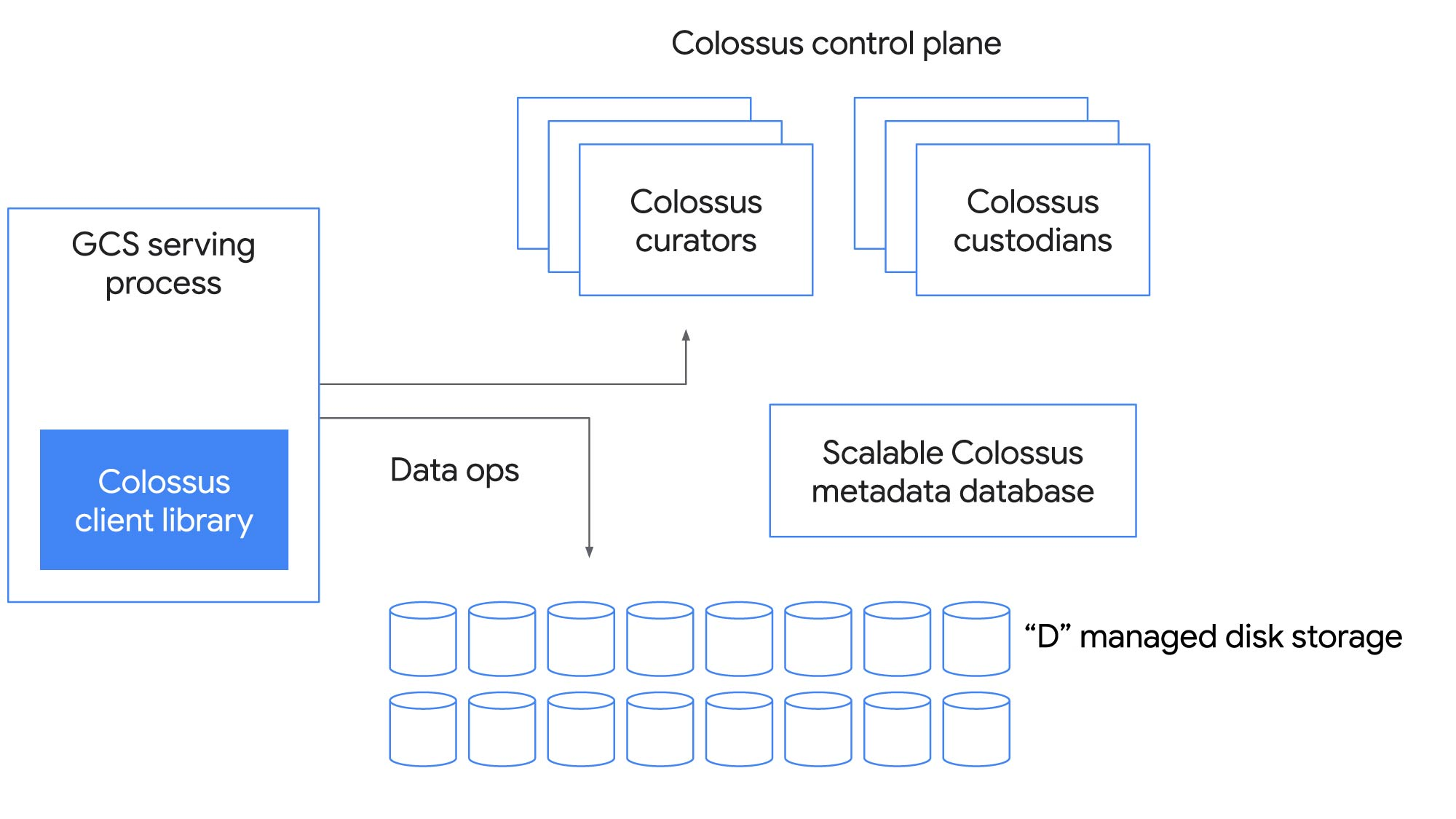
The new control plane consists of two main components:
- Metadata Database: All file system metadata (e.g., file names, permissions, block locations) is no longer held in a single server's memory. Instead, it's stored in Google's high-performance, scalable NoSQL database—Bigtable. By offloading metadata storage to a database that is itself horizontally scalable, Colossus effectively removed the limit on the number of files it could manage.
- Curators: These are stateless servers that act as the new "masters." A client wanting to perform a metadata operation (like creating a file) communicates with a Curator. Because the state is in Bigtable, many Curators can operate in parallel, each handling a subset of the metadata. This horizontal scaling of metadata servers solved the GFS master's throughput bottleneck. If metadata load increases, Google can simply add more Curators.
A peek behind Colossus, Google's file system | Google Cloud Blog
This blog post provides an excellent overview of the Colossus architecture and its key components.
Start by reading the section Colossus in a nutshell. Then, continue to the descriptions of the components, focusing on the roles of the Curators and the Metadata database. Note the explicit motivation to solve GFS scaling limits by using Bigtable.
Key Improvement 2: Enhanced Efficiency
Colossus introduced more sophisticated techniques to improve both storage and operational efficiency, directly impacting cost and performance at scale.
Erasure Coding:
GFS's 3x replication is a form of replication-based redundancy. Colossus made a fundamental shift towards using erasure coding, specifically Reed-Solomon (RS) codes.
- In a typical RS configuration, like RS(10, 4), a block of data is split into 10 data "shards," and 4 parity "shards" are computed. The 14 total shards are stored on different servers. The system can tolerate the loss of any 4 of these 14 shards and still reconstruct the original data.
- This approach provides higher durability than 3x replication but with much lower storage overhead. An RS(10,4) scheme has a overhead (or 40%), a dramatic improvement over the 200% overhead of 3x replication. Given Google's exabyte-scale storage, this translates to massive cost savings.
Hot/Cold Data Tiering:
Colossus is intelligent about data placement. It recognizes that not all data is accessed with the same frequency.
- Hot Data: Newly written or frequently accessed data is placed on high-performance, low-latency flash storage (SSDs).
- Cold Data: As data ages and is accessed less frequently, Colossus background processes automatically migrate it to cheaper, high-density, but slower hard disk drives (HDDs).
This automated tiering ensures that expensive, high-performance storage is used for the data that needs it most, while bulk data resides on more cost-effective media, optimizing the price-performance of the entire system.
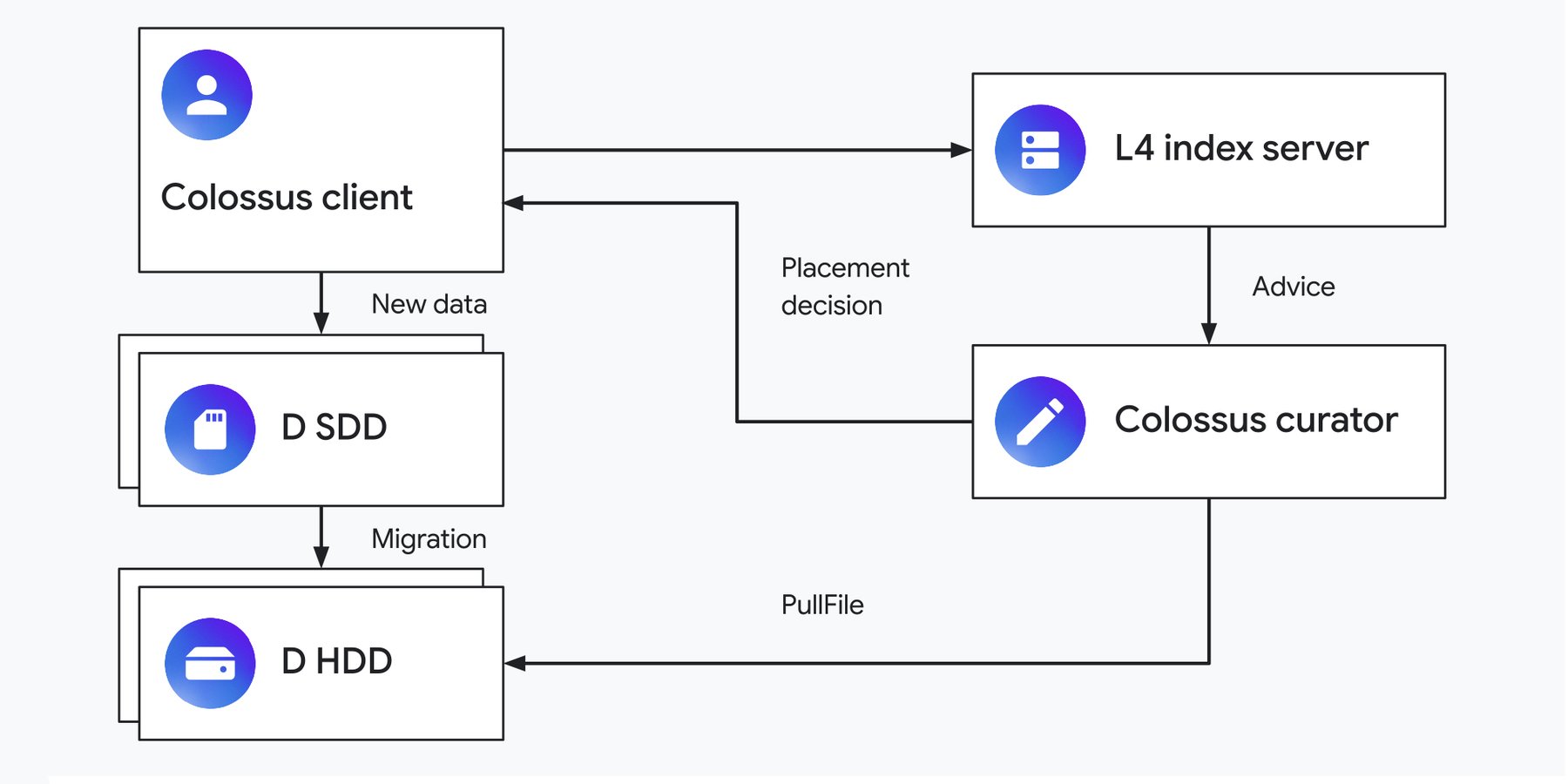
Key Improvement 3: Client-Side Intelligence
In Colossus, the client library became significantly more sophisticated. While the GFS client was relatively thin, the Colossus client takes on responsibility for complex logic, such as implementing the software RAID (erasure coding) mentioned above. When writing data, the client itself calculates the parity shards and writes all data and parity shards to the storage servers (called "D" servers) directly.
This design choice—pushing complex logic to the client—is a recurring pattern in large-scale systems. It allows the core storage service to remain simpler while enabling application-specific trade-offs. Different applications using Colossus can use different client libraries with different encoding schemes (e.g., some might still use 3x replication for very low latency, while others use aggressive erasure coding for archival).
Conclusion
The transition from GFS to Colossus represents a critical evolutionary step in distributed storage design, driven by the need to support a broader workload mix at an unprecedented scale. GFS was a brilliant, specialized solution for its time, while Colossus is a generalized, hyper-scalable platform that forms the bedrock of Google's modern infrastructure.
Here are the key takeaways from this evolution:
- Overcoming the Master Bottleneck: Colossus replaced the single GFS master with a distributed control plane consisting of stateless Curators and a scalable metadata database (Bigtable), eliminating bottlenecks in both file count and metadata operation rate.
- Improving Storage Efficiency: It moved from a standard 3x replication model to more space-efficient erasure coding (Reed-Solomon), dramatically reducing storage overhead and cost.
- Optimizing Performance and Cost: Colossus implements automatic data tiering, placing hot data on SSDs and migrating cold data to HDDs, maximizing performance where needed and minimizing cost elsewhere.
- Empowering the Client: A significant amount of logic, including RAID calculations, was pushed into the client library, allowing for greater flexibility and application-specific trade-offs.
We've now seen Google's approach to building a cluster-level file system, which began with a centralized master (GFS) and evolved into a logically centralized but physically distributed model (Colossus). In our next lesson, we will shift our focus to a completely different design philosophy. We will analyze the Amazon Dynamo paper's design choices, which famously popularized a fully decentralized, "masterless" architecture. This will provide a powerful contrast and deepen your understanding of the fundamental trade-offs in distributed storage design.