Welcome to the next step in our exploration of foundational distributed storage. In previous lessons, we analyzed the architectures of GFS/Colossus and Amazon's Dynamo. You saw how GFS relies on a centralized master for metadata management to orchestrate a vast number of chunkservers, and how Dynamo embraces a radically decentralized, peer-to-peer model to prioritize availability.
Today, we will synthesize this knowledge. The goal is not just to list the differences between these two seminal systems, but to compare the GFS-style centralized metadata approach versus the Dynamo-style decentralized approach as fundamental architectural patterns. Understanding the trade-offs inherent in each is a critical skill for designing and evaluating systems at a Principal Engineer level. We will build a framework that allows you to determine which philosophy is better suited for a given problem, a key aspect of technical strategy.
The Great Divide: Centralized vs. Decentralized
At the heart of the difference between the GFS and Dynamo architectures lies a single, fundamental question: Where does the system's metadata live? The answer dictates nearly every other aspect of the system, from consistency and availability to scalability and operational complexity.
-
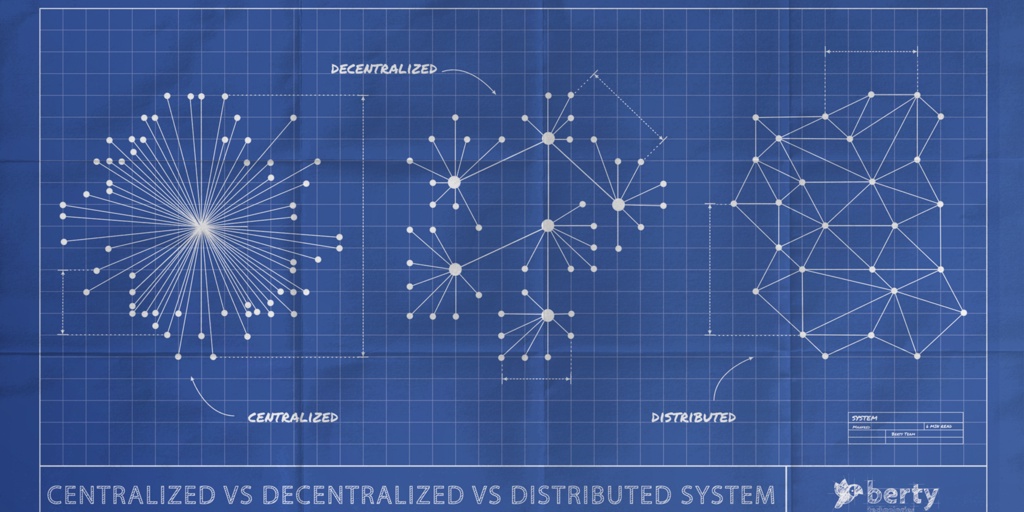
Centralized Metadata (GFS-style): A logically single entity, the master, holds the authoritative knowledge of the system's state. It knows which data (chunks/tablets) lives on which data nodes (chunkservers/tablet servers). A client must consult this central authority to locate data. While the master itself can be made fault-tolerant using consensus protocols (like Paxos in Chubby), it remains a single logical point for metadata operations.
-
Decentralized Metadata (Dynamo-style): There is no master. Metadata about data location is distributed across all nodes in the system. Each node has a partial but sufficient view of the system (the "ring") to route a request to its peers. This collective knowledge is updated and kept eventually consistent via peer-to-peer gossip protocols.
This image provides a classic visual shorthand for these network topologies.
To formalize this comparison, we will draw on an academic paper that categorizes and analyzes these exact architectural patterns.
[PDF] Comparison of Distribution Technologies in Different NoSQL ...
This paper provides an excellent framework for categorizing distributed databases. We will focus on its classification of "Master-Slave Systems" (which corresponds to the GFS/BigTable approach) and "Ring Systems" (the Dynamo approach).
Please read the following sections to understand the core characteristics of each category: Start with a brief look at the description of Google BigTable in Section 2.2, from the beginning of the section. This will serve as a good refresher on the centralized model. Next, read the sections that define and compare the architectural patterns. Focus on Section 4.2, "Ring Systems" (p. 43) and Section 4.3, "Master-Slave Systems" (p. 44). Pay close attention to the subsections on Failure Situation and Consistency Model for each. Finally, review Table 4.3 on page 47, which provides a concise summary of the differences.
The paper you just read provides a structured way to think about these systems. Let's expand on that framework and build a comprehensive comparison across several critical dimensions.
An Architectural Trade-off Analysis
Here is a side-by-side comparison of the two architectural philosophies.
| Dimension | Centralized Metadata (GFS/BigTable) | Decentralized Metadata (Dynamo) |
|---|---|---|
| Request Routing | Client asks Master for data location, then talks to Data Node. Client caches locations. | Client can ask any node. The contacted node acts as a coordinator, using its local ring info to find the right peers. |
| Consistency | Stronger by default. The Master can serialize metadata operations and acts as a single source of truth. | Eventual by default. Optimized for availability. Consistency is "tunable" via N,R,W parameters. |
| Availability | Lower. The Master is a Single Point of Failure (SPOF). If it's down, metadata operations (e.g., finding a file) halt. | Higher by design. No SPOF. The system is "always writable." Uses sloppy quorum and hinted handoff to tolerate failures. |
| Scalability | Metadata is a bottleneck. Scaling the Master is a major challenge (this led Google from GFS to Colossus). Adding data nodes is simple. | Incrementally scalable. Adding/removing nodes is handled peer-to-peer. Load is redistributed via consistent hashing. |
| Failure Handling | Master detects data node failures and re-replicates data. Master failure requires failover to a replica (a complex, critical event). | Nodes detect peer failure via timeouts. Gossip protocol propagates membership changes. System gracefully degrades. |
| Conflict Resolution | Conflicts are largely prevented at the source by the Master, which can lock resources or serialize access. | Conflicts are expected. They are detected during reads (using vector clocks) and resolved by the application. |
| Operational Complexity | Conceptually simpler global state. Debugging metadata issues can be easier. However, managing the high-availability Master is complex. | Difficult to reason about global state. Debugging emergent, system-wide issues (e.g., gossip loops, widespread version conflicts) is very hard. |
| Typical Use Case | Large-scale data processing, systems needing strong consistency, and as a foundation for higher-level structured storage (like Bigtable). | Services needing extreme write availability where eventual consistency is acceptable (e.g., shopping carts, user sessions, social media feeds). |
Let's delve deeper into a few of these trade-offs.
Consistency vs. Availability
This is the most famous trade-off, often discussed in the context of the CAP and PACELC theorems.
- A GFS-style system inherently prioritizes Consistency. By channeling metadata changes through a master, it can ensure that all clients see a consistent view of the namespace. If the master cannot coordinate with other components (e.g., during a network partition), it will choose to become unavailable rather than risk inconsistency.
- A Dynamo-style system explicitly chooses Availability. As the Dynamo paper famously states, for a service like a shopping cart, rejecting a customer's "add to cart" action is a worse outcome than potentially dealing with a data conflict later.
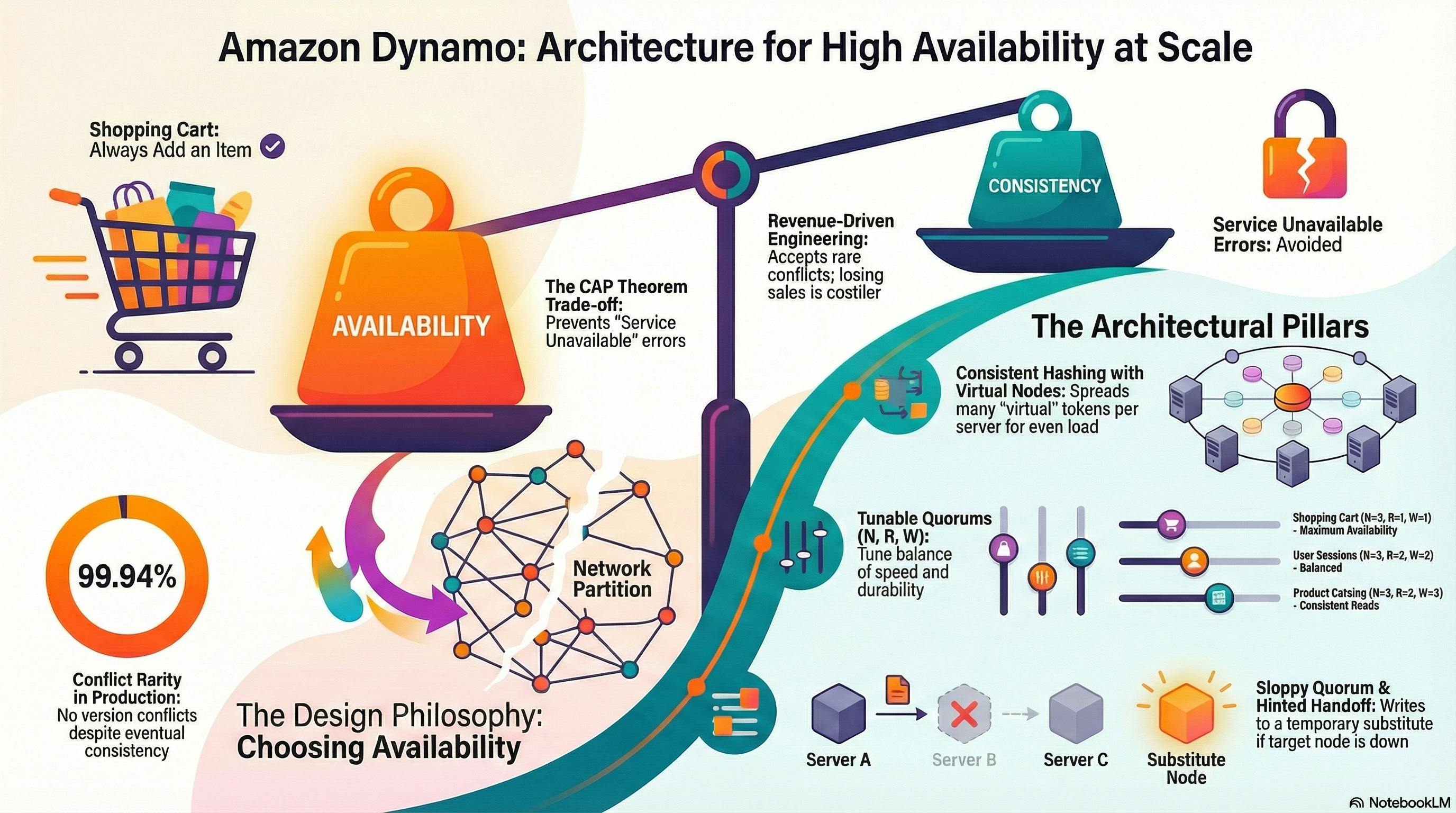
The choice to be "always writeable" in the Dynamo model forces the complexity of conflict resolution onto the read path and, ultimately, to the application. Vector clocks allow the system to detect conflicts, but it's the application that must perform semantic reconciliation—for example, merging two versions of a shopping cart.
Scalability and Bottlenecks
In a distributed system, any centralized component is a potential scalability bottleneck.
- In the GFS model, the master must handle metadata requests for every client operation. While clients cache this information, any cache miss or file creation requires talking to the master. As the cluster grows and the number of files/tablets runs into the millions, the master's memory and CPU become the limiting factor for the entire system's scale. This is precisely the problem Google solved by evolving GFS into Colossus, which shards the metadata layer itself.
- The Dynamo model is designed for seamless, incremental scalability. Because partitioning is handled by consistent hashing and membership is managed by gossip, new nodes can be added with minimal coordination. The work of bootstrapping a new node (transferring the appropriate key ranges) is distributed among its new neighbors on the ring, avoiding a "thundering herd" problem at a central coordinator.
The Principal Engineer's Choice: When to Use Which?
As a Principal Engineer, your role is not just to understand these patterns but to decide which one to apply. The choice is never about which is "better" in the abstract, but which is "fitter" for the specific problem's requirements.
You should favor a GFS-style centralized architecture when:
- Strong consistency is a primary requirement. If your application logic fundamentally depends on atomic operations, transactions, or a globally consistent view of data, a centralized coordinator is often the most direct way to provide these guarantees.
- The system needs to perform global coordination. Tasks like master election, distributed locking, or allocating strictly increasing transaction IDs require a single point of arbitration. This is what services like ZooKeeper or Chubby (which is built on Paxos) provide. Bigtable, for instance, is built on GFS but also uses Chubby for master election and to store the location of its root tablet.
- The metadata workload is manageable. If the number of objects is not astronomically high, or if the access patterns allow for very effective client-side caching, a centralized master may be perfectly adequate and simpler to manage than a fully decentralized system.
You should favor a Dynamo-style decentralized architecture when:
- Extreme availability (especially write availability) is non-negotiable. If the service must accept writes under almost any failure condition, a decentralized, "always writeable" model is the clear choice.
- The application can tolerate eventual consistency. If it's acceptable for reads to temporarily return stale data, you can gain tremendous benefits in availability and performance.
- The business logic can handle conflict resolution. This is a critical prerequisite. The application must be designed to merge divergent data versions. A shopping cart can merge items, but it's much harder to merge conflicting bank account balances.
- The workload consists of simple key-value operations. Decentralized systems are optimized for
get(key)andput(key)operations. They are generally not a good fit for complex queries, scans over multiple keys, or transactions.
Conclusion
Today we've moved from analyzing individual systems to comparing the architectural philosophies that underpin them. We have established a framework for contrasting the GFS-style centralized approach with the Dynamo-style decentralized one, rooted in how each manages system metadata.
Here are the key takeaways:
- Centralized Metadata (GFS/BigTable): Offers stronger consistency and a simpler programming model for developers at the cost of a potential single point of failure and a metadata scalability bottleneck. It prioritizes having a single source of truth.
- Decentralized Metadata (Dynamo): Offers extreme availability and seamless scalability at the cost of weaker consistency guarantees and increased operational complexity. It prioritizes being "always on," pushing conflict resolution to the application.
Understanding this fundamental trade-off is essential for senior-level system design. There is no universally correct answer; there is only the right architecture for a given set of requirements, constraints, and priorities.
In our next lesson, we will put this framework into practice. We will move from comparing these canonical systems to tackling design problems, where you will need to evaluate storage system design trade-offs for a given workload pattern.