Welcome back. In our previous lesson, we conducted a detailed comparison of Paxos and Raft, moving past the common platitudes to understand their fundamental design and implementation trade-offs. We saw that while their steady-state performance is similar, their approaches to leader election and failure recovery are distinct, making each suitable for different engineering contexts.
So far, we've focused on "clean" failures—nodes crashing or networks partitioning in predictable ways. In this lesson, we will venture into the messier, more insidious world of real-world system behavior. You will analyze the impact of gray failures such as slow nodes and clock drift on consensus protocol stability. Understanding these subtle failure modes is critical for building and operating reliable systems at Google's scale. For a Principal Engineer, the ability to diagnose issues that don't manifest as simple crashes is a hallmark of deep expertise.
The Achilles' Heel: Understanding Gray Failure
In an ideal world, components either work perfectly or fail completely and cleanly (a "fail-stop" model). In reality, systems often limp along in a degraded state. This is the essence of gray failure. These are not binary up/down events but partial, intermittent, and often subtle degradations that are notoriously difficult for standard monitoring to detect.
A superb overview of this problem comes from a review of the Microsoft Azure paper, "Gray failure: the Achilles' heel of cloud-scale systems."
Gray failure: the Achilles' heel of cloud-scale systems
This blog post by Adrian Colyer provides a concise summary of the key ideas from a seminal paper on gray failure, based on experiences from Microsoft Azure. It defines the problem, gives concrete examples, and explains why traditional fault-tolerance mechanisms are often ineffective.
Start by reading the introduction and the formal definition. Pay close attention to the concept of differential observability—this is the core of the problem. Next, review the real-world examples. These anecdotes from Azure perfectly illustrate how gray failures manifest and cause major incidents, from paradoxically lower availability with more redundancy to cascading failures. Finally, read the section on why standard mechanisms fail. This directly connects to our topic, explaining why protocols like Paxos, which assume a fail-stop model, are vulnerable.
As the article makes clear, gray failure is a problem of perspective. The system's internal health checks (e.g., a heartbeat mechanism) report "healthy," while applications using the system experience timeouts and errors. Consensus protocols like Paxos and Raft were designed around the fail-stop assumption. When a component enters a gray failure state—for instance, a node becomes pathologically slow but doesn't crash—it violates this core assumption, leading to unexpected and severe stability problems.
Case Study 1: The Impact of a Slow Consensus Leader
Let's examine one of the most common and disruptive gray failures: a slow node. While a slow follower can reduce the fault-tolerance margin, a slow leader directly impacts the entire cluster's performance. It becomes a bottleneck, unable to process client requests or replicate log entries efficiently. Latency skyrockets, and throughput plummets.
Worse, simple timeout-based failure detectors may not replace the leader. The slow leader might still be sending heartbeats, just not frequently enough for good performance but just frequently enough to prevent followers from timing out and starting a new election. The system is left in a persistently degraded state.
This problem has led to new research on creating consensus protocols that are resilient to such slowdowns. A recent example is HoliPaxos, which integrates a slowdown detector directly into the consensus logic.
[PDF] Towards More Predictable Performance in State Machine Replication
This research paper proposes HoliPaxos, an enhanced version of MultiPaxos designed for more predictable performance. A key contribution is its integrated mechanism for detecting and handling leader slowdowns.
First, skim the Introduction (Section 1) to understand the paper's motivation: the unpredictability caused by "bolt-on" components like simple failure detectors. Read the description of the problem in Section 2.2.1. This succinctly frames why traditional detectors fail. Carefully study Section 3.2, Integrated Slowdown Detection. This is the core of their solution. Focus on how it works: the leader self-monitors the variance of its in-flight request queue using the CUSUM algorithm and triggers a graceful leadership change upon detecting a persistent anomaly. Note how it avoids false positives from simple workload increases. Finally, look at the experimental results in Section 4.4, particularly Figure 10, Slowdown Detection Performance.
The results from the HoliPaxos paper clearly illustrate the impact.
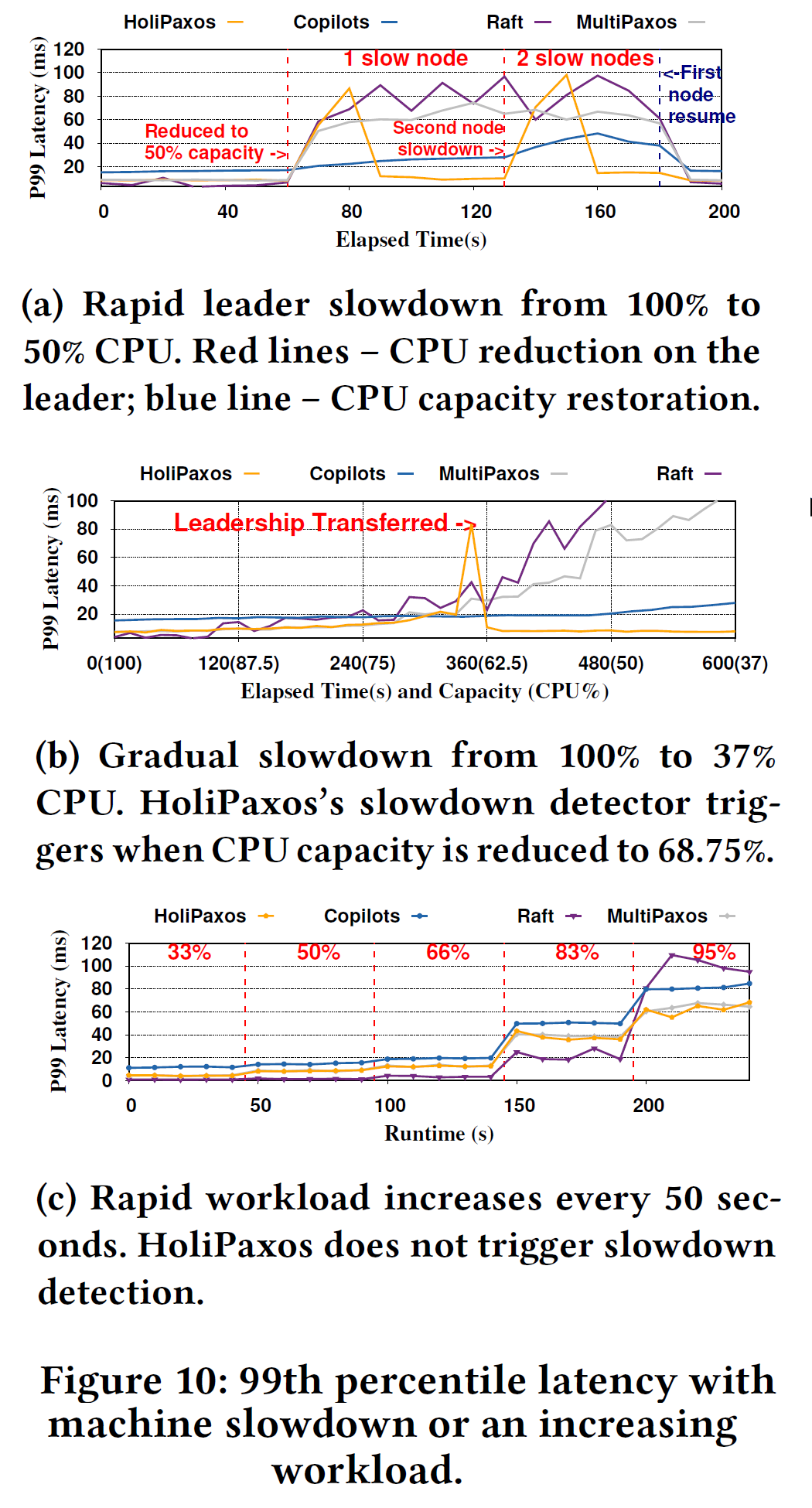
HoliPaxos demonstrates a powerful principle: to combat gray failure, the system's observability must be improved. Instead of a simple up/down signal, the leader uses a more sophisticated, multi-dimensional view of its own health (queue depth variance, throughput) to make an informed decision to abdicate leadership. This is a significant step beyond the simple timeout mechanisms in base Raft or bolt-on detectors for Paxos.
Case Study 2: The Trouble with Time and Clock Drift
Another critical gray failure is clock drift. The clocks on different computers are not perfectly synchronized. They are based on quartz crystal oscillators, and their frequency is affected by manufacturing variations and, significantly, temperature. A server in a hot rack can have its clock run noticeably faster or slower than its peers.
Martin Kleppmann provides an excellent primer on physical time and its pitfalls.
Distributed Systems 3.1: Physical time
This lecture explains the fundamentals of physical clocks in computers, the complexities of official time standards like UTC, and the dramatic impact that clock-related issues can have on distributed systems.
First, watch the segment on how physical clocks work. This covers quartz oscillators, their inaccuracies, and the concept of clock drift measured in parts-per-million (ppm). Next, watch the segment explaining UTC and the leap second. This is crucial. Pay close attention to the story of the 2012 incident, where a leap second caused a livelock in the Linux kernel, taking down major services. This is a perfect, real-world example of a clock-related gray failure. Finally, watch the short segment on leap second smearing. This describes the pragmatic solution adopted by Google and others.
How does this affect consensus?
- Timeouts: Raft's liveness depends heavily on timeouts for leader election. If a node's clock drifts too fast, it may time out prematurely and trigger disruptive, unnecessary elections. If its clock is too slow, it may fail to detect a legitimate leader failure in a timely manner.
- Leases: Many production consensus systems (including those at Google) use leases to improve stability. A leader is granted the exclusive right to lead for a specific duration. Clock drift can cause a node to believe a lease has expired when it has not, or vice versa. Without careful fencing mechanisms, this can lead to a "split-brain" scenario where two nodes believe they are the leader, violating safety.
The leap second problem is an extreme example of this. The incident described by Kleppmann highlights how a one-second discontinuity can introduce bugs that bring down entire systems. The solution, "leap smearing," is a classic example of Google-style pragmatic engineering. Instead of handling the one-second jump, Google's NTP servers "smear" the extra second by telling a lie: they slow down the clocks by a minuscule amount over a 24-hour window. The clocks never experience a discontinuity, and the software remains blissfully unaware. This prioritizes system stability over perfect timekeeping accuracy, a critical trade-off for global-scale infrastructure.
Conclusion
In this lesson, we explored the challenging domain of gray failures and their impact on consensus protocols. We've moved beyond simple crash models to the subtle, partial failures that are a primary cause of major outages in modern distributed systems.
Here are your key takeaways:
- Gray failures are subtle, degraded performance states that are difficult to detect with traditional binary health checks, due to "differential observability."
- Consensus protocols like Paxos and Raft, which are built on a fail-stop assumption, can be destabilized by gray failures.
- Slow nodes, particularly slow leaders, act as performance bottlenecks. Advanced protocols like HoliPaxos address this by integrating sophisticated slowdown detectors that enable graceful failover.
- Clock drift undermines the timeout and lease mechanisms essential for liveness and stability in consensus. Extreme events like leap seconds can trigger catastrophic bugs.
- Pragmatic engineering solutions, like Google's leap smear, are employed to mitigate these clock-related risks in large-scale systems by prioritizing stability over absolute timekeeping accuracy.
We've now analyzed Paxos from its theory to its practical failure modes. This prepares us perfectly for our next lesson, where we will analyze the architecture of Chubby, Google's distributed lock service built on Paxos. We'll see how the theoretical concepts we've discussed were translated into one of the most foundational pieces of Google's infrastructure.