Welcome to your first lesson in our "Introduction to Formal Philosophy" course. Given your extensive background in physics and mathematics, you're accustomed to working within structured, logical systems. Philosophy, at its core, shares this emphasis on rigorous argumentation. This first module is designed to equip you with the fundamental tools for dissecting and evaluating those arguments.
Today, we will focus on the most foundational skill of all: how to read a philosophical text and identify its essential components. By the end of this lesson, you will be able to pinpoint the thesis (or conclusion), the premises (the reasons supporting that thesis), and the overall argumentative structure within a passage. This skill is the bedrock upon which all further philosophical analysis is built.
What is an Argument?
In everyday language, an "argument" often implies a dispute or a quarrel. In philosophy and logic, the term has a precise, technical meaning. A philosophical argument is a structured attempt to persuade a reader of the truth of a particular claim by providing rational support.
To get a formal definition, let's start with a short video from an Oxford University course on critical reasoning.
This video, from a lecture by Marianne Talbot, provides a clear and accessible definition of what constitutes an argument in the philosophical sense. It also introduces the key terms we'll be using throughout this course.
Please watch the first part, which provides the core definition: What is an argument?. Then, continue with the next segment which defines our key terms for today: Premises and Conclusion.
As the video explains, an argument is composed of two parts:
- Conclusion: The single statement that the argument is intended to establish as true. This is the main point, or the thesis, of the argument.
- Premises: The statements offered as reasons or evidence in support of the conclusion. An argument can have one or many premises.
A key insight from the video is that "premise" and "conclusion" are functional roles. A sentence is not intrinsically a premise or a conclusion. The same statement could serve as a conclusion in one argument and a premise in another. What matters is the role it plays within a specific argumentative context.
This relationship is often represented in a "standard form," which clarifies the structure:
(P1) Premise 1
(P2) Premise 2
...
(C) Therefore, Conclusion
For a quick summary of these ideas in text, you can refer to the first page of the following guide.
How to Read a Philosophical Text?
This guide from LMU's Research Center for Neurophilosophy provides a concise definition of a philosophical argument and its components.
Focus on the first page, under the headings "Key Features of Philosophical Texts" and the provided example. Notice how the argument is broken down into its premises (P1, P2) and conclusion (C).
Distinguishing Arguments from Non-Arguments
A crucial part of analyzing a text is recognizing what is part of an argument and what isn't. Philosophical writing contains more than just premises and conclusions; it also includes explanations, descriptions, asides, and assertions.
Arguments vs. Causal Explanations
One of the most common points of confusion is the difference between an argument and an explanation. Both often use the word "because," but for different purposes.
- An argument uses a "rational because." It provides reasons to believe that a conclusion is true.
- Example: "The streets are wet, because it has been raining." (The rain is my reason for believing the streets are wet).
- A causal explanation uses a "causal because." It states the cause of an accepted fact.
- Example: "The storm broke because the clouds formed and the sky blackened." (This isn't an argument for why the storm broke; it's an explanation of the physical causes).
Your scientific training constantly involves moving between seeking logical justification and identifying causal mechanisms. This distinction is just as vital in philosophy.
Watch this segment from the same Oxford lecture, where this exact distinction is discussed with examples.
This part of the lecture provides several examples and asks you to determine if they are arguments. Pay close attention to the discussion of the first example about the storm.
Watch the segment from Which are arguments?. Notice how the group analyzes the "witches float" example, correctly identifying the conclusion even though it appears at the beginning of the sentence.
Arguments vs. Assertions
Another important distinction is between an argument and an assertion, particularly a complex one like a conditional statement (an "if...then..." sentence).
- An argument must have at least one premise and one conclusion that are asserted as true.
- A conditional statement, like "If it is snowing, then the mail will be late," asserts only one thing: the relationship between the "if" part and the "then" part. It does not individually assert that it is snowing, nor that the mail will be late. Therefore, a conditional statement on its own is not an argument.
This next clip clarifies this point.
Here, the lecturer distinguishes between arguments and assertions. The analysis of the "if...then" sentence is particularly useful.
Watch the segment from Argument vs. Assertion.
Statement vs. Proposition
To refine our toolkit, we need one more distinction that will be critical as we move into formal logic. We need to separate the linguistic expression from its meaning.
- A statement is the actual sentence you read or hear—the specific sequence of words.
- A proposition is the underlying meaning or information content of that sentence.
For example, "It is raining," "Il pleut," and "Es regnet" are three different statements that all express the same proposition.
In logic, we are primarily concerned with the relationships between propositions, not the grammatical quirks of the statements used to express them. This is analogous to the distinction between syntax and semantics in formal languages and programming, where the goal is to operate on the meaning, not just the symbolic representation.
1.1 Basic Concepts: Arguments, Premises, & Conclusions
This video by Mark Thorsby introduces the important distinction between a statement and the proposition it expresses.
Watch the section from Statements vs. Propositions. This will be a foundational concept for our later work in logic.
How to Find the Conclusion and Premises
Now for the practical task: how do you find these components in a dense philosophical text?
Strategy 1: Look for Indicator Words
Philosophers often use signposts to guide the reader through their reasoning. These "indicator words" can signal whether a statement is functioning as a premise or a conclusion.
| Premise Indicators | Conclusion Indicators |
|---|---|
| since | therefore |
| because | thus |
| for | hence |
| as | so |
| given that | accordingly |
| for the reason that | consequently |
| inasmuch as | it follows that |
| as shown by | we may conclude |
Strategy 2: Ask "What is the Main Point?"
Sometimes, especially in complex prose, there are no indicator words. In this case, ask yourself: What is the single main idea the author is trying to convince me of? What is the ultimate "takeaway" of this passage? That's your conclusion. Everything else that provides a reason to believe that takeaway is a premise.
The video below provides a good overview of these practical strategies.
1.1 Basic Concepts: Arguments, Premises, & Conclusions
This segment offers a practical guide to identifying premises and conclusions using the two strategies we just discussed.
Please watch from How to find the conclusion.
Exercise: Reconstructing an Argument
Let's apply these skills to a real philosophical text. Below is a famous passage from the 18th-century philosopher David Hume.
Read the passage carefully, and then try to identify:
- The Conclusion: What is the main point Hume is arguing for?
- The Premises: What reasons does he provide to support this point?
Take any action allowed to be vicious: Willful murder, for instance. Examine it in all lights, and see if you can find that matter of fact, or real existence, which you call vice. In whichever way you take it, you find only certain passions, motives, volitions and thoughts. There is no other matter of fact in the case. The vice entirely escapes you, as long as you consider the object. You never can find it, till you turn your reflection into your own breast, and find a sentiment of disapprobation, which arises in you, towards this action. Here is a matter of fact, but it is the object of feeling, not of reason. It lies in yourself, not in the object. So that when you pronounce any action or character to be vicious, you mean nothing, but that from the constitution of your nature you have a feeling or sentiment of blame from the contemplation of it.
—David Hume, A Treatise of Human Nature
Take a moment to formulate your answer before moving on.
...
Ready? Now, let's work through it with a guided analysis from the UNC Writing Center. This resource provides a step-by-step reconstruction of the Hume passage.
Philosophy - The Writing Center
This guide offers a clear, practical demonstration of how to reconstruct an argument from a primary text.
Read the sections titled "Argument Reconstruction" and focus on Steps 1-7, which apply directly to the Hume passage. Compare their analysis of the conclusion and premises with your own. Then read the final prose summary to see how the pieces fit together.
As the analysis shows, Hume's argument can be summarized as follows:
- Conclusion: The "viciousness" (wrongness) of an action is not a property of the action itself, but rather a feeling of disapproval ("disapprobation") in the person observing it.
- Premise 1: When we examine a "vicious" act like murder, we don't find any objective "matter of fact" corresponding to "vice." We only see passions, motives, and thoughts.
- Premise 2: When we look inward, we do find a feeling of disapproval in ourselves toward the act.
- Implicit Premise/Sub-conclusion: Therefore, this feeling is what we must mean by "vice."
This process of identifying the conclusion and premises is called argument reconstruction. It is the single most important skill for reading philosophy.
Conclusion
In this lesson, we have established the foundational concepts for analyzing philosophical texts.
Key Takeaways:
- A philosophical argument consists of premises (reasons or evidence) that are offered in support of a conclusion (the main claim or thesis).
- These roles are functional; they depend on the context of the argument, not on the sentences themselves.
- Arguments must be distinguished from non-argumentative uses of language, such as causal explanations and simple assertions (including conditional "if...then" statements).
- You can identify an argument's components by looking for indicator words and by asking what the author's main "takeaway" is.
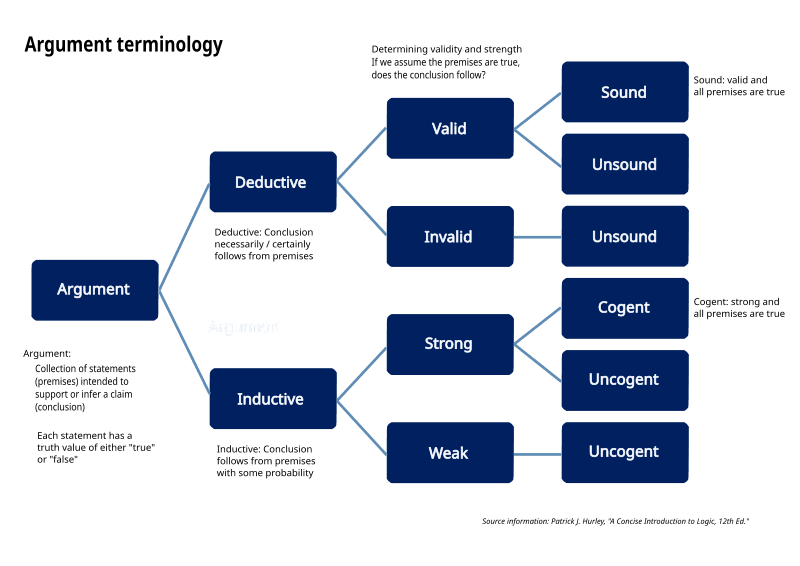
Preview of the Next Lesson:
Looking at the flowchart, you can see that arguments branch into two fundamental types: deductive and inductive. In our next lesson, we will explore this crucial distinction. We will ask: What does it mean for a conclusion to necessarily follow from its premises, versus just being made probable by them? Understanding this difference will open up the next level of argumentative analysis.