Welcome to your third lesson on political philosophy. In our previous discussions, we examined the arguments of Hobbes, who justified absolute monarchy as the only escape from a brutal state of nature, and Locke, who countered with a vision of limited government designed to protect pre-existing natural rights to life, liberty, and property. Locke's social contract was a pragmatic agreement to remedy the "inconveniences" of the state of nature.
Today, we turn to the third great social contract theorist, Jean-Jacques Rousseau (1712–1778). Rousseau found both Hobbes's absolutism and Locke's liberal constitutionalism inadequate. He believed that modern society, even a Lockean one, did not free people but rather wrapped their chains in "garlands of flowers." He poses a far more profound and challenging question: How can individuals unite in a political society while remaining truly free, obeying only themselves? This lesson will explore Rousseau's radical answer, which revolves around the celebrated and complex concepts of the general will and popular sovereignty.
1. From Natural Goodness to Civilized Chains
To understand Rousseau's political project, we must first grasp his unique diagnosis of the human condition. Unlike Hobbes, he does not see the state of nature as a "war of all against all." And unlike Locke, he doesn't see it as a mostly peaceable society of rational individuals. For Rousseau, primitive man is a solitary, non-rational, and peaceful creature, driven by self-preservation (amour de soi) and a natural compassion for the suffering of others (pitié). This is the famous "noble savage"—not noble in a moral sense, as morality doesn't yet exist, but good in that he is uncorrupted.
So, what went wrong? Rousseau's famous opening to The Social Contract provides the answer: "Man is born free, and everywhere he is in chains." The chains are forged by society itself. As people begin to live in communities, a new, corrosive psychological drive emerges: amour propre, or pride/vanity. This is the desire to be seen and esteemed by others, leading to comparison, competition, jealousy, and inequality. The invention of private property is the final nail in the coffin, leading to dependency, exploitation, and a fraudulent social contract (like the one Rousseau believes Locke describes) that legitimizes the power of the rich over the poor.
To get a clear picture of Rousseau's starting point, this short video offers a vivid portrait of his view of the state of nature and his fundamental critique of surrendering freedom.
Jean-Jacques Rousseau - The Social Contract | Political Philosophy
This video, "Jean-Jacques Rousseau - The Social Contract," offers a concise overview of Rousseau's foundational ideas.
Please watch the section covering Rousseau's view of natural liberty. Pay close attention to how his conception of the state of nature differs from that of Hobbes and Locke, and why he argues that renouncing freedom is equivalent to renouncing one's humanity.
2. The Fundamental Problem of Politics
Given that society is both necessary and the source of our corruption, Rousseau sets himself an ambitious task. He doesn't seek to return us to the woods but to find a legitimate form of political association that solves the problem of amour propre and dependence. He frames the problem in Book I, Chapter 6 of The Social Contract:
"To find a form of association which will defend and protect with the whole common force the person and goods of each associate, and in which each, while uniting himself with all, may still obey only himself, and remain as free as before."
This is the core challenge. How can you be subject to the authority of a state and yet obey only yourself? Rousseau rejects Hobbes's solution of absolute submission as the act of a madman, creating no rights or duties. He also finds Locke's solution of majority rule within a representative government insufficient, as the minority is still subject to the will of others.
The following lecture segment powerfully lays out this central problem and Rousseau's critique of his predecessors.
Jean-Jacques Rousseau's Philosophy
In "Jean-Jacques Rousseau's Philosophy," the lecturer unpacks the opening of The Social Contract and Rousseau's search for a legitimate form of political authority.
Watch the segment from Man is Born Free. This clip dissects Rousseau's famous opening line, his critique of both Hobbes's "right of the strongest" and Locke's majoritarianism, and culminates in his precise formulation of the problem that only the "general will" can solve.
3. The Solution: The General Will
Rousseau's solution to this seemingly impossible problem is the general will (la volonté générale). This is perhaps the most crucial and most contested concept in his philosophy.
The social contract, for Rousseau, is an act of total alienation of each associate, together with all his rights, to the whole community. This sounds like Hobbes, but there's a critical difference: you don't give your rights to a sovereign individual or group; you give them to the community of which you yourself are an equal member. In giving yourself to all, you give yourself to no one.
From this act of association, a new collective entity is formed—the sovereign. The will of this sovereign is the general will. It is not simply the sum of all individual, private wills (which Rousseau calls the "will of all"). Rather, it is the will that emerges when each citizen thinks not about their private interest, but about the common good.
- The Will of All: The aggregate of private desires. "I want lower taxes on my business." "I want a new park in my neighborhood."
- The General Will: The will for the common interest. "What tax policy is best for the entire community?" "What public works benefit everyone?"
The lecturer in the previous video provides an exceptionally clear example to distinguish these concepts.
Jean-Jacques Rousseau's Philosophy
Let's continue with the same lecture to demystify the general will.
Watch the segment explaining what the general will is. The lecturer first defines it by what it is not (consensus, majority rule, sum of private wills) and then uses the practical analogy of a university curriculum committee to show how a group can move from self-interest to a collective decision that all participants genuinely endorse as being for the best.
For the law to be an expression of the general will, it must have two features: generality of source (it must come from all the people) and generality of object (it must apply to all the people). It cannot target specific individuals. When you vote on such a general law, you ask yourself not "What's in it for me?" but "Is this proposal in conformity with the general will?"
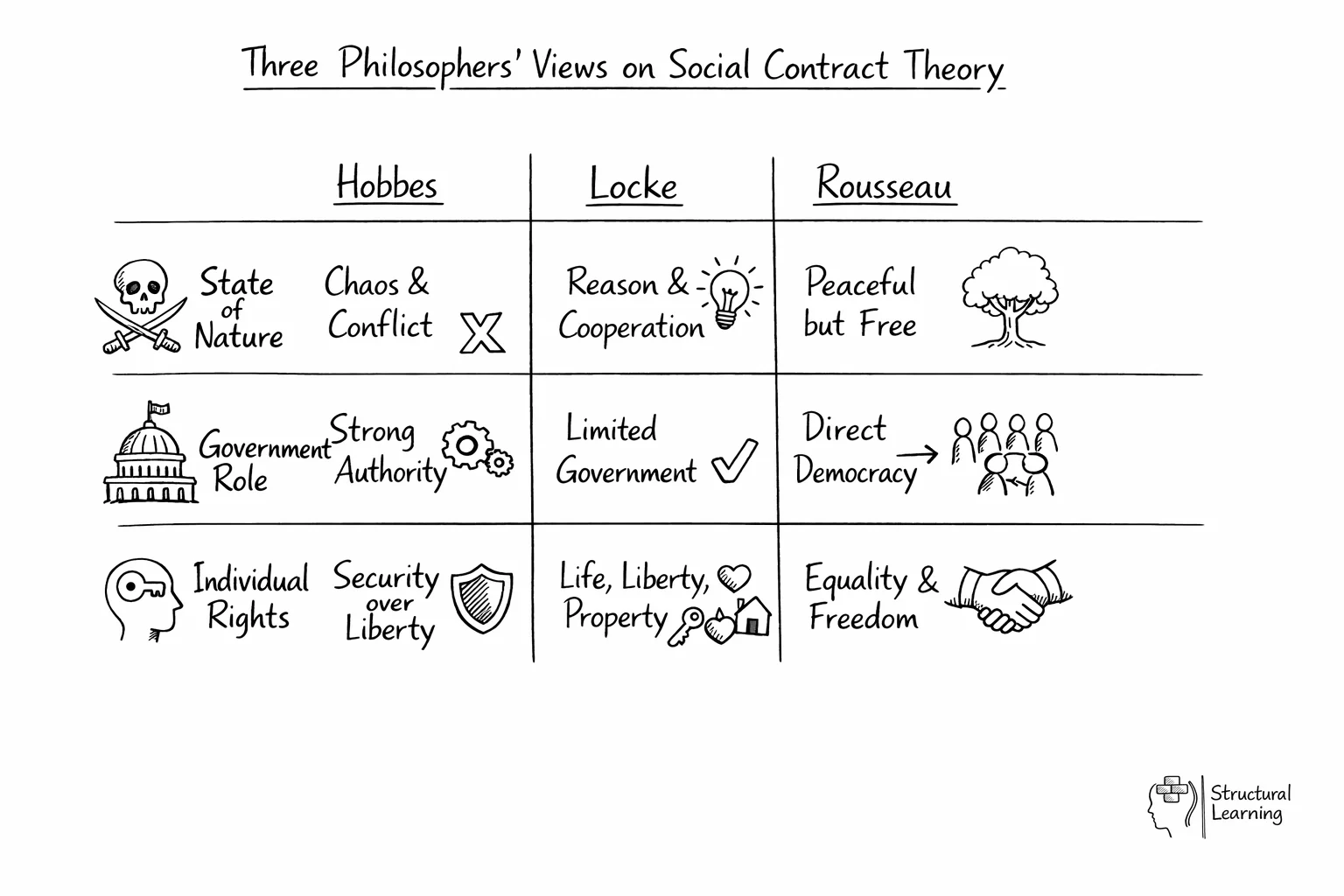
The following image provides a useful, high-level comparison of the three social contract theorists we have studied.
4. Popular Sovereignty and the Rejection of Representation
Rousseau's concept of the general will leads directly to his theory of popular sovereignty. For Rousseau, sovereignty is nothing less than the exercise of the general will, and it has four key characteristics:
- Inalienable: The people cannot give their sovereignty away. You cannot have a "sovereign" king in the Hobbesian sense.
- Indivisible: There can only be one supreme will in the state. Rousseau rejects the Lockean idea of separation of powers between legislature and executive as a division of sovereignty itself.
- Infallible: The general will is always right and always tends to the public advantage. This is a highly controversial claim we will return to.
- Absolute: The sovereign power has absolute authority over all its members.
This leads to a startling conclusion: Rousseau rejects representative government. He famously quipped that the people of England are free only during the election of members of Parliament; as soon as they are elected, slavery overtakes them, and they are nothing. To hand over your will—your legislative capacity—to a representative is to give up your freedom. Sovereignty cannot be represented; it can only be exercised directly by the assembled people.
This is the basis of Rousseau's preference for small city-states (like his native Geneva) where direct democracy is, at least in theory, possible. The "sovereign" is the people in their legislative capacity, making the laws. The "government," by contrast, is merely the executive agent, a subordinate body tasked with applying the laws in particular cases.
To get a precise scholarly understanding of the general will and its political implications, the following text is essential.
Jean-Jacques Rousseau - Stanford Encyclopedia of Philosophy
This entry from the Stanford Encyclopedia of Philosophy offers a detailed analysis of Rousseau's political thought.
Please read the following three sections: The introduction to his political philosophy. The idea of the general will, which discusses the key tension between its "democratic" and "transcendental" interpretations. The emergence of the general will, which explores the conditions required for it to manifest, including the problematic role of the "legislator."
5. Paradoxes of Freedom and Authority
Rousseau's theory is famous for its paradoxes, which challenge our ordinary understanding of freedom. Your background in dissecting formal systems will be an asset in appreciating their structure.
"Forced to be Free"
In a notorious passage, Rousseau states that if anyone refuses to obey the general will, "he shall be constrained to do so by the whole body; which means nothing else than that he shall be forced to be free." How can being forced be a form of freedom?
Rousseau distinguishes between several types of liberty:
- Natural Liberty: The unlimited freedom of the state of nature, which is ultimately worthless due to conflict.
- Civil Liberty: The freedom to enjoy one's property and person under the protection of law.
- Moral Liberty: The highest form of freedom, which is "obedience to a law which we prescribe to ourselves." This is autonomy.
When you are forced to obey the general will, you are being forced to abide by the rational law you gave yourself as a citizen. This act liberates you from two kinds of slavery:
- Slavery to your own particular appetites and impulses (achieving moral liberty).
- Slavery to the arbitrary will of other powerful individuals (what is often called republican freedom).
The Infallible Will
How can the general will always be right, even though, as Rousseau admits, "the deliberations of the people are not always equally correct"? This seems like a flat contradiction.
One way to understand this is to see the general will as an ideal standard. The common good is the "truth" of the matter for the community. The people, through deliberation, try to discover it. Sometimes they fail; they are "deceived." But the standard itself, the common good, remains correct.
This has led to an "epistemic" interpretation of Rousseau, which you might find particularly interesting. It frames voting not as a battle of preferences, but as a collective process of discovery. This is where a concept from mathematics, Condorcet's Jury Theorem, becomes highly relevant.

This model suggests that under the right conditions—where citizens are genuinely trying to identify the common good and have a better-than-random chance of being right—a democratic assembly is a remarkably reliable tool for finding it.
Conclusion
Rousseau offers a profound and challenging alternative to the political visions of Hobbes and Locke. He argues that true legitimacy and freedom are not found in surrendering to an absolute sovereign or in the negative liberty of a limited state, but in the positive liberty of actively participating as a citizen in a community that governs itself through the general will. The social contract does not just protect us; it transforms us from selfish individuals into moral citizens.
- Key Takeaways:
- Rousseau's social contract aims to reconcile individual freedom with state authority by creating a system where each person, in obeying the law, obeys only themselves.
- The general will is the collective will of the people aimed at the common good, distinct from the "will of all" which is the sum of private interests.
- Popular sovereignty is the exercise of the general will by the assembled people. It is inalienable, indivisible, and cannot be represented.
- True freedom is moral liberty—autonomy, or obedience to a law one prescribes to oneself. This is why one can be "forced to be free" by being made to follow the general will.
- Rousseau's theory posits a radical, direct democracy where citizens are not just subjects of the law but are its authors, achieving freedom through politics, not from it.
Preview of the Next Lesson:
Having now explored the social contract theories of Hobbes, Locke, and Rousseau in detail, our next lesson will be dedicated to a systematic comparison of their views. We will analyze their differing conceptions of human nature, the state of nature, the purpose of government, and the nature of sovereignty to understand the profound and lasting impact their competing visions have had on modern political thought.