Welcome back. In our last lesson, we delved into the complex architecture of John Rawls's original position, understanding it not as a historical narrative, but as a formal "reasoning machine." We saw how its key component, the veil of ignorance, serves as a procedural constraint to model fairness and compel the rational parties to adopt a conservative maximin choice strategy.
Today, we will examine the output of this carefully designed procedure. Our objective is to state and explain Rawls's two principles of justice. This involves understanding their strict hierarchical relationship—the priority of liberty—and unpacking the most groundbreaking and controversial element: the difference principle. The logical structure of these principles, particularly their lexical ordering, represents a form of constrained optimization that may resonate with the formal systems you've encountered in physics and computational modeling.
1. The Principles of Justice
Having established the fair conditions of the original position, the parties must choose the principles that will govern the basic structure of their society. Rawls argues that they would not choose utilitarianism, as it would risk sacrificing the fundamental rights of a minority for the greater good of the majority—a gamble the maximin rule forbids. Instead, he contends they would agree on two specific principles, arranged in a strict "lexical" or "serial" order.
Let's turn directly to the primary source, Rawls's A Theory of Justice, for his initial formulation of these principles.
rawls-theory-of-justice-most-of-chapter-2.pdf
This excerpt from Chapter 2 of A Theory of Justice presents Rawls's first statement of the two principles and introduces their serial ordering.
Please read the first three paragraphs, from the statement of the principles. Pay close attention to the precise wording and the explanation of the "serial order."
As you've just read, the two principles are:
- The Liberty Principle: "Each person is to have an equal right to the most extensive scheme of equal basic liberties compatible with a similar scheme of liberties for others."
- The Second Principle: "Social and economic inequalities are to be arranged so that they are both (a) reasonably expected to be to everyone’s advantage, and (b) attached to positions and offices open to all."
The crucial rule here is the lexical priority. The first principle must be fully satisfied before the second is considered. This means that basic liberties cannot be traded away for any amount of social or economic gain. For example, you cannot justify restricting freedom of speech for a minority group on the grounds that it would lead to greater economic prosperity for society as a whole. For the parties in the original position, securing their fundamental liberties is the non-negotiable first priority.
2. The First Principle: Maximum Equal Liberty
The first principle affirms a set of fundamental rights and liberties that are familiar in modern constitutional democracies. Rawls lists these as including political liberty (the right to vote and hold office), freedom of speech and assembly, liberty of conscience, freedom of the person, and the rights associated with the rule of law.
Why would the parties unanimously agree to this principle and its priority? Behind the veil of ignorance, no one knows what their personal conception of the good will be—their religious, philosophical, or moral beliefs. To gamble away the liberty to pursue those beliefs, whatever they may be, would be irrational. The safest and most rational choice is to secure for everyone the most extensive set of liberties possible, ensuring that you will be free to live according to your own values once the veil is lifted.
The following video provides a clear explanation of why utilitarianism is rejected in favor of securing these basic liberties.
Justice: What's The Right Thing To Do? Episode 08: "WHATS A FAIR START?"
In this clip from his "Justice" lecture series, Professor Michael Sandel explains the reasoning behind the first principle.
Please watch from the beginning of the lecture until the introduction of the second principle. Focus on the argument for why the parties would refuse to trade fundamental rights for economic advantages.
One distinctive feature of Rawls's first principle is the requirement for the fair value of the political liberties. This means that everyone should have a genuinely fair opportunity to participate in the political process, regardless of their wealth or social class. This goes beyond mere formal rights and has radical implications, suggesting measures like public financing of elections to prevent economic power from translating into political dominance.
3. The Second Principle: Justifying Inequality
The second principle addresses social and economic inequalities. It is more complex and consists of two distinct parts, which are also lexically ordered.
(b) Inequalities must be attached to offices and positions open to all under conditions of fair equality of opportunity.
(a) Inequalities must be to the greatest benefit of the least-advantaged members of society (the difference principle).
Notice the ordering: fair equality of opportunity has priority over the difference principle.
3.1 Fair Equality of Opportunity (FEO)
This condition demands more than just formal equality of opportunity (e.g., no laws explicitly barring people from certain jobs based on race or gender). FEO requires that individuals with the same level of talent and ambition should have the same prospects of success, regardless of the social class they were born into.
To achieve this, society must actively work to mitigate the influence of social contingencies. This implies robust public investment in education, healthcare, and other resources to ensure that a child from a poor family has a real, substantive chance to compete with a child from a wealthy family.
Rawls argues that even a perfect meritocracy—where FEO is fully realized—is still morally inadequate. This is because, even if we remove the influence of social background, people's life prospects would still be determined by the "natural lottery" of innate talents and abilities. And from a moral point of view, being born with a particular talent is just as arbitrary as being born into a wealthy family. You didn't do anything to deserve it.
This argument against moral arbitrariness is the foundation for the most radical part of his theory.
Justice: What's The Right Thing To Do? Episode 08: "WHATS A FAIR START?"
Professor Sandel provides a powerful step-by-step argument that dismantles the moral claims of feudal, libertarian, and meritocratic systems, leading directly to Rawls's more egalitarian conclusion.
Please watch this segment from the discussion of moral arbitrariness. Trace the logic from the critique of birthright to the critique of the "natural lottery."
3.2 The Difference Principle
Having argued that inequalities stemming from both social and natural contingencies are morally arbitrary, Rawls introduces his solution: the difference principle. It does not demand strict equality. Instead, it states that social and economic inequalities are permissible if and only if they work to the greatest benefit of the least-advantaged members of society.
Let's consider a simple numerical example to see how this works. Imagine four possible economic structures for a society:
| Economy | Least-Advantaged Group Income | Middle Group Income | Most-Advantaged Group Income |
|---|---|---|---|
| A | 10,000 | 10,000 | 10,000 |
| B | 12,000 | 30,000 | 80,000 |
| C | 30,000 | 90,000 | 150,000 |
| D | 20,000 | 100,000 | 500,000 |
The difference principle instructs us to choose the system that maximizes the position of the worst-off group.
- Economy A represents perfect equality.
- Economy B is unequal, but everyone is better off than in A.
- Economy C is more unequal than B, but the least-advantaged group is even better off.
- Economy D has the highest total wealth and benefits the top groups enormously, but the position of the least-advantaged is worse than in C.
Rawls's difference principle selects Economy C. It allows for significant inequalities, but only because those inequalities are structured to raise the floor for everyone, and specifically to make the least-advantaged as well-off as they can possibly be.
This principle can also be represented graphically, which makes its connection to optimization problems clearer.
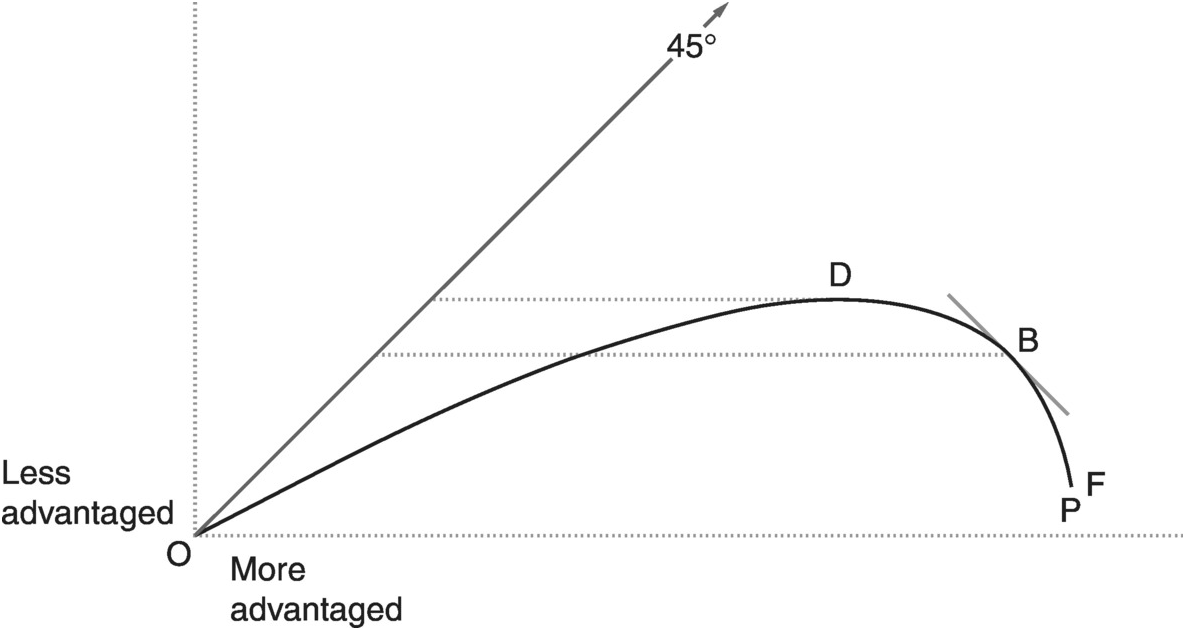
In this diagram from Rawls's book:
- The 45° line represents perfect equality.
- The curve
OPis the "contribution curve." It shows that as the prospects of the more advantaged (x1) increase, so do the prospects of the least advantaged (x2), up to a certain point. This might happen because higher wages for entrepreneurs create incentives for innovation and job creation that benefit unskilled workers. - The L-shaped lines are the indifference curves for the difference principle. You are indifferent between any points on a given L-shape, but you want to get to the highest "corner" possible. This shape represents the
maximinlogic: a gain for the better-off is of no value unless it also improves the situation of the worst-off. - The difference principle selects point
a, the peak of the curve forx2. At this point, the expectations of the least advantaged are maximized. Allowing the more advantaged to become even richer (moving right of pointa) would be unjust, because it would come at the expense of the least advantaged.
Essentially, the difference principle treats the distribution of natural talents as a common asset. Those who are lucky in the genetic lottery are welcome to use their gifts to gain wealth, but only on terms that improve the situation of those who were not so lucky. This gives philosophical substance to the ideal of fraternity or social solidarity.
4. Moral Desert vs. Legitimate Expectations
A common objection to the difference principle is that it ignores effort and moral desert. Shouldn't people who work harder or contribute more deserve a greater reward?
Rawls's response is subtle and profound. He draws a distinction between moral desert and entitlements to legitimate expectations.
- Moral Desert: The idea that people deserve certain rewards based on their intrinsic virtue or effort. Rawls argues that even our willingness to make an effort is so heavily influenced by arbitrary factors (family background, natural talents) that it cannot be the basis for justice.
- Legitimate Expectations: Once a just set of rules (the two principles) is in place, people are entitled to whatever they acquire by playing by those rules.
Professor Sandel explains this difficult but crucial distinction using the analogy of games.
Justice: What's The Right Thing To Do? Episode 08: "WHATS A FAIR START?"
This clip addresses the key objections of incentives and effort, culminating in the distinction between moral desert and entitlement.
Please watch from the section on objections. Focus on the lottery vs. baseball game analogy. Why does Rawls believe that distributive justice is not about rewarding moral desert?
The upshot is that in a Rawlsian society, Bill Gates would be entitled to his fortune if the economic system that allowed him to acquire it was designed to be to the greatest benefit of the least advantaged. However, he could not claim that he morally deserved that fortune in a pre-institutional sense. Justice is about the fairness of the background rules, not about rewarding individual virtue.
Conclusion
In this lesson, we have moved from the procedure of the original position to its substantive output: Rawls's two principles of justice. These principles provide a framework for a just society that attempts to blend the liberal commitments to liberty and equality in a novel and powerful way.
- Key Takeaways:
- Rawls proposes two principles of justice: (1) The Liberty Principle, which guarantees the most extensive scheme of equal basic liberties for all, and (2) a principle for regulating inequalities.
- These principles are in lexical priority: Liberty is non-negotiable and cannot be sacrificed for economic gains.
- The second principle has two parts: Fair Equality of Opportunity (FEO), which seeks to correct for social disadvantages, and the Difference Principle.
- The Difference Principle is the core of Rawls's egalitarianism. It permits social and economic inequalities only if they are structured to be to the greatest possible benefit of the society's least-advantaged members.
- The justification for the difference principle rests on the idea that the distribution of natural talents is morally arbitrary. Society should be arranged so this "natural lottery" benefits all, especially the least fortunate.
- Rawls distinguishes between moral desert (which he rejects as a basis for justice) and entitlements to legitimate expectations (what people earn under fair rules).
Preview of the Next Lesson:
Rawls's theory, with its focus on the "pattern" of distribution that best serves the least advantaged, represents a high point of 20th-century liberal egalitarianism. However, this entire approach faces a powerful challenge from a different philosophical tradition. What if justice has nothing to do with achieving a specific distributive pattern, but is solely about respecting individual rights and the history of their acquisitions? In our next lesson, we will explore Robert Nozick's libertarian entitlement theory, which offers a radical critique of Rawls and presents a starkly different vision of a just society.