Welcome to our next lesson. In our previous discussion, we celebrated a high point in the history of logic: Gödel's Completeness Theorem. It revealed a perfect harmony for first-order logic, where the syntactic world of formal proofs () exactly mirrors the semantic world of truth (). This established that a finite, mechanical set of rules could capture all universal logical truths.
Today, we confront the other side of this story by turning to Kurt Gödel's even more famous Incompleteness Theorems. These theorems reveal what happens when a formal system moves beyond pure logic and becomes powerful enough to describe the arithmetic of the natural numbers. In doing so, we will discover the inherent limitations of any such formal system and explore the profound philosophical shockwaves these limitations sent through mathematics, computer science, and the philosophy of mind. Our goal is to understand not just what the theorems say, but what they mean for the nature of truth, proof, and reason itself.
1. Hilbert's Dream of a Final Theory
At the turn of the 20th century, mathematics was in the midst of a "foundational crisis." The discovery of paradoxes, such as Bertrand Russell's in set theory, shook the discipline's claim to absolute certainty. In response, the brilliant mathematician David Hilbert proposed an ambitious program to place all of mathematics on a secure and final foundation.
Hilbert's vision was to create a single formal system that could encompass all of mathematics. He believed that for this system, we would be able to prove three crucial properties:
- Completeness: Every true mathematical statement could be proven within the system.
- Consistency: The system would be free from contradiction; it would be impossible to prove both a statement and its negation.
- Decidability: There would be a mechanical procedure, an algorithm, that could determine whether any given mathematical statement was provable or not.
Hilbert's dream was essentially a declaration of faith in the ultimate power of formal reason. His famous 1930 address concluded with the defiant slogan, "Wir müssen wissen, wir werden wissen" — "We must know, we will know."
The following video provides an excellent account of this historical context and introduces the young logician who, at that very same conference, quietly announced results that would show Hilbert's dream to be unattainable.
The Veritasium video "Math's Fundamental Flaw" masterfully sets the stage for Gödel's work.
Please watch the section from this timestamp. It details the foundational crisis, the debate between formalists and intuitionists, Russell's paradox, and Hilbert's three famous questions that defined his program.
2. The Method: Arithmetization and Self-Reference
Gödel's stroke of genius was not just to find a flaw, but to use the power of a formal system against itself. He devised a method to make a formal system capable of talking about its own properties. The core idea is to translate statements about the system (metamathematics) into statements within the system's own language (arithmetic).
This technique is known as arithmetization, or more popularly, Gödel numbering. It involves assigning a unique natural number to every symbol, formula, and sequence of formulas (a proof) in the formal language. Once this is done, a metamathematical statement like "The formula is provable" can be translated into a purely arithmetical statement, such as "There exists a number that has the property , where is the arithmetical relation corresponding to 'being the Gödel number of a proof of the formula with Gödel number ⌜A⌝'."
Given your background in programming, you can think of this as a form of encoding. Just as any text, image, or program can be represented as a sequence of binary numbers on a computer, Gödel showed that any syntactic element of a formal system can be represented as a single natural number.
This diagram illustrates the basic concept, showing how symbols in a formula are assigned codes, which are then used as exponents for a product of prime numbers to generate a unique Gödel number for the formula.
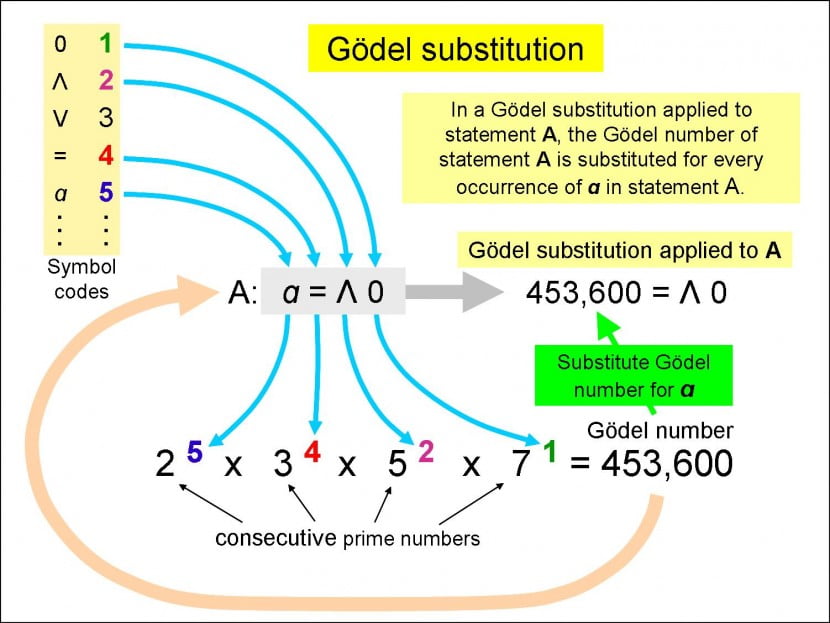
The next step is to achieve self-reference. Gödel used a clever trick known as the Diagonalization Lemma to construct a sentence that refers to its own Gödel number. In essence, he constructed a sentence, let's call it , which is provably equivalent to the statement "The sentence with Gödel number ⌜G⌝ is not provable."
This creates a formal, mathematically precise version of the ancient Liar's Paradox ("This statement is false"), but with a crucial difference. Instead of 'false', it uses 'unprovable'.
To see this method explained intuitively, let's return to the Veritasium video.
This segment explains the core mechanics of Gödel's proof.
Please watch from this part. It walks through the process of Gödel numbering and the construction of the self-referential "unprovable" statement.
For a rigorous and detailed explanation of arithmetization and the Diagonalization Lemma, the Stanford Encyclopedia of Philosophy article is the definitive resource.
Gödel's Incompleteness Theorems
This article provides the technical foundation for the theorems.
Please read the sections Arithmetization and Diagonalization. This will formalize the intuitive ideas presented in the video, covering Gödel numbering, the concept of representability, and the Diagonalization Lemma.
3. The Incompleteness Theorems
With the machinery of arithmetization and self-reference in place, Gödel was able to prove his two groundbreaking theorems.
The First Incompleteness Theorem
This theorem deals a direct blow to Hilbert's hope for completeness.
First Incompleteness Theorem: Any consistent, effectively axiomatized formal system capable of expressing basic arithmetic contains a true statement that is not provable in .
The unprovable statement is, of course, the Gödel sentence , which asserts its own unprovability. Let's trace the logic:
- If were provable in , then the system would be proving "This sentence is not provable." This seems contradictory. More formally, if , then because provability is representable in the system, we would also have . But is defined such that . This means would also prove , making the system inconsistent.
- Therefore, if is consistent, it cannot prove . .
- Since asserts its own unprovability, and we have just concluded it is unprovable, must be true.
So, we have a statement, , which is true but unprovable within the system. This demonstrates that the system is incomplete.
The Second Incompleteness Theorem
This theorem destroys the second part of Hilbert's program: the goal of proving a system's own consistency from within.
Second Incompleteness Theorem: For any consistent, effectively axiomatized formal system capable of expressing basic arithmetic, the consistency of cannot be proven within itself.
The intuition here is remarkably elegant. The proof of the first theorem can be summarized as the statement: "If is consistent, then is unprovable." Gödel showed that this entire line of reasoning can be formalized within F itself. So, we have:
where is the arithmetical formula expressing the consistency of .
Now, suppose for a moment that could prove its own consistency. That is, assume . Then, by a simple application of modus ponens, the system could conclude . But we already know from the first theorem that if proves , it is inconsistent. Thus, a consistent system cannot prove its own consistency.
For the formal statements and conditions of these theorems, you can consult the SEP article.
Gödel's Incompleteness Theorems
This reading covers the theorems themselves and the conditions for their application.
Focus on the sections The First Theorem and The Second Theorem for precise statements of the results.
4. The Philosophical Significance
The technical results are staggering, but their philosophical implications are even more profound. They fundamentally changed our understanding of mathematics and the limits of formal reason.
The End of Hilbert's Program and the Nature of Truth
The most immediate impact was the collapse of Hilbert's grand project. Gödel's theorems provided definitive negative answers to two of his three questions:
- Is mathematics complete? No.
- Can mathematics prove its own consistency? No.
- (The third question, on decidability, was later answered "no" by Alonzo Church and Alan Turing, work that was deeply intertwined with Gödel's.)
More fundamentally, the theorems established an unbridgeable gap between truth and provability. Before Gödel, many formalists and logical positivists held that mathematical truth was nothing more than provability within a formal system. Gödel showed this to be false. There are mathematical truths that forever lie beyond the reach of any single axiomatic system.
In the following lecture, philosopher Juliette Kennedy provides a powerful summary of these implications.
The Road to Gödel's Incompleteness Theorems - Juliette Kennedy
This excerpt from "The Road to Gödel's Incompleteness Theorems" by Juliette Kennedy directly addresses the philosophical meaning of the theorems.
Please watch the segment from this timestamp. She articulates three crucial negative conclusions: Mathematics cannot be mechanized. Infinitistic concepts cannot be eliminated. Mathematical truth cannot be replaced by the concept of proof.
The "Minds vs. Machines" Debate
Perhaps the most contentious philosophical application of Gödel's theorems is the argument that they prove the human mind is not a machine. The argument, famously advanced by philosopher J.R. Lucas and physicist Roger Penrose, goes something like this:
- Any machine or computer can be modeled as a formal system.
- For any such consistent formal system , its Gödel sentence is true but unprovable by the system.
- However, we, as human reasoners, can "see" that is true.
- Therefore, our minds can do something no formal system can do.
- Conclusion: The human mind is not a machine.
This is a powerful and intuitive argument. J.R. Lucas states it with characteristic force in his paper "The Implications of Gödel's Theorem."
The Implications of Gödel's Theorem
This article by J.R. Lucas is a classic (and controversial) exposition of the philosophical consequences of Gödel's work, including the anti-mechanist argument.
Read the introduction in section I, his explanation of the Gödelian formula in section II, his argument about reason outrunning rules in section VI, and his summary of the theorem's revolutionary impact in section IX.
However, this anti-mechanist argument is widely considered to be flawed. The standard critique, which you may have already anticipated, targets premise (3). For us to "see" that is true, we must first assume that the system is consistent. But how can a human mind know with absolute certainty that a given complex formal system (let alone its own cognitive processing) is consistent? Gödel's second theorem shows that even the system itself cannot prove this. The argument presupposes that the human mind has a privileged, infallible insight into the consistency of formal systems, an assumption that is far from obvious.
This complex debate is carefully analyzed in the SEP article.
Gödel's Incompleteness Theorems
This section of the article directly confronts the anti-mechanist claims.
Please read the section ‘Gödelian’ arguments against mechanism. It outlines the argument by Lucas and Penrose and presents the standard refutation. Also read the subsequent section on Gödel's own, more cautious view.
Gödel's own conclusion was more subtle. He presented a disjunction: "either... the human mind... infinitely surpasses the power of any finite machine, or else there exist absolutely unsolvable diophantine problems." He personally leaned towards the first option, but he acknowledged that the theorems alone do not force this conclusion.
Conclusion
The journey from the completeness of logic to the incompleteness of arithmetic is a dramatic one. It represents a fundamental limit on what can be achieved through formal axiomatic systems. Hilbert's dream of a single, complete, and provably consistent foundation for all of mathematics was shown to be impossible.
Key Takeaways:
- Incompleteness: Any formal system powerful enough for arithmetic will have statements that are true but unprovable within that system.
- Unprovable Consistency: No such system can prove its own consistency.
- Truth vs. Provability: Gödel's theorems definitively separate the concept of truth from the system-relative concept of provability. Mathematical truth transcends any single formal framework.
- Limits of Mechanization: The theorems imply that mathematical reasoning cannot be fully mechanized or captured by a finite set of rules. This has fueled ongoing debates about the nature of human consciousness and its relation to computation.
- The Power of Self-Reference: The core technical innovation—using arithmetic to encode statements about arithmetic—is a powerful idea that resonates through logic, computer science (e.g., Turing machines, computability theory), and even physics.
While the theorems reveal limits, they are not a cause for despair. They did not invalidate existing mathematics but rather revealed a deeper, more complex, and perhaps more interesting structure to mathematical reality. They show that no single formal system, no matter how powerful, can ever have the final word.
Preview of the Next Lesson:
Gödel's results had a complex relationship with various schools of thought in the philosophy of mathematics. One such school, Intuitionism, had long been skeptical of the classical view of truth, particularly regarding infinite sets. In our next lesson, we will explore intuitionistic logic, which redefines logic itself to align truth more closely with constructive provability, providing a radical alternative to the classical framework we have been studying.