Welcome back to our study of logic. In the previous lesson, we assembled the complete toolkit for natural deduction in first-order logic, adding the four crucial rules for handling universal and existential quantifiers. You are now equipped to construct formal proofs for a vast array of arguments.
In this lesson, we will apply this powerful machinery to a historically central class of deductive arguments: syllogisms. For over two millennia, from Aristotle until the development of modern logic in the 19th century, the study of syllogisms was the study of logic. Our goal is to demonstrate how our more expressive system of predicate logic can formalize and evaluate these classical arguments with precision. You will learn to define a syllogism, translate its propositions into predicate logic, and then use the natural deduction rules you've just mastered to prove its validity or demonstrate its invalidity.
1. The Structure of a Syllogism
A categorical syllogism is a deductive argument consisting of exactly three categorical propositions: two premises and one conclusion. The propositions involve three terms: a major term, a minor term, and a middle term.
A categorical proposition asserts or denies a relationship between two categories or classes of things. There are four standard forms:
- A (Universal Affirmative): All S are P
- E (Universal Negative): No S are P
- I (Particular Affirmative): Some S are P
- O (Particular Negative): Some S are not P
The term that appears as the predicate of the conclusion is the major term (P), and the premise containing it is the major premise. The term that is the subject of the conclusion is the minor term (S), and the premise containing it is the minor premise. The middle term (M) appears in both premises but not in the conclusion, linking the other two terms.
For example, consider this classic argument:
- All humans are mortal. (Major Premise)
- All Greeks are human. (Minor Premise)
- Therefore, all Greeks are mortal. (Conclusion)
Here, "mortal" is the major term (P), "Greeks" is the minor term (S), and "human" is the middle term (M).
Traditionally, syllogisms were also classified by their mood (the sequence of A, E, I, O propositions) and figure (the arrangement of the S, P, and M terms). While this created a complex taxonomy of 256 possible forms, our modern predicate logic allows us to analyze them directly without memorizing this system. Another method, using Venn diagrams, provides a visual way to test for validity.
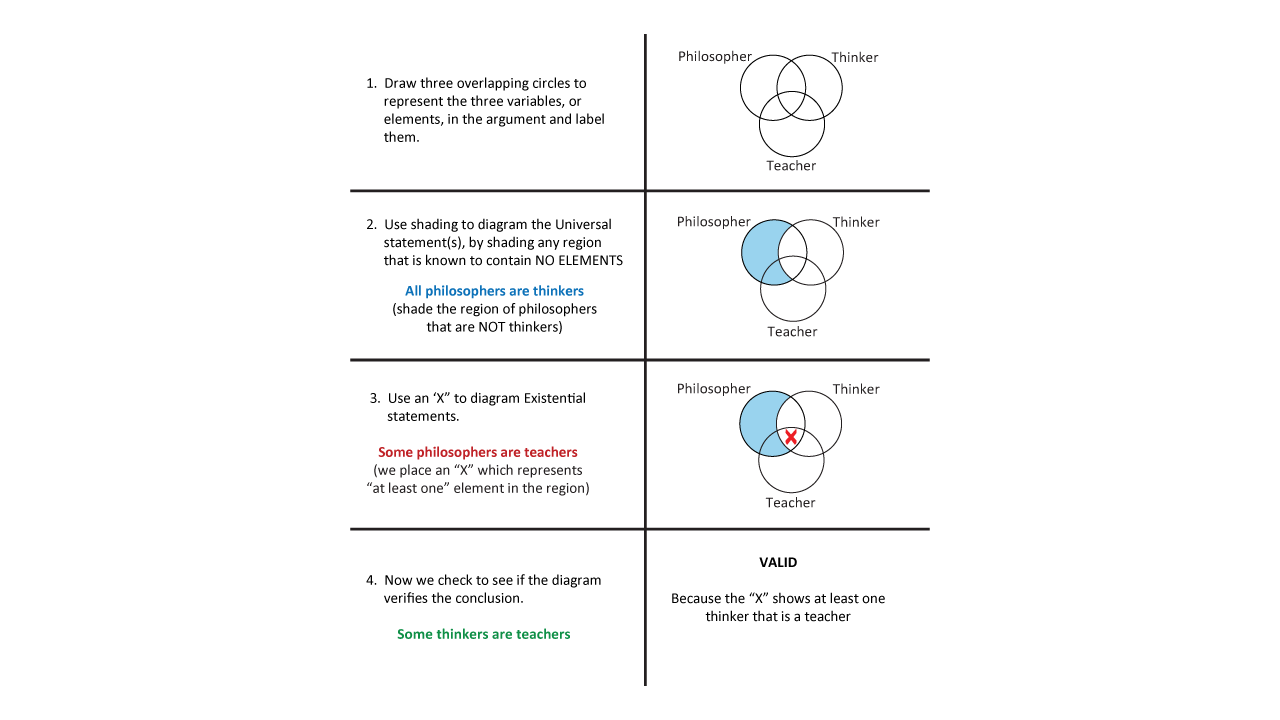
While visual methods like Venn diagrams are useful, our focus will be on the more rigorous and universally applicable method of formal proof.
2. Translating Syllogisms into Predicate Logic
The key to analyzing syllogisms is translating the four categorical forms into the language of predicate logic. This requires careful use of quantifiers and connectives. The structure of the translation differs significantly between universal and particular statements.
Chapter 6 – Revised Fundamental Methods of Logic
This section of the text "Revised Fundamental Methods of Logic" provides a clear and concise guide to translating the four categorical forms into quantified predicate notation.
Please read the section titled "Subject-Predicate Propositions". Focus on the four resulting symbolic forms for A, E, I, and O statements. Pay special attention to why universal statements use a conditional (\supset) while particular statements use a conjunction (\cdot).
As the reading makes clear, the standard translations are:
- A-form (All S are P):
- For any x, if it is an S, then it is a P.
- E-form (No S are P):
- For any x, if it is an S, then it is not a P.
- I-form (Some S are P):
- There exists an x such that it is an S and it is a P.
- O-form (Some S are not P):
- There exists an x such that it is an S and it is not a P.
A common mistake is to use a conjunction for a universal statement, e.g., . This translates to "Everything is an S and everything is a P," which is a much stronger and usually incorrect claim. Similarly, using a conditional for a particular statement, , is too weak. It would be made true by the existence of a single thing that is not an S, which fails to capture the intended meaning.
3. Proving a Valid Syllogism: "Barbara"
Let's use our natural deduction rules to prove the validity of the syllogism mentioned earlier, known traditionally as "Barbara" (AAA-1).
- Premise 1: All humans are mortal.
- Premise 2: All Greeks are human.
- Conclusion: All Greeks are mortal.
Translation:
Let be "x is a Greek", be "x is a human", and be "x is mortal".
- Premise 1:
- Premise 2:
- Conclusion:
Formal Proof:
The overall strategy to prove is to use Universal Introduction (). This requires us to prove for an arbitrary constant . To prove that conditional, we will use Conditional Proof (), assuming and deriving .
| Line | Formula | Justification |
|---|---|---|
| 1. | Premise | |
| 2. | Premise | |
| 3. | ____ | |
| 4. | ____ | |
| 5. | ____ | |
| 6. | ____ | |
| 7. | ____ | |
| 8. | 3-7, Conditional Proof () | |
| 9. | 8, Universal Introduction () |
Explanation:
- In line 3, we introduce an arbitrary individual, , and assume it is a Greek.
- In lines 4 and 6, we use Universal Elimination on our premises. Since the premises hold for all x, they must hold for our specific individual .
- Lines 5 and 7 are standard applications of Modus Ponens. We chain the implications from Greek to human, and from human to mortal.
- In line 8, we conclude that if our arbitrary individual is a Greek, then it is mortal.
- Finally, in line 9, because was truly arbitrary (it wasn't mentioned in the premises and had no special properties), we can generalize our conclusion from the specific case of to all individuals using Universal Introduction. The argument is valid.
4. Proving a Syllogism with an Existential Quantifier
Now let's tackle a syllogism that involves particular propositions, which will require us to use the rules for the existential quantifier. Consider the syllogism "Darii" (AII-1):
- Premise 1: All mammals are animals.
- Premise 2: Some pets are mammals.
- Conclusion: Some pets are animals.
Translation:
Let be "x is a pet", be "x is a mammal", and be "x is an animal".
- Premise 1:
- Premise 2:
- Conclusion:
Formal Proof:
Our strategy here is to use Existential Elimination () on premise 2. We will assume an arbitrary instance, , and from it, derive our conclusion .
| Line | Formula | Justification |
|---|---|---|
| 1. | Premise | |
| 2. | Premise | |
| 3. | ____ | |
| 4. | ____ | |
| 5. | ____ | |
| 6. | ____ | |
| 7. | ____ | |
| 8. | ____ | |
| 9. | ____ | |
| 10. | 2, 3-9, Existential Elimination () |
Explanation:
- Line 3 is the key step. We know from premise 2 that something is both a pet and a mammal. We can't know what it is, so we start a sub-proof and give this unknown thing a temporary, arbitrary name, .
- Inside the sub-proof (lines 4-9), we dismantle our assumption, use the universal premise, and construct the proposition we want.
- In line 9, we have shown that from the existence of , we can prove that "some pet is an animal".
- Line 10 completes the rule. Since the conclusion we reached inside the sub-proof () does not contain the temporary name , we can export it from the sub-proof. We have successfully shown that the existence of some pet that is a mammal guarantees the existence of some pet that is an animal.
5. Existential Import and Proving Invalidity
A crucial point of divergence between traditional and modern logic is the concept of existential import. Traditional Aristotelian logic assumed that universal propositions like "All S are P" imply the existence of at least one S. Modern predicate logic makes no such assumption. The statement is considered vacuously true if there are no S's.
This leads to situations where syllogisms deemed valid by Aristotle are considered invalid in modern logic. For example:
- P1: All unicorns are magical. ()
- P2: All unicorns have horns. ()
- C: Some things with horns are magical. ()
This argument is invalid in modern logic. If unicorns don't exist, the set of unicorns is empty. The premises are vacuously true, but the conclusion is false. The argument only becomes valid if we add a third premise: "There are unicorns" ().
To prove a syllogism is invalid, we must construct a counterexample: an interpretation (a model) where all premises are true but the conclusion is false. This can often be done with a very small universe of discourse.
Let's prove the following syllogism invalid:
- P1: No artists are bakers. ()
- P2: Some bakers are not chefs. ()
- C: Some artists are not chefs. ()
We need to define a universe and assign properties such that P1 and P2 are true, and C is false. Let's try a universe with two individuals, and .
- Universe U:
- Interpretation:
- Artist (A):
- Baker (B):
- Chef (C):
Now, let's check the truth values:
- P1:
- For : is , which is , which is True.
- For : is , which is , which is True.
- Since it holds for all individuals, Premise 1 is True.
- P2:
- Let's check : is , which is , which is False.
- Let's check : is , which is , which is False.
- My counterexample failed. Let's adjust.
Let's try a new interpretation. We need a baker who is not a chef.
- Universe U:
- Interpretation:
- Artist (A):
- Baker (B):
- Chef (C):
Let's re-check:
- P1:
- For : is , which is True.
- For : is , which is True.
- Premise 1 is True.
- P2:
- Let's check : is , which is , which is True.
- So, Premise 2 is True. (We found our baker who is not a chef: .)
- C:
- Let's check : is , which is False.
- Let's check : is , which is False.
- The statement is false for all individuals. So, the Conclusion is False.
Since we have found an interpretation where the premises are true and the conclusion is false, the syllogism is invalid.
For a more systematic method of finding such counterexamples, you can use a truth-table approach over a small domain.
Chapter 6 – Revised Fundamental Methods of Logic
This text explains how to formally prove invalidity by constructing a counterexample model. It provides a highly systematic, almost algorithmic, method using a truth table for a small universe.
Read the section on "Proving Invalidity" and carefully follow the step-by-step construction of the truth table for "Invalid Example #2". This mechanical process is a powerful tool for demonstrating non-validity.
Conclusion
In this lesson, we bridged a 2000-year gap in the history of logic, demonstrating that the classical theory of the syllogism can be fully captured and analyzed within modern first-order predicate logic. By translating the four categorical propositions into quantified statements, we can deploy our powerful natural deduction system to rigorously prove validity or construct counterexamples to demonstrate invalidity.
Key Takeaways:
- Categorical syllogisms are three-proposition arguments built from A, E, I, and O forms.
- Universal statements () translate using the universal quantifier and a conditional ().
- Particular statements () translate using the existential quantifier and a conjunction ().
- The validity of any syllogism can be formally evaluated by constructing a natural deduction proof.
- The invalidity of a syllogism can be proven by constructing a counterexample, an interpretation (often in a small, finite domain) where all premises are true and the conclusion is false.
- Modern logic differs from traditional logic in its handling of existential import for universal statements, rendering some traditionally valid syllogisms invalid.
Preview of the Next Module:
We have now completed our foundational study of propositional and predicate logic. You are equipped with the primary tools of formal logical analysis. In the next module, "Modal Logic and Metalogic," we will venture into more advanced territory. We will begin by adding operators for "necessity" and "possibility" to our language, allowing us to formally reason about what must be and what could be. We will then turn our analytical lens back onto logic itself, investigating the profound meta-theorems of soundness, completeness, and Gödel's incompleteness, which have deep implications for mathematics, computer science, and philosophy.