In our previous lessons, we explored the dynamics of scientific change through the lenses of Popper, Kuhn, and Lakatos. We focused on the methodology of science—how theories are tested, how scientific communities operate, and how we might rationally appraise progress. We've seen how Lakatos attempted to synthesize Popper's rationalism with Kuhn's historical observations, proposing that science proceeds through competing research programmes.
Now, we pivot from the question of how science works to a more fundamental question about its meaning: What is the relationship between our most successful scientific theories and reality itself? When your quantum field theory textbooks speak of virtual particles, or your condensed matter models describe excitons, are these merely useful fictions for calculation, or are they descriptions of real, existing entities? This lesson tackles this very question, introducing the central debate in the philosophy of science between scientific realism and anti-realism.
Our goal is to compare scientific realism and anti-realism, focusing on one of the most influential forms of anti-realism, constructive empiricism. We will dissect the core arguments for each position and explore the profound implications they have for what we think we know about the world through science.
1. Scientific Realism and the "No-Miracles" Argument
At its heart, scientific realism is the view that science is getting at the truth. It's an optimistic stance that aligns with the common-sense intuition many scientists hold: that science makes progress by discovering more and more about how the world, in its deepest structures, actually is.
More formally, scientific realism is typically defined by three core commitments:
- Metaphysical Commitment: There exists a mind-independent world. The objects, properties, and structures investigated by science exist objectively, regardless of our thoughts or theories about them.
- Semantic Commitment: Scientific theories are to be taken literally. When a theory posits unobservable entities like electrons or spacetime curvature, these claims are genuine statements about the world that are either true or false.
- Epistemological Commitment: Our best, most mature scientific theories are at least approximately true. They provide genuine knowledge of the world, encompassing both its observable and its unobservable aspects.
The most powerful argument in favor of this view is the No-Miracles Argument (NMA). It posits that the astonishing predictive and manipulative success of science would be a miracle if our theories weren't, at some level, latching onto the real structure of the world. Consider the staggering precision of quantum electrodynamics or the successful predictions of general relativity. For a realist, the best explanation for this success is that the theories are approximately true and their central terms (like 'electron' or 'gravitational field') genuinely refer to real things. This is a form of Inference to the Best Explanation (IBE).
The following video provides an excellent overview of scientific realism and the No-Miracles Argument.
PHILOSOPHY FOR SCIENTISTS - Scientific Realism and Antirealism
This video, "PHILOSOPHY FOR SCIENTISTS" from Humanities Southampton, clearly defines scientific realism and its primary justification.
Please watch the first two segments. The first part, from the definition of scientific realism, outlines the core tenets of the position. The second part, from the No-Miracles Argument, explains the main argument in its favor.
2. The Anti-Realist Challenge: The Pessimistic Meta-Induction
Anti-realism is not a single doctrine but a family of views united by skepticism towards the realist's claims, particularly regarding the unobservable. The most historically potent argument against realism is the Pessimistic Meta-Induction (PMI).
The PMI flips the No-Miracles Argument on its head. It argues from the history of science itself. This history is a graveyard of theories that were once empirically successful but are now considered false. These theories posited unobservable entities that we no longer believe exist—think of the luminiferous ether, phlogiston, or the caloric theory of heat. Proponents of these theories could have (and did) point to their success as evidence of their truth. Yet, they were wrong.
The PMI asks: if so many successful past theories have been overturned, why should we be so confident that our current theories—like the Standard Model of particle physics—have finally gotten it right? The most likely induction from history is that our current theories will also one day be found false and their theoretical entities discarded.
PHILOSOPHY FOR SCIENTISTS - Scientific Realism and Antirealism
Now, let's watch the corresponding segment from the same video, which presents this powerful counterargument.
Watch from this section on the Pessimistic Meta-Induction. Notice how it uses the historical record to challenge the realist's optimism.
This tension between the NMA (the "positive" argument from success) and the PMI (the "negative" argument from history) sets the stage for the modern debate. Realists have offered various replies, such as arguing that our current theories are more mature and successful than past ones, or restricting belief to only certain parts of theories. This has led to more nuanced versions of both realism and anti-realism.
3. A Sophisticated Anti-Realism: Constructive Empiricism
Perhaps the most influential modern form of anti-realism is constructive empiricism, developed by Bas van Fraassen. It presents a subtle and powerful alternative to full-blown realism, one that tries to account for the practice of science without committing to belief in unobservables.
Constructive empiricism shares realism's metaphysical commitment to a mind-independent world and its semantic commitment to interpreting theories literally. Where it diverges sharply is on the epistemological front.
Here are the key tenets of constructive empiricism:
- The Aim of Science: The goal of science is not to discover the truth about the world (especially the unobservable parts), but to produce theories that are empirically adequate.
- Empirical Adequacy: A theory is empirically adequate if what it says about the observable phenomena (past, present, and future) is true. The theory must "save the phenomena." It doesn't matter if its claims about unobservables are true.
- Acceptance vs. Belief: To accept a theory is to believe that it is empirically adequate and to commit to using it as the basis for further research. This is different from believing the theory to be true in its entirety. The constructive empiricist remains agnostic about the existence of unobservable entities like quarks or superstrings. They are useful theoretical posits in models that successfully describe observable reality, but we have no warrant to believe they actually exist.
To understand this view, let's turn to some authoritative sources.
Constructive Empiricism - Stanford Encyclopedia of Philosophy
This SEP article provides a clear and precise definition of constructive empiricism. It carefully lays out the distinctions crucial to understanding van Fraassen's position.
Please read the introductory sections 1.1 through 1.6. Focus on these key points: The contrast with scientific realism regarding the aim of science and the nature of acceptance. How CE agrees with realists on a literal interpretation of theories, setting it apart from older forms of instrumentalism. The core definition of empirical adequacy. The crucial and controversial definition of what counts as observable. Note that for van Fraassen, this is relative to our biological capacities as an "epistemic community," not what we can detect with instruments.
Van Fraassen's distinction between observable and unobservable is a frequent point of contention. For him, the moons of Jupiter are observable (because an astronaut could go there and see them with the naked eye), but a proton is not. As a physicist, you are accustomed to "observing" particles through complex apparatuses. Van Fraassen argues that in such cases, you are observing the instrument (e.g., a trail in a cloud chamber), not the particle itself. You then infer the particle's existence based on a theory you accept. The constructive empiricist stops short of making that final belief-laden inference about the unobservable entity.
To hear the view from the source, the following is a fascinating discussion where Bas van Fraassen himself explains his position.
Bas C. van Fraassen - Critical Realism in Science and Theology
This video from the channel Closer To Truth features an interview with Bas van Fraassen, where he contrasts his constructive empiricism with the realism of Ernan McMullin.
Please watch from his explanation of constructive empiricism. Pay close attention to how he frames the debate as a disagreement about the criteria for success in science (truth vs. empirical adequacy) and why he sees his position as a different understanding of the scientific enterprise.
How does constructive empiricism explain the success of science without invoking miracles? Van Fraassen offers a Darwinian explanation: theories are born into a "life of fierce competition." Only the ones that are successful at predicting observable phenomena survive. We are left with empirically adequate theories not because of a miracle, but because all the inadequate ones have been weeded out.
4. A Map of the Landscape
The debate between realism and anti-realism is a complex landscape with many intermediate positions. The following diagrams provide a helpful visual summary of the major viewpoints and how they relate.
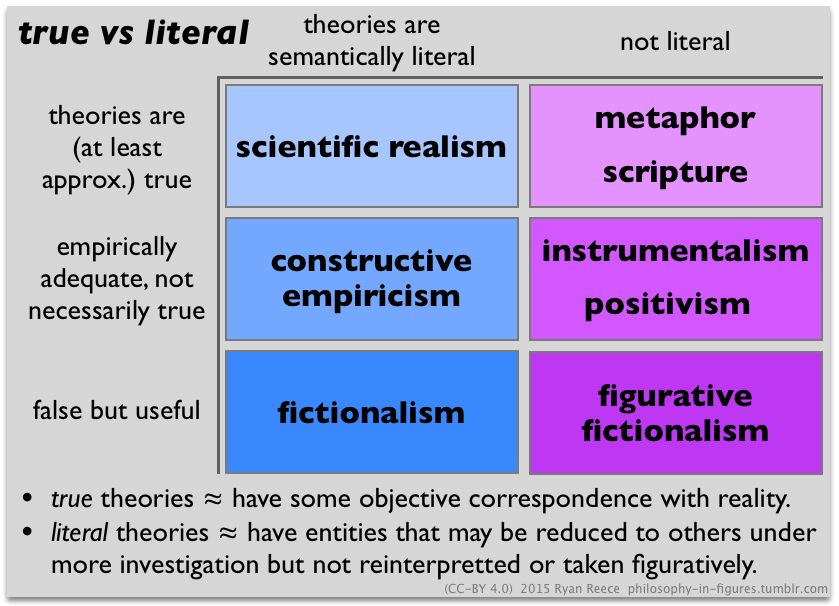
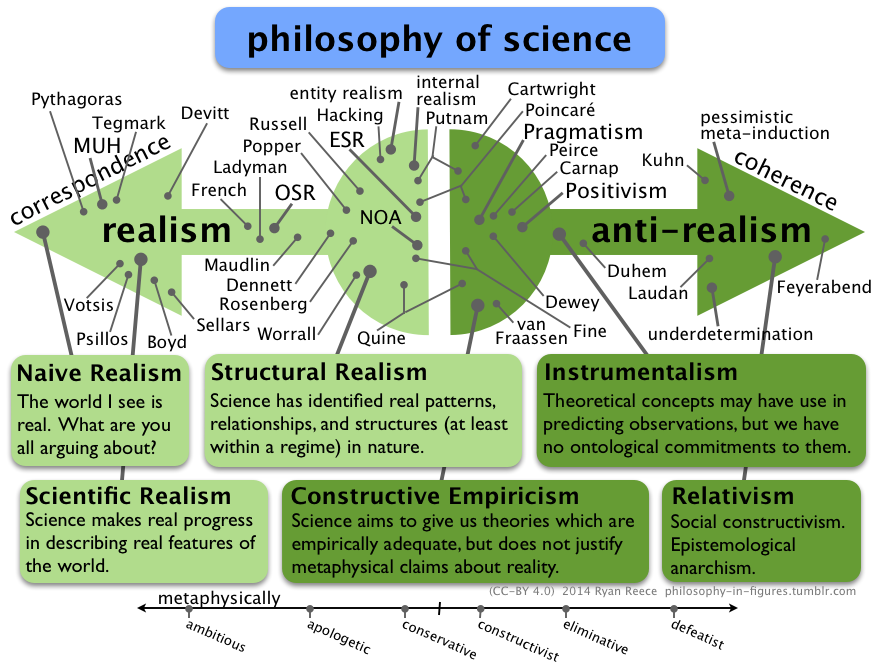
These charts show that "anti-realism" is a broad church. Constructive empiricism holds the middle ground: it agrees with realism on literal semantics but stops short of epistemic commitment to unobservables.
One important compromise position worth noting is structural realism. This view attempts to reconcile the NMA and the PMI. It concedes to the PMI that the nature of unobservable entities described by our theories often changes (e.g., light as particles, then waves, then quantum fields). However, it argues, in the spirit of the NMA, that the underlying mathematical structure is often retained across theory change. Structural realists argue we should be realists about this enduring mathematical structure, but remain agnostic about the "things" that instantiate it. This position is particularly attractive given your background in physics and mathematics, where the formalism of a theory is paramount.
Conclusion
Today, we've navigated the core debate over the ultimate aim and achievement of science. We've seen that what might seem like a straightforward question—"Do scientific theories describe reality?"—opens up a complex and fascinating philosophical landscape.
- Key Takeaways:
- Scientific Realism holds that science aims for a literally true description of the world, including its unobservable aspects. Its primary defense is the No-Miracles Argument: the success of science is best explained by its approximate truth.
- Scientific Anti-Realism expresses skepticism about this claim. Its classic argument is the Pessimistic Meta-Induction: the history of science is filled with successful but false theories, suggesting our current ones are likely false too.
- Constructive Empiricism, a key anti-realist view, proposes that science aims not for truth but for empirical adequacy—truth about the observable world. It advocates accepting our best theories but remaining agnostic about the reality of unobservables.
- The debate forces us to clarify what we mean by "observable," what counts as "success," and what we should reasonably believe based on scientific evidence.
This fundamental disagreement between realism and anti-realism colors many other discussions in the philosophy of science. It is not a debate with an easy answer, but a foundational tension that drives much of the inquiry in the field.
Preview of the Next Lesson:
One of the most powerful weapons in the anti-realist's arsenal is the problem of underdetermination of theory by evidence. This is the idea that for any body of evidence, there will always be multiple, mutually incompatible theories that can account for it. If this is true, what basis do we have for choosing one theory as "the true one," as the realist desires? In our next lesson, we will explore this problem and its profound epistemological consequences.