Welcome to our final lesson in the module on ethics. In our previous session, we investigated non-cognitivism, analyzing how theories like emotivism and prescriptivism propose that moral statements do not describe facts but rather express feelings or issue commands. We concluded by noting that these theories are often motivated by a deep skepticism about the very possibility of grounding moral claims in factual reality.
Today, we will dissect the historical and logical origin of that skepticism: the famous is-ought gap. Our learning outcome is to explain this gap and its profound implications for deriving moral conclusions from factual premises. We will begin with its classic formulation by David Hume, explore its historical context in the wake of the scientific revolution, and then, leveraging your background in formal systems, dive into a contemporary logical analysis of what is now called "Hume's Law." This principle represents one of the most significant and debated pivots in the history of ethics.
1. Hume and the "New Relation"
The is-ought problem is most famously associated with the 18th-century Scottish philosopher David Hume. In his early masterpiece, A Treatise of Human Nature, Hume made an observation so sharp and consequential that it continues to structure metaethical debates today.

Hume's era was shaped by the immense success of the scientific revolution. Thinkers like Newton and Galileo had demonstrated the power of describing the world through universal, mathematical laws—laws of what is. This created a tension: if science provides a complete description of reality, what is the status of claims about what ought to be?
Let's begin with a video that sets this historical scene and then presents Hume's core argument. This will frame the problem in terms of a clash between the world of scientific description and the world of moral evaluation—a clash that should be familiar given your own studies in physics.
The video "Normativity" by Professor Daniel Bonevac provides the ideal context for understanding Hume's insight.
First, watch the segment on the influence of the scientific revolution from Voltaire and Diderot. This section explains how the triumph of descriptive science led thinkers to question the basis of non-scientific domains like morality. Next, watch the crucial section on David Hume's argument. Pay close attention to his reasoning that since morals influence action and reason alone does not, morality cannot be a conclusion of reason. This leads directly to his famous observation about the move from 'is' to 'ought'.
As the video explains, Hume’s argument rests on his theory of motivation. He contends that reason is purely representational; it deals with facts and relations but cannot, by itself, compel us to act. Morality, on the other hand, is intrinsically motivating. Therefore, moral distinctions cannot be derived from reason alone. They must arise from our "passions" or sentiments.
This leads to the celebrated passage where he crystallizes the is-ought problem. Let's examine this passage itself, along with expert commentary from the Stanford Encyclopedia of Philosophy.
This article provides a scholarly analysis of the is-ought passage and its various interpretations.
Please read section 5, "Is and ought." Focus on Hume's precise wording: he finds it "altogether inconceivable" how this "new relation" of ought can be a "deduction" from others that are "entirely different from it."
Hume's point is fundamentally about logical inference. He observes that writers on morality will proceed for some time describing the world—stating what is the case—and then, without justification, suddenly begin making prescriptive claims about what ought to be the case. He challenges his readers to provide the missing logical step that connects these two distinct types of claims. To Hume, it seems that no such connection exists; you cannot validly deduce an "ought" from an "is."
2. The Logic of the Gap: What is Hume's Law?
Hume's observation has since been hardened into a principle known as Hume's Law: No normative conclusion can be validly inferred from a set of purely descriptive premises.
To understand the logical force of this claim, let's consider a simple, modern formulation.
Metaethics - Moral Naturalism 1
The video "Metaethics - Moral Naturalism 1" by Kane B offers a very clear logical breakdown of the problem.
Watch the initial segment on the is-ought gap, which presents a straightforward example of an invalid argument. Then, watch the following segment from two interpretations of the gap, which distinguishes a simple logical point from a deeper metaphysical one.
The video makes a crucial distinction between two ways to interpret the is-ought gap:
-
A Logical Point: Deductive logic is "conservative" or non-ampliative. The conclusion of a valid deductive argument is, in a sense, already contained within its premises. You cannot get a conclusion about hedgehogs from premises that say nothing about hedgehogs. Similarly, you cannot get a conclusion containing the concept of "ought" from premises that lack it entirely. This is a point about the formal structure of deduction.
-
A Metaphysical Point: Normative properties are fundamentally and irreducibly different from natural, descriptive properties. "Oughtness" is just not the kind of thing that can be constituted by any set of "is" facts.
The first interpretation is a widely accepted principle of logic. The second is a deep and controversial metaethical thesis that motivates non-cognitivism and poses a severe challenge to moral naturalism.
3. A Formal Treatment of Hume's Law
The simple logical interpretation seems powerful, but philosophers have identified apparent counterexamples that challenge it. Consider this one, based on the principle that "ought implies can":
- Jones cannot do X. (Descriptive premise)
- Therefore, it is not the case that Jones ought to do X. (Normative conclusion)
This appears to be a valid argument that moves from an "is" (a statement of inability) to an "ought" (a negated moral obligation). This has led contemporary philosophers to develop more sophisticated, formal accounts of Hume's Law. Your background makes you uniquely equipped to appreciate this move, which treats the problem using the tools of modal logic and model theory.
Let's examine a paper by Gillian Russell that attempts to prove a precise version of Hume's Law. The core innovation is to define "normative" not by its surface grammar (containing the word "ought"), but by its semantic behavior.
This paper provides a rigorous, formal analysis of Hume's Law, which you should find intellectually stimulating. It showcases philosophy operating with a high degree of logical precision.
First, read section 1.1, "Ought implies Can," to understand the counterexample that necessitates a more nuanced version of the law. Next, jump to section 3.2, "Hume's Law." This is the conceptual heart of the argument. Focus on the core idea: a sentence is Normative if and only if it is S-shift-breakable. This means its truth-value is vulnerable to changes in the "normative standards" (the set S of "superb worlds" in the model). Non-normative sentences are "S-shift-preserved"—their truth value doesn't change when you change the moral standard. Finally, read the analysis of the counterexample in section 4.0.5, "¬♦p ⊧ ¬Op." This shows how the formal framework resolves the problem.
Let's unpack the formal strategy presented by Russell.
- The Problem: Arguments like
¬♦p ⊧ ¬Op("it is not possible that p" entails "it is not the case that you ought to do p") seem to have a non-normative premise and a normative conclusion. - The Solution: Russell proposes the Limited Normative Barrier. It states that you can't get a normative conclusion from non-normative premises unless the premises are so strong that they restrict the possible models in a way that guarantees the conclusion's truth, no matter how the normative standard (S) is shifted.
- Applying it to the Counterexample:
- The premise
¬♦p("p is impossible") is non-normative. Its truth isn't affected by changing our moral standards. - The conclusion
¬Op("it's not the case that you ought to do p") is normative. Its truth can be affected by changing our moral standards (in some models). - However, the argument is valid. The premise
¬♦pis extremely strong. It tells us there are no possible worlds where p is true. Therefore, no matter which set of worlds we select as our "superb" or ideal worlds (S), none of them will be a p-world. This meansOpmust be false, and¬Opmust be true. - The argument doesn't violate the Limited Barrier because it meets the "unless" clause. The descriptive premise is so powerful that it leaves no room for the normative conclusion to be falsified by a shift in norms.
- The premise
This formal approach provides a precise and robust version of Hume's Law that accounts for both the powerful intuition behind it and the clever counterexamples that threaten it.
4. The Broader Implications
What is the philosophical upshot of this centuries-long debate? The is-ought gap forces a fundamental choice in metaethics and marks a dividing line between major philosophical worldviews.
-
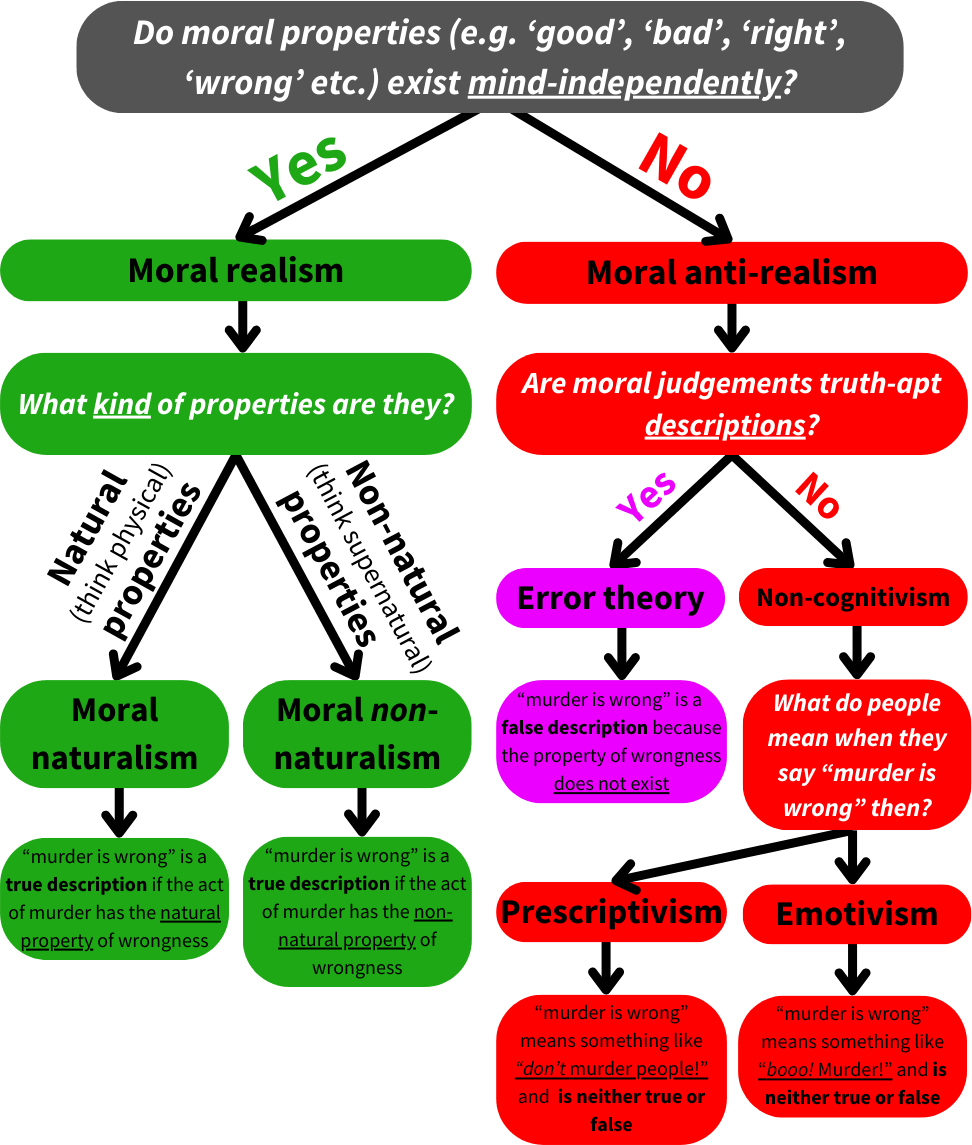
Motivation for Non-Cognitivism: As we saw in the last lesson, if you accept that the gap is unbridgeable, non-cognitivism becomes a very attractive option. If moral judgments can't be derived from facts, perhaps that's because they aren't statements of fact at all. They are expressions of attitude (emotivism) or universal commands (prescriptivism).
-
Challenge for Moral Naturalism: Moral naturalism, a form of realism, holds that moral properties are natural (e.g., physical or psychological) properties. Hume's Law presents a direct challenge to this view. If "wrongness" is just a natural property like "causing pain," then it seems a statement about causing pain should entail a statement about wrongness. Naturalists must either show that the is-ought gap is illusory or find a way to bridge it, for instance by arguing that there are analytic truths linking descriptive terms to normative ones (e.g., "An action is wrong if and only if it fails to maximize happiness").
-
Sellars' Two Images: A powerful way to frame this entire problem, especially for someone with your background, is through the 20th-century philosopher Wilfrid Sellars' distinction between the manifest image and the scientific image of the world.
Let's return to the "Normativity" video one last time to explore this profound idea.
Watch the final major segment on Sellars' two images.
The scientific image is the world as described by your physics textbooks: a collection of microparticles, fields, and forces governed by value-free causal laws. It is a world of "is." The manifest image is the world of common sense and human experience: a world of persons who act for reasons, who are free and responsible, and whose actions are subject to normative evaluation—right, wrong, rational, or foolish. It is a world infused with "ought."
Sellars argues that the central task of philosophy is to fuse these two images into a single, coherent, "stereoscopic" vision. The is-ought problem is, in this view, the philosophical expression of the deep and abiding clash between these two fundamental conceptions of reality.
Conclusion
Today, we have traced the is-ought gap from its origins in Hume's response to the scientific revolution to its modern, formal treatment in logic. We've seen that it is far more than a historical curiosity; it is a live and powerful challenge that continues to shape contemporary philosophy.
- Key Takeaways:
- Hume's Observation: Moral arguments often make an unjustified logical leap from descriptive premises ("is") to prescriptive conclusions ("ought").
- Hume's Law: Formally, this is the principle that a normative conclusion cannot be validly deduced from purely non-normative premises.
- Formal Interpretation: A sophisticated modern understanding of Hume's Law defines "normative" sentences as those whose truth-value is vulnerable to shifts in normative standards ("S-shift-breakable"). This allows for a "limited barrier" that accommodates certain counterexamples.
- Philosophical Implications: The is-ought gap is a primary motivation for non-cognitivism, a major hurdle for moral naturalism, and can be seen as the ultimate tension between the scientific and manifest images of the world.
This lesson concludes our module on ethics. We've journeyed from normative theories that tell us how to act, like utilitarianism and deontology, to metaethical theories that question the very nature of moral reality and language.
Preview of the Next Module:
We now pivot from the realm of individual morality to that of collective life. In our next module, we begin our study of Political Philosophy. We will start with one of the most influential attempts to ground political authority in a scientific understanding of human nature: Thomas Hobbes's theory of the social contract. In his own way, Hobbes undertakes the ambitious project of deriving an "ought"—the structure of a just society—from a stark and unsentimental account of what human beings are in a "state of nature."