Welcome to the first lesson of your course on mastering research in mechanical engineering. As you transition from undergraduate studies to a Master's program, developing rigorous research skills will be paramount. This initial module is designed to equip you with the fundamental tools you'll need, starting with one of the most critical: finding relevant and high-quality literature.
Today's lesson focuses on a single, vital learning outcome: to conduct a systematic literature search using academic databases and effective search strategies. This goes far beyond a simple Google search. You will learn a structured, reproducible method for exploring the vast body of academic work in your field. This skill is the bedrock for writing literature reviews, identifying research gaps, and ultimately, formulating your own research projects, including the capstone for this course.
We will explore what makes a search "systematic," how to plan your search by deconstructing a research question, how to choose the right databases for engineering, and finally, the practical techniques for building powerful search queries that yield precise and comprehensive results.
The Anatomy of a Systematic Search
Before diving into the "how," it's essential to understand the "what" and "why." A systematic literature search is the foundational phase of a Systematic Literature Review (SLR), a formal research methodology designed to minimize bias and ensure a comprehensive survey of a topic. Unlike a casual search where you might follow interesting links, a systematic search is planned, documented, and reproducible.
The following flowchart provides a high-level map of the entire SLR process. In this lesson, we will concentrate on the first two major phases: "Outline study question" and "Identifying relevant literature."
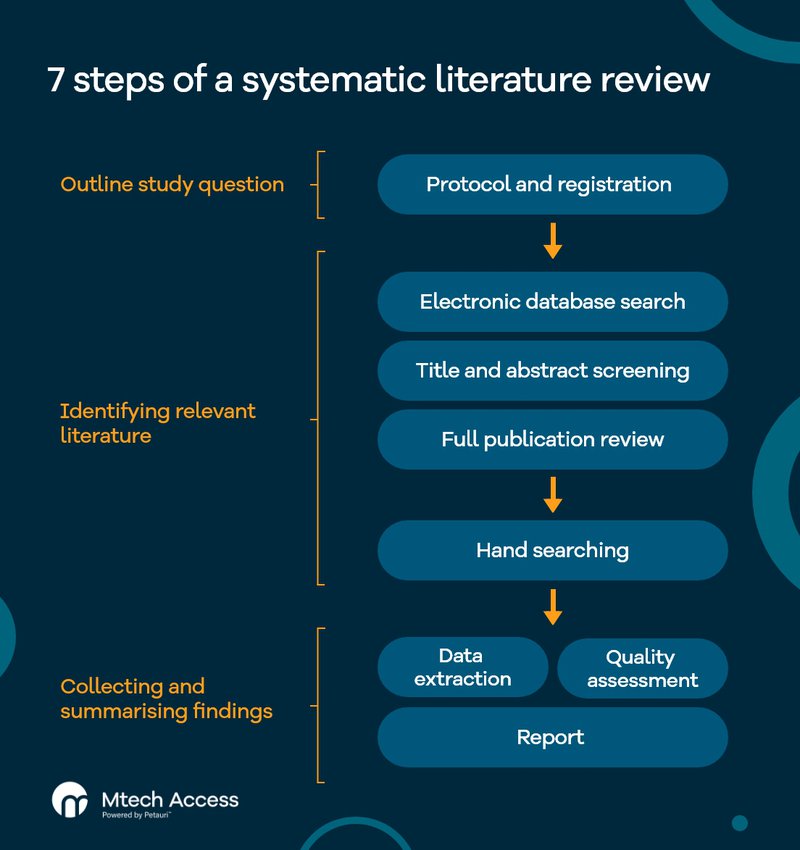
To appreciate why this structured approach is so valuable, it's helpful to contrast it with the more common "narrative" review.
💪 Systematic Literature Review Made EASY: A Step-by-Step Guide
Please watch this segment from the video "Systematic Literature Review Made EASY" by Research with Dr. Saeed. The presenter provides a clear distinction between a traditional narrative review and a systematic review.
Watch the section from the beginning of the comparison to understand the subjective nature of traditional reviews. Then, continue watching from the introduction to systematic reviews to learn about the core principles of a systematic approach: it is system-driven, transparent, reproducible, and aims to reduce researcher bias.
As the video explains, the rigor of a systematic search removes your personal judgment from the selection process as much as possible. Instead of you deciding which papers "look interesting," you design a system—a protocol—that makes the decisions for you. This transparency and objectivity are what make your findings credible to the academic community.
Phase 1: Planning Your Search Strategy
A successful search begins long before you type anything into a search box. Careful planning ensures your search is both efficient and effective. This involves defining your topic, selecting keywords, and choosing the right places to look.
From Research Question to Keywords
Every search starts with a question. A well-defined question acts as your guide. Let's use an example relevant to your interests in mechanism design and robotics:
What are the recent advancements in control strategies for compliant robotic manipulators?
To translate this question into a search query, you must first break it down into its core concepts. Then, for each concept, you need to brainstorm synonyms and related terms. Different authors will use different terminology, and a good search must capture this variety.
Search strategies – From Search to Source: Finding Reliable Information
This guide, "Search strategies," provides an excellent framework for deconstructing a topic. Focus on how it moves from a research question to a structured set of concepts and terms.
Please read the sections Keywords and synonyms and the subsequent example table. Pay close attention to the process of identifying main concepts and then finding alternative terms for each.
Applying this method to our example question, we can identify three main concepts:
- Concept 1: The device
compliant robotic manipulatorsoft robotflexible manipulatorcompliant mechanism
- Concept 2: The method
control strategycontrol systemmotion controltrajectory trackingfeedback control
- Concept 3: The focus
advancementsrecentnovelstate-of-the-art
While you can include terms from Concept 3 in your search, it's often more effective to handle this aspect using date filters within the database, which we'll discuss shortly.
Choosing the Right Academic Databases
For engineering research, specialized databases are your primary tool. They index peer-reviewed journals and conference proceedings, ensuring the information is credible. While multidisciplinary databases are useful, field-specific ones often provide deeper technical content.
For a mechanical engineer, two of the most important databases are Scopus and EI Compendex.
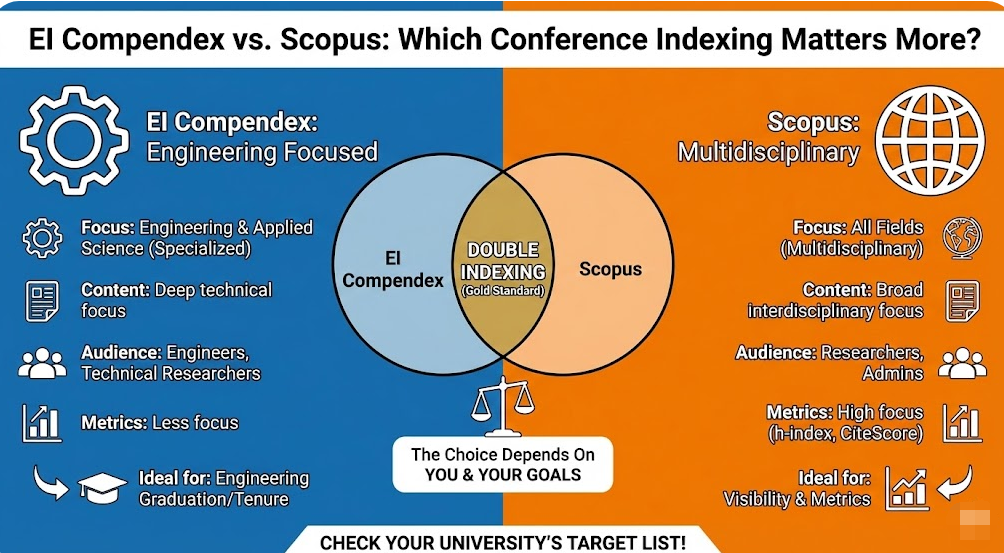
As the image shows:
- Scopus is excellent for interdisciplinary topics and provides powerful citation metrics (like the h-index), which help you gauge a paper's or author's impact.
- EI Compendex offers a deep, specialized focus on engineering and applied science, making it ideal for finding highly technical papers relevant to your core discipline.
Other critical databases for your field include:
- IEEE Xplore: Essential for topics in robotics, electronics, and computer science. It's the home of publications from the Institute of Electrical and Electronics Engineers.
- Web of Science: A major multidisciplinary database similar to Scopus, also with strong citation analysis tools.
- Google Scholar: A useful tool for broader searches and for finding papers that might be missed by other databases. However, it should be used as a supplement, not a primary source, as its quality control is less stringent.
A comprehensive systematic search typically uses at least two different databases to ensure broad coverage.
Phase 2: Executing the Search
Now we move to the practical part: building a search query and executing it in a database. A well-constructed "search string" combines your keywords with special operators to tell the database exactly what to look for.
The Toolkit: Boolean Operators and Search Modifiers
The power of database searching comes from a set of simple but powerful tools.
Search strategies – From Search to Source: Finding Reliable Information
This guide provides clear explanations of the essential operators you'll use to build a sophisticated search string.
Please read the following sections: Boolean operators (AND, OR, NOT) to understand how to combine your concepts. Phrase searching to learn how to search for exact phrases using quotation marks. Truncation to see how an asterisk (*) can find variations of a word root. Nesting to understand how to group terms using parentheses. Finally, look at the complete example to see how all these elements come together.
Let's use these tools to build a search string for our example topic. The logic is as follows:
- Use OR to group synonyms within a single concept.
- Use AND to connect the different concepts together.
- Use quotation marks
""for exact phrases. - Use the truncation symbol
*for word variations. - Use parentheses
( )to control the order of operations.
Our search string might look something like this:
("compliant robotic manipulator" OR "soft robot*" OR "flexible manipulator")
AND("control strategy" OR "control system" OR "motion control" OR "trajectory tracking")
This query instructs the database to find articles that contain at least one term from the first group AND at least one term from the second group.
Executing and Refining the Search in a Database
Let's see this in action. The following video demonstrates how to use the advanced search functionality in Scopus, one of the key databases for your field.
💪 Systematic Literature Review Made EASY: A Step-by-Step Guide
The presenter gives a live demonstration of building and executing a complex search query in Scopus. This will solidify your understanding of how to apply the search operators you just read about.
Watch the segment from the start of the Scopus demo. Focus on how the presenter: Navigates to the advanced search page. Builds a query using TITLE-ABS-KEY to search in the title, abstract, and keywords. Uses AND, OR, and parentheses ( ) to structure the search. Uses the truncation asterisk *. Uses filters on the results page to narrow the search by subject area, document type, etc. Exports the final results.
After your initial search, you will almost always need to refine the results. You can use filters provided by the database to narrow your results by:
- Publication Date: To find the "recent advancements" from our example, you could limit the search to the last 5-10 years.
- Document Type: You can often limit results to "Journal Articles" or "Conference Papers" to focus on peer-reviewed content.
- Subject Area: This can help eliminate irrelevant results if your topic crosses disciplines.
Documenting Your Process
The final, crucial step is to document everything. For a search to be reproducible, you must record exactly what you did.
This guide from the University of Ottawa library provides practical advice for graduate students.
Read the section under "Getting started," specifically the point about keeping track of your searching.
Your search log can be a simple spreadsheet with columns for:
- Database Name (e.g., Scopus)
- Date of Search
- Full Search String Used
- Filters Applied (e.g., "Date: 2018-2023; Document Type: Article")
- Number of Results Found
This record is not just for others; it's for you. It prevents you from re-doing work and allows you to systematically update your search later.
Conclusion
In this lesson, we have laid the groundwork for one of the most important skills in academic research. You have learned that a systematic literature search is a planned, transparent, and reproducible process designed to provide a comprehensive and unbiased overview of a topic.
Here are the key takeaways:
- Systematic vs. Simple: A systematic search is driven by a pre-defined protocol to minimize researcher bias, unlike a casual search.
- Plan Your Search: The process starts with a clear research question, which you deconstruct into concepts and a rich set of keywords and synonyms.
- Choose Your Tools: For mechanical engineering, databases like Scopus, EI Compendex, and IEEE Xplore are your primary sources for high-quality, peer-reviewed literature.
- Master the Syntax: Effectively using Boolean operators (
AND,OR), phrase searching (""), truncation (*), and nesting (( )) is essential for building precise and powerful search queries. - Document Everything: Keeping a detailed log of your searches is fundamental to the principles of transparency and reproducibility.
Having mastered the art of finding papers, your next challenge is to understand what's inside them. In our next lesson, we will address the learning outcome: "Critically evaluate the methodology, assumptions, and conclusions of a research paper in mechanical engineering." You will learn how to move from a list of search results to a deep, critical understanding of the research itself.