Introduction
Welcome to your second lesson. In our first session, we explored how personal memory can be the raw material for writing, and you drafted your first piece by transforming a memory into prose and then into free verse. A key takeaway was the importance of sensory detail in making an experience feel real to a reader.
Today, we will build directly on that idea. The goal of this lesson is to identify the five types of sensory imagery (visual, auditory, tactile, olfactory, and gustatory) in a literary text. By the end of our session, you will have a precise vocabulary for recognizing and describing how writers create immersive worlds. This is a foundational skill in the writer's toolkit, essential for moving from simply "telling" a reader something to "showing" them.
What is Imagery?
In creative writing, "imagery" refers to language that appeals to our five senses. It's how writers translate the world of their story or poem into a text so that a reader can experience it, not just be informed about it.
To start with a clear, straightforward definition, please watch the beginning of the following video.
Imagery | Types of Imagery | Auditory, Tactile & more | Rhetorical devices
The video 'Imagery | Types of Imagery' from the channel English with NS provides a very clear breakdown of this literary device. We'll watch the first part to establish our core definition.
Watch from 00:50 to 01:44. Focus on the core definition of imagery as descriptive language that appeals to the five senses to create mental pictures and a sensory experience.
As the video explains, imagery is about painting a picture in the reader's mind. The term is a bit misleading because it's not just about what we see. It engages our full sensory apparatus.
Here is a helpful visual summary of the five categories we'll be discussing.
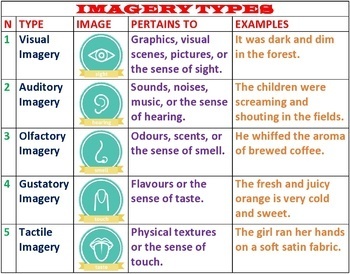
The Five Types of Sensory Imagery
Now that we have a general definition, let's explore each of the five types of imagery in detail. The same video offers concise explanations and examples for each one.
Imagery | Types of Imagery | Auditory, Tactile & more | Rhetorical devices
We will now continue with the 'Imagery | Types of Imagery' video, which devotes a section to each of the five senses.
Please watch from 01:44 to 08:56. The video is clearly sectioned, so you can follow along as it covers: Visual Imagery (sight) Auditory Imagery (sound) Olfactory Imagery (smell) Gustatory Imagery (taste) Tactile Imagery (touch) For each type, notice how the examples use specific, concrete words to evoke the sensation.
Identifying Imagery in a Literary Text
You've now seen clear definitions and simple examples. The next step is to see how these tools are used in more complex literary works. Published poets and authors weave these different sensory threads together to create rich and memorable experiences.
The following text provides poetic examples for each type of imagery. As you read, try to feel the experience each poet is creating.
4.11: Sensory Imagery - Humanities LibreTexts
The article 'Sensory Imagery' from Humanities LibreTexts offers a fantastic collection of poetic excerpts that demonstrate each type of imagery. This will help you see these concepts in action.
Please read the section titled 'Types of Sensory Images'. It begins after the 'Show Don't Tell' section. Go through the examples for Auditory, Gustatory, Olfactory, Tactile, and Visual imagery.
Analysis in Action
Let's practice identifying these different strands of imagery.
Exercise 1: Analyzing a Prose Passage
In this first short video, the narrator analyzes a passage from Kate Chopin's "The Story of an Hour." First, read the passage yourself and try to identify the types of imagery used. Then, watch the video to compare your analysis.
"What is Imagery?": A Literary Guide for English Students and Teachers
The video '"What is Imagery?"' from OSU School of Writing, Literature and Film provides a perfect, self-contained example for analysis.
First, read this passage from the story: "She could see in the open square before her house the tops of trees that were all aquiver with new spring life. The delicious breath of rain was in the air. In the street below a peddler was crying his wares. The notes of a distant song which someone was singing reached her faintly and countless sparrows were twittering in the eaves." Jot down which senses are being appealed to and which words create those effects. Then, watch the video from 00:26 to 01:17 to see the analysis.
How did you do? You likely spotted:
- Visual: "the tops of trees that were all aquiver"
- Olfactory: "The delicious breath of rain"
- Auditory: "a peddler was crying his wares," "notes of a distant song," "sparrows were twittering"
Notice how Chopin doesn't just use one type of imagery; she layers them to create a full, believable scene that immerses the reader.
Exercise 2: From Visuals to Words
Your interests include philosophical writers like Kafka, who are masters at using imagery to create a powerful mood and explore complex psychological states. Let's use this as a final exercise.
Look closely at the following illustration, inspired by Kafka's The Metamorphosis.

Your task is to describe this scene, but try to engage all five senses. Imagine you are in the room.
- Visual: What do you see? (This is the most obvious. Note the textures, the light, the cracks in the wall.)
- Auditory: What do you hear? Is there silence? A scratching sound? Muffled noises from outside the room?
- Olfactory: What does it smell like? (Dust, stale air, something else?)
- Tactile: What would you feel if you were Gregor? (The stiffness of the shell, the texture of the sheets, the temperature of the room.)
- Gustatory: What might he taste? (This is often the hardest, but perhaps there's a dryness in the mouth, or the taste of old food.)
Take a few minutes to write down a word or phrase for each sense. This exercise demonstrates how a single, powerful image can be a starting point for a full sensory exploration, which is key to conveying an abstract feeling like alienation.
Conclusion
In this lesson, we have moved from a general appreciation of sensory detail to a specific, technical understanding of imagery.
Key Takeaways:
- Imagery is the use of descriptive language that appeals to the five senses.
- The five types are: visual (sight), auditory (sound), olfactory (smell), gustatory (taste), and tactile (touch).
- Effective writers often layer multiple types of imagery to create an immersive and memorable experience for the reader.
- Analyzing imagery in texts is a critical reading skill that helps you understand how a piece of writing achieves its effects.
Preview of the Next Lesson:
Now that you can identify sensory imagery, our next step will be to apply this knowledge more directly to your own writing. In the next lesson, you will learn how to use concrete sensory details to describe an abstract emotion. We'll take feelings like joy, loneliness, or anxiety and learn how to "show" them to the reader through the five senses, rather than just "telling" them.