Welcome to the final lesson of our first module. In our last session, we established a crucial framework for quality control by learning how to evaluate AI-generated content for brand consistency and factual accuracy. You now have a systematic way to act as the editor and brand guardian for your AI assistant.
This lesson closes the loop on the "Evaluation Flywheel" we discussed. Instead of just reacting to and fixing imperfect outputs, we will now focus on proactively engineering better ones from the start. Today's goal is to learn how to write specific, structured prompts that produce consistent and usable outputs for social media tasks. This skill transforms you from a user of AI into its director, enabling you to guide the model toward the precise results you need, dramatically increasing your efficiency and the quality of your work.
The Problem with Vague Instructions
As a social media executive, you know that giving a junior team member a vague task like "write a post about our new product" would likely result in a generic first draft needing significant revision. Large Language Models, despite their vast knowledge, operate similarly. They are like infinitely capable interns who lack specific context about your goals, brand, and audience. A vague prompt leads to a vague, average output.
To get expert-level results, you must provide an expert-level brief. This is where prompt engineering comes in. Instead of random instructions, we will use structured systems, or frameworks, to build our prompts. Given your computer science background, you can think of this as moving from calling a function with no arguments to calling it with a well-defined set of parameters that precisely control its behavior.
Prompt Engineering Frameworks: Complete Systems for ...
This article from Medium provides a clear distinction between simple prompt patterns and comprehensive frameworks.
First, read the introduction, from Why Use Frameworks?. The author uses a great analogy, comparing patterns to individual LEGO blocks and frameworks to the complete instruction manual. This captures the essence of what we're aiming for: a complete system for building great prompts.
By using frameworks, we replace guesswork with a reliable, repeatable process for communicating our intent to the AI.
Deconstructing a Prompt: The Core Components
While many different prompt frameworks exist, they all share a common set of core components. Understanding these building blocks is more important than memorizing any single acronym. This video provides a concise breakdown of these essential elements.
Master the Perfect ChatGPT Prompt Formula (in just 8 minutes)!
Watch this video, "Master the Perfect ChatGPT Prompt Formula," by Jeff Su. It clearly explains the six main components of an effective prompt and their hierarchy of importance.
Watch the video from the beginning until the end of the component breakdown. Pay close attention to the six building blocks he introduces: Task: The specific action you want the AI to perform (e.g., "Write," "Analyze," "Generate"). Context: The background information, the "who, what, where, when, why." Exemplars: Examples of the desired output (we'll explore this more in the next module). Persona: The role you want the AI to adopt (e.g., "You are a senior copywriter"). Format: The desired structure of the output (e.g., table, bullet points, JSON). Tone: The stylistic and emotional quality of the writing (e.g., formal, witty, empathetic).
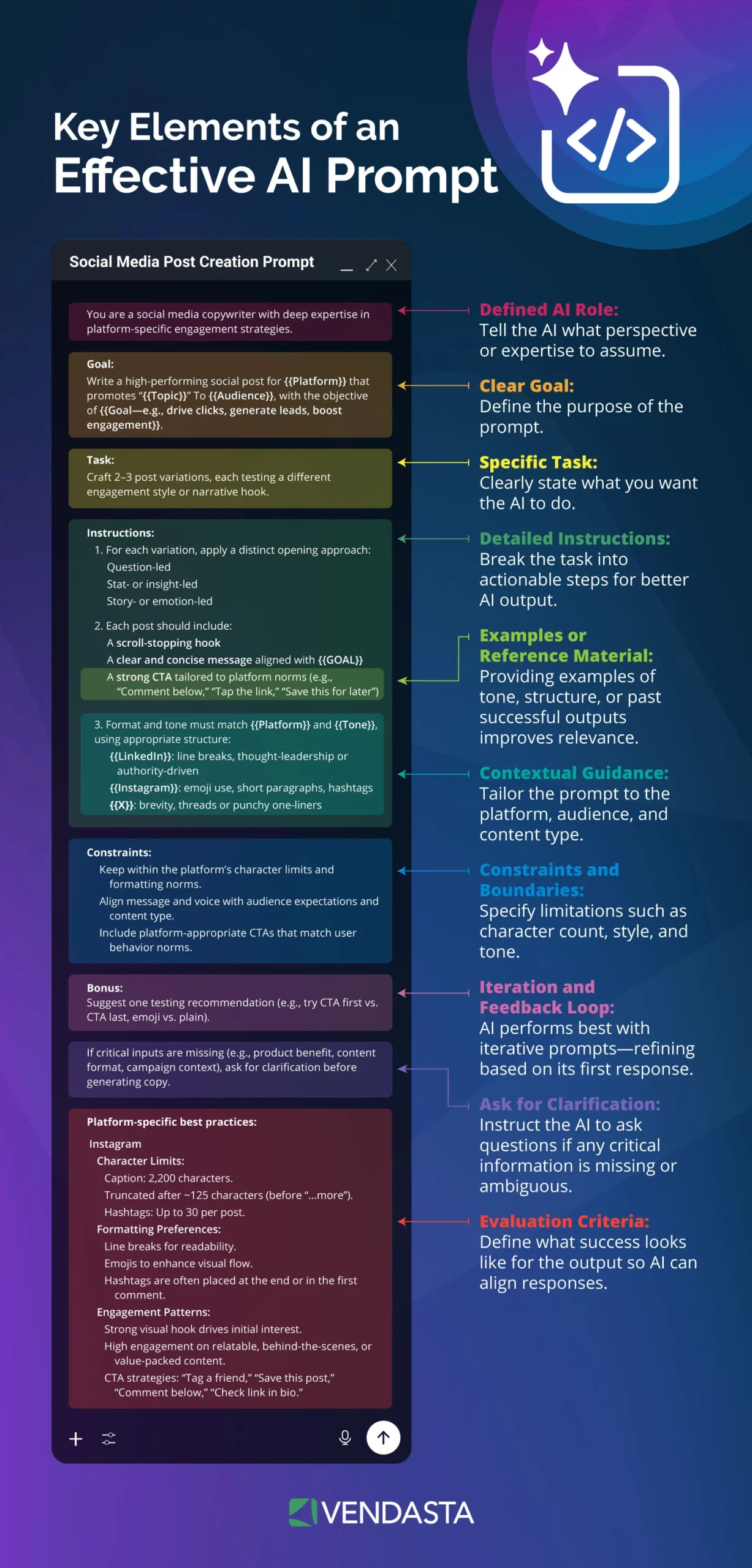
The image below, "Key Elements of an Effective AI Prompt," provides a fantastic visual summary of how these components come together in a practical social media context.
Popular Prompting Frameworks for Marketers
Now that you understand the components, let's look at a few popular frameworks that assemble them in slightly different ways. You don't need to use all of them; the goal is to find one or two that fit your workflow.
11 Must-Know ChatGPT Prompt Frameworks for Marketers
This article from ButterCMS provides an excellent overview of several prompting frameworks specifically tailored for marketing tasks.
Read through the section on frameworks. As you read, focus on understanding these three in particular: RACE (Role, Action, Context, Expectation): A simple, versatile framework for daily tasks. It's a great starting point. CRISPE (Capacity/Role, Insight, Statement, Personality, Experiment): This is a powerful framework for creative social media work because it explicitly includes Personality (tone and style) and Experiment (generating variations). COSTAR (Context, Objective, Style, Tone, Audience, Response Format): This is a highly comprehensive framework from the "Prompt Engineering Frameworks" article you read earlier. It is ideal for high-stakes content where you need to leave nothing to chance.
Notice the overlap. "Role" in RACE is similar to "Capacity" in CRISPE and the "Persona" from the video. "Expectation" in RACE covers "Format" and "Tone." The specific framework isn't as important as ensuring you've provided the AI with all the necessary information to succeed.
Practical Application: From Vague to Specific
Let's put this into practice. We'll use the example from the ButterCMS article: writing a promotional email for a reusable water bottle, but we'll adapt it for a social media post.
Initial Vague Prompt:
"Write a social media post about our new reusable water bottle."
The output would be generic, lacking brand voice, a clear call to action, or audience awareness. As a social media expert, you'd immediately discard it.
Applying the CRISPE Framework:
Now, let's build a structured prompt piece by piece.
- C (Capacity/Role): "You are a brand marketing copywriter for an eco-conscious lifestyle brand."
- I (Insight): "Our target audience is environmentally-conscious millennials who care about reducing plastic waste and prefer stylish, sustainable, and cost-effective products. Our new bottle is made from 100% recycled plastic."
- S (Statement): "Write an Instagram post to launch our new reusable water bottle."
- P (Personality): "The tone should be engaging, friendly, and upbeat, reflecting our eco-friendly values. It should connect with customers on an emotional level, inspiring them to make a positive impact."
- E (Experiment): "Generate 3 distinct versions of the caption. Each should have a different opening hook. Include 3-5 relevant hashtags."
The Final, Structured Prompt:
You are a brand marketing copywriter for an eco-conscious lifestyle brand. Our target audience is environmentally-conscious millennials who care about reducing plastic waste and prefer stylish, sustainable, and cost-effective products. Our new bottle is made from 100% recycled plastic.
Your task is to write an Instagram post to launch this new water bottle.
The tone should be engaging, friendly, and upbeat, reflecting our eco-friendly values. It should connect with customers on an emotional level, inspiring them to make a positive impact.
Generate 3 distinct versions of the caption. Each should have a different opening hook. All versions should end with a call to action to shop the link in our bio and include 3-5 relevant hashtags.
The output from this prompt will be significantly more targeted, on-brand, and immediately usable. The difference in quality comes not from a better AI, but from better instructions. The image below provides more examples of such structured prompts for various social media tasks.

Iterating on Your Prompts
Even with a great framework, your first prompt might not be perfect. Prompting is an iterative process. Here are two powerful techniques for refining your prompts and outputs, which leverage the AI itself as a collaborator.
The Step-by-Step master class on writing better prompts than 99% of people
This video from the Enovair channel, though a bit long, contains some exceptional "hacks" for advanced prompting. We will focus on two of them.
First, watch the section on the AI Prompt Helper, from Hack number two. This demonstrates how you can ask the AI to analyze and improve your own prompts, which is a fantastic way to learn and get better results. Next, watch the section on making the AI its own editor, from Hack number four. In this "self-improvement loop," you ask the AI to critique its own response and rewrite it. This is an incredibly powerful way to iterate on a draft without having to manually tweak your prompt each time.
By using these iterative techniques, you are actively managing the "Improve" step of the Evaluation Flywheel. You're not just fixing the output; you're teaching the AI (and yourself) how to do better next time.
Conclusion
In this lesson, you've learned to transition from being a passive recipient of AI-generated content to an active director of its creation. By providing clear, structured instructions, you can guide the AI to produce outputs that are far more consistent, relevant, and aligned with your strategic goals.
Here are the key takeaways:
- Vague Prompts Yield Vague Results: To get expert-level output, you must provide an expert-level brief.
- Frameworks Provide Structure: Frameworks like RACE, CRISPE, and COSTAR provide a reliable "recipe" for building effective prompts by ensuring you include all the necessary components.
- The Core Components are Key: More important than any single framework are the building blocks: Role, Context, Task, Format, Tone, and Examples.
- Prompting is Iterative: Use techniques like the "AI Prompt Helper" and "Self-Critique" to refine your prompts and outputs, turning the AI into a collaborative partner.
This lesson concludes our first module, "AI-Assisted Strategy Foundations." You now have a complete workflow for using an AI assistant to analyze data, generate ideas, draft copy, evaluate the results, and refine your prompts for continuous improvement.
In our next module, "Advanced Prompt Engineering for Campaigns," we will build directly on these skills. The first lesson will dive deep into a technique we briefly mentioned today: few-shot prompting, where you provide the AI with specific examples to gain granular control over the format and style of your content.