Introduction
Welcome to our final lesson in the "Social Positioning and Reputational Warfare" module. Over the past few lessons, we've dissected the ways online groups establish and enforce norms through tactics like moral policing and gatekeeping. We've focused on how communities control who belongs and what behaviors are acceptable. Today, we shift from these group-level dynamics to more intimate, but equally potent, forms of manipulation that you will likely encounter in your direct messages and comment sections.
This lesson addresses two specific tactics: negging and triangulation. Our goal is to equip you with strategies to neutralize the subtle confidence erosion of negging and to gracefully disengage from the manufactured drama of triangulation. For you, as a lingerie designer and a public figure in alternative lifestyle communities, mastering these defenses is crucial. Negging directly targets your appearance and choices, while triangulation seeks to weaponize your influence and embroil you in disputes. By the end of this lesson, you will have a clear framework for identifying and defusing both.
Part 1: Neutralizing Negging
Negging is a manipulative tactic that cloaks an insult within a backhanded compliment. Its primary purpose is to subtly undermine your self-confidence, making you more susceptible to the manipulator's influence. It's a psychological probe designed to find and exploit your insecurities.
To understand its mechanics, it's helpful to see it as a form of psychological "negation" that operates through intermittent reinforcement—a mix of positive and negative signals that creates confusion and a desire for the manipulator's approval.
Reject Toxic Help , Backhanded Compliments, Negging!
The video "Reject Toxic Help, Backhanded Compliments, Negging!" by the channel Nothingness: Antidote to Narcissism offers a precise breakdown of the psychology behind negging.
First, watch the introduction to the concept of negging from this segment. Then, focus on the speaker's analysis of the backhanded compliment's formula: "compliment what you do, but attack who you are." Finally, watch the explanation of how this tactic functions as intermittent reinforcement from this part, creating disorientation.
As the video explains, a neg is not a direct insult. It's crafted to be deniable, leaving you wondering if you're being overly sensitive. This ambiguity is the source of its power.
Let's look at some examples tailored to your online presence.
Amanda LaCount Column: Back-Handed Compliments Are Really ...
This article by Amanda LaCount provides excellent real-world examples of negging, especially related to body image and public perception, which are highly relevant.
Read the sections detailing the author's experiences with backhanded compliments. Focus on the examples like "I wish I had your confidence" and the comments she receives when she wears revealing items like a bikini, described from this point onward.
The examples in the article are classic negging formulas. Here’s how they might manifest in your comments section:
-
On a photo of your lingerie design:
- "You're so brave to post photos like this. I could never."
- Translation: "Normal people wouldn't post this; you are an outlier, and perhaps you should feel self-conscious." The compliment ("brave") is a vehicle for an implied judgment.
- "That's a beautiful design! It would look incredible on a 'real' model."
- Translation: "Your work is good, but you are not." This directly applies the formula: compliment the action (design), attack the person (you).
- "You're so brave to post photos like this. I could never."
-
On a post about your relationship dynamic:
- "It's amazing that you're so open about your lifestyle. Your husband is a saint for being so supportive."
- Translation: "Your choices are strange and require exceptional tolerance from others." This minimizes your agency and frames your partner's acceptance as the truly remarkable, and difficult, feat.
- "It's amazing that you're so open about your lifestyle. Your husband is a saint for being so supportive."
Strategies to Neutralize Negging
Given your background in game theory, you can view a neg as an opening move in a psychological game where the opponent's goal is to destabilize you. Your goal is not to "win" the game on their terms but to invalidate the game itself.
Strategy 1: The Gray Rock Method (Strategic Disengagement)
The most effective response to negging is often no response, or a response so dull it offers no emotional purchase. This technique is known as "going gray rock."
What happens when you go "gray rock"?
In this video, "What happens when you go 'gray rock'?", Dr. Ramani explains this powerful disengagement technique.
Watch the definition of gray rock from the beginning. Next, understand the psychological principle of why it works by denying "narcissistic supply" from this segment. Finally, listen to the comparison between gray rocking and direct confrontation from this part.
A negger craves a reaction—defensiveness, anger, or confusion. This reaction is their "supply." Going gray rock starves them of this supply.
- Neg: "You're so brave to wear that."
- Gray Rock Responses:
- Simply 'liking' the comment and moving on.
- A bland reply: "Thanks for your feedback."
- Ignoring it completely.
This response is highly efficient. It requires minimal energy and makes the negger's attempt to provoke you obvious and impotent.
Strategy 2: Calmly Question the Premise (Strategic Re-framing)
This is a more active strategy for situations where you feel a response is warranted. Instead of getting defensive, you use curiosity to turn the spotlight back on the negger's underlying assumption.
Amanda LaCount Column: Back-Handed Compliments Are Really ...
The author briefly touches on a more direct approach in the conclusion of the article.
Read the final two paragraphs, where the author suggests you can "call them out" and educate them.
While the author suggests this for educational purposes, we can adapt it as a powerful re-framing tool.
- Neg: "You're so brave to wear that."
- Re-framing Response: "That's an interesting perspective. What about it seems brave to you?"
This does several things:
- It avoids accepting the premise that your action is unusual.
- It calmly puts the burden of explanation on them.
- It forces them to either expose their prejudice ("Well, most women with your body type wouldn't...") or retreat ("Oh, I just meant it looks great").
Choosing between Gray Rock and Re-framing depends on your energy and goals. Gray Rock is for efficient dismissal. Re-framing is for actively dismantling the manipulator's frame.
Part 2: Disengaging from Triangulation
Triangulation is the act of bringing a third party into a two-person conflict. The goal is to avoid direct communication, validate one's own position, and build an alliance against the other person. The manipulator casts themselves as the Victim, the other person as the Persecutor, and attempts to recruit you as the Rescuer.
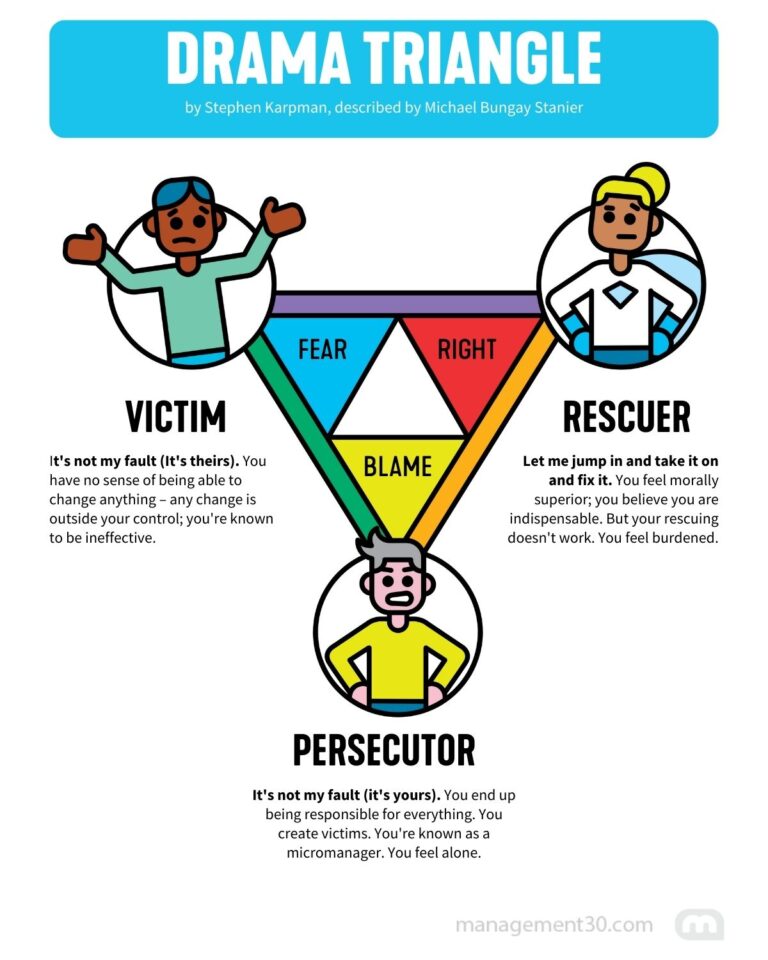
This dynamic is incredibly common in online communities, where it's easy to pull others into disputes via DMs, @-mentions, or vague public posts.
How To De-Escalate Conflict & Build Stronger Movements
This article by Kai Cheng Thom provides a superb, systems-level explanation of triangulation and its function in conflicts.
Read the section titled "Conflict De-Escalation & Triangulation." Pay close attention to the concept of being "at the point of the triangle" and the outsized influence this third party has.
As an efficiency expert, you can view triangulation as the deliberate introduction of instability into a system. A conflict between two people (a dyad) is complex enough. Adding a third person (a triad) exponentially increases the variables and communication pathways, making a clean resolution nearly impossible. The triangulator thrives in this chaos.
Identifying Triangulation
You are a prime target for triangulation because of your visibility. People will want to leverage your influence.
- Scenario: A follower DMs you: "I can't believe @SomeUser is attacking your lifestyle in the comments. They did the same thing to me last week. You have a bigger platform, you should really call them out. We need to stand up to them."
- Analysis: Party A (the follower) is in conflict with Party B (@SomeUser). They are pulling you in as Party C (The "Point"), casting you as a powerful Rescuer to fight their battle.
The image below offers a set of reflective questions for each party in a conflict. As someone being pulled into the "Point" (Party C), these questions are your first line of defense.

Strategies for Disengagement
Your goal is to refuse the role of Rescuer and step out of the triangle.
Strategy 1: Maintain Neutrality and Encourage Direct Communication
This is your default strategy. You explicitly refuse to take a side and redirect the responsibility back to the original parties.
- Triangulation Attempt: "You should really call out @SomeUser for what they said."
- Disengagement Response: "I appreciate you bringing this to my attention, but I think this is a conflict between the two of you. I'm not comfortable getting in the middle of it. I encourage you to address your concerns with them directly."
This response is firm, clear, and boundary-setting. It refuses the role of Rescuer and dissolves the triangle.
Strategy 2: The "Metaskills" Approach for Constructive De-escalation
In some cases, especially with people you value within your community, you might choose to take a more constructive, but still neutral, role. This involves using what Kai Cheng Thom calls "metaskills" and "microskills" to guide the person toward resolution without becoming entangled yourself.
How To De-Escalate Conflict & Build Stronger Movements
This section of the article outlines a set of practical skills for de-escalation.
Read the section titled "Conflict Metaskills & Microskills." Focus on the definitions of Curious Questions and Firm Boundaries.
Let's apply these microskills.
- Triangulation Attempt: "I'm so hurt that my friend @Friend is siding with people who criticize your cuckold-hotwife content. They should be supporting us."
- De-escalation Response:
- Compassionate Statement (Validate feeling, not content): "It sounds like you feel really betrayed by your friend's position. That must be painful."
- Curious Question (Promote self-reflection): "What would ideal support from @Friend look like for you in this situation?" or "Have you had a chance to talk to them about how their comments made you feel?"
- Firm Boundary (Refuse the role): "I can be here to listen as you process this, but I can't intervene in your friendship with them. That's a boundary I need to maintain."
This approach allows you to be supportive without getting caught in the crossfire. You are acting as a sounding board, not a weapon.
Conclusion
Today, we've added two vital defensive maneuvers to your skillset for navigating social media. You are now equipped to handle both the subtle erosion of negging and the dramatic entanglement of triangulation.
Key Takeaways:
- Negging is a backhanded compliment designed to lower your status and confidence. Neutralize it by either starving it of an emotional reaction (Gray Rock method) or by calmly questioning its underlying premise (Re-framing).
- Triangulation pulls you into a conflict as a third party to serve someone else's agenda. Disengage by maintaining strict neutrality, setting firm boundaries, and always encouraging direct communication between the original parties.
- Both tactics are fundamentally about casting you in a role—the insecure target or the powerful rescuer. Your primary defense is to recognize the script and refuse to play your assigned part.
This lesson concludes our module on "Social Positioning and Reputational Warfare." You now have a comprehensive framework for understanding and defending against personal and group-level attacks on your reputation and standing.
In our next module, "The Attention and Outrage Economy," we will zoom out. Instead of just focusing on the tactics people use, we'll investigate the systemic engine that incentivizes this behavior: the social media economy that runs on engagement, emotion, and outrage. We will explore concepts like clout chasing and envy baiting, and you will even apply your Design of Experiments background to create a framework for ethically testing your own content strategies.