Introduction
Welcome to our next lesson. In our previous discussion, we deconstructed negging, analyzing how backhanded compliments are used to undermine confidence and establish dominance. We now move to another powerful and complex social positioning tactic: the victim complex. While negging is a direct, albeit veiled, attack on an individual, the victim complex operates by manipulating the social perception of an entire conflict.
Our learning objective for this session is to define victim complex and identify its use as a defensive and offensive tool in community disputes. This is an especially critical concept for you. Given your public presence as a lingerie designer and your open participation in alternative lifestyle communities, you operate in spaces where disagreements can be frequent and intense. Understanding how individuals strategically adopt a victim persona to win arguments, evade accountability, or even attack others is essential for navigating these dynamics without being unfairly targeted or manipulated.
Part 1: From Personal Grievance to Social Strategy
At its simplest, a victim complex is a personality trait where an individual feels constantly victimized by the actions of others, even in neutral situations. However, in the context of online disputes, this goes beyond a mere personality trait and becomes a strategic tool. It's a method of reframing a conflict not as a disagreement between equals, but as an act of oppression by a powerful aggressor against a helpless victim.
To understand the mechanics of this, we first need to place it within a broader sociological framework. The following resource, an article summarizing the work of sociologists Bradley Campbell and Jason Manning, introduces the concept of a "culture of victimhood." This will provide a strong theoretical foundation for the rest of our lesson.
Where microaggressions really come from: A sociological account
This article from Jonathan Haidt's blog, The Righteous Mind, summarizes a key academic paper that contrasts a "culture of dignity" with an emerging "culture of victimhood." It explains why publicizing one's grievances has become a powerful social strategy.
First, read the introduction, starting from the beginning. This will introduce the core idea of a culture where individuals appeal to third parties (like an online audience) by highlighting their victimization. Next, focus on the section titled "Victimhood as Virtue." This part is crucial, as it explains the central mechanism: in certain contexts, claiming victim status doesn't lower your social standing, but actually raises your moral status, making you appear innocent and worthy of support.
As the article highlights, the key insight is that presenting oneself as a victim can be a powerful way to gain moral authority. In an online dispute, the person who successfully casts themselves as the "victim" often wins the support of the audience, regardless of the facts of the matter. This transforms a simple disagreement into a moral play where bystanders feel compelled to rush to the defense of the "oppressed."
Part 2: The Victim Complex as a Weapon: Crybullies and DARVO
When victimhood is used strategically, it can be both a shield (defensive) and a sword (offensive). A useful modern term for someone who wields this weapon is a "crybully"—a person who aggressively attacks or provokes others, but then claims to be the victim the moment they face criticism or consequences.
The 'Crybully' Phenomenon: You've Seen It Before, but It's Viral Now!
This article from The Teen Magazine provides a clear and direct explanation of the "crybully" and the psychological tactics they use.
Read the introductory section for a concise definition of a 'crybully'. Then, read the section titled "The Psychology Behind the Crybully." Pay close attention to the five points it raises, especially the DARVO strategy and the concept of "Victimhood Currency."
The DARVO strategy is the operational sequence of the crybully. It's an acronym that stands for Deny, Attack, and Reverse Victim and Offender.
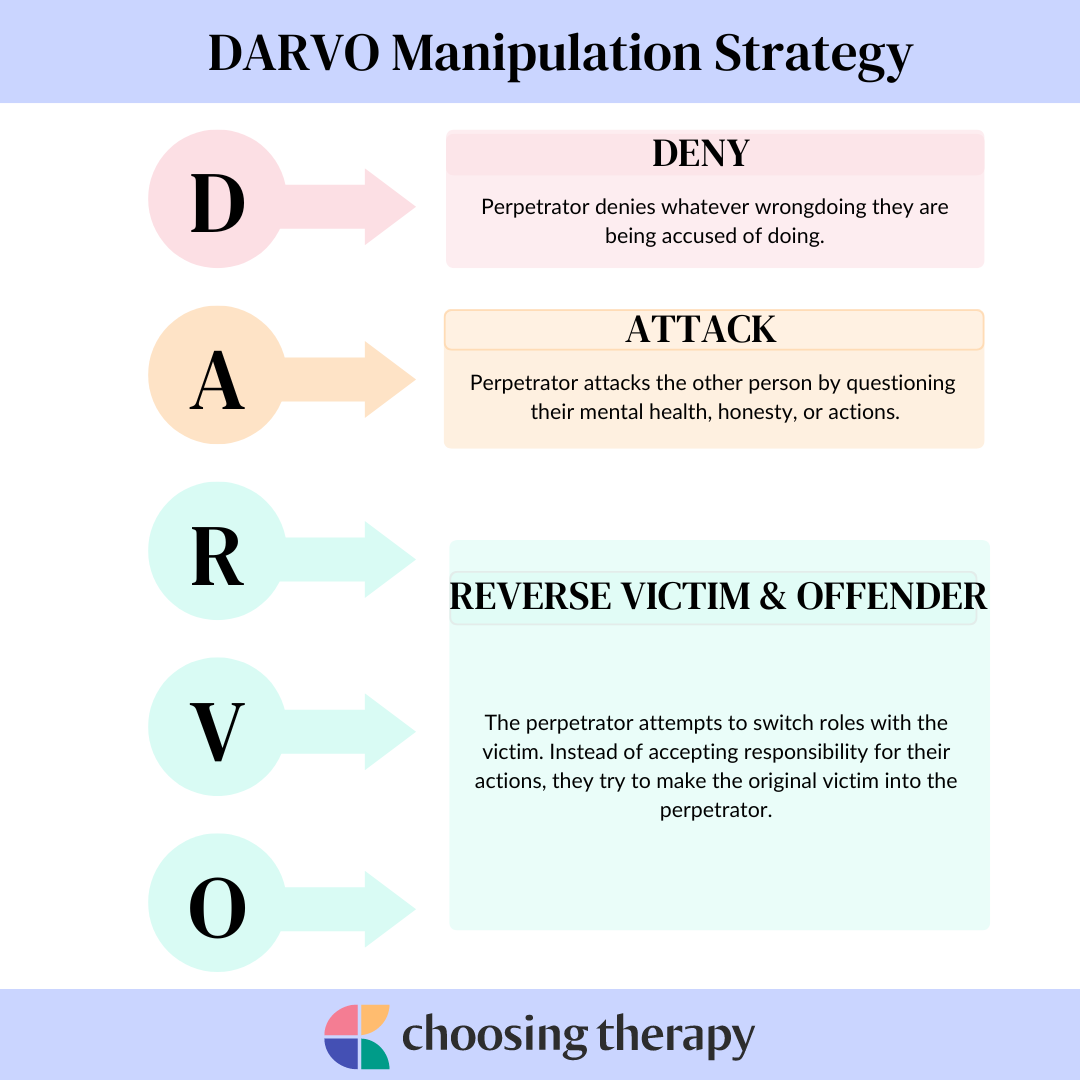
Let's break down how this works in practice:
- Deny: The perpetrator denies their wrongdoing.
- Attack: Instead of addressing the issue, they attack the person who is holding them accountable, often questioning their credibility, sanity, or motives.
- Reverse Victim and Offender: This is the crucial step. The perpetrator claims that they are the one being attacked, bullied, or victimized. The original victim is now cast as the aggressor.
This script is incredibly effective because it hijacks our natural empathy. An audience sees someone claiming to be hurt and may instinctively rush to their defense, without first analyzing who initiated the conflict.
Part 3: The "Virtuous Victim" and Its Appeal
Why is claiming victimhood so effective? Research in psychology points to the "virtuous victim effect." People tend to perceive victims as being more moral, trustworthy, and deserving of support. This perception creates a powerful incentive for individuals, particularly those with manipulative tendencies, to feign victimhood.
The following video segment with Rob Henderson, a Cambridge PhD and expert on social status, delves into this phenomenon and its connection to darker personality traits.
The Psychology of Victimhood, Envy, and Social Status with Rob Henderson | Blendr Report EP154
This interview with Rob Henderson on the Blendr Report provides a psychological explanation for why victimhood is so appealing and how it is exploited.
Please watch the segment from this timestamp. Henderson explains the "virtuous victim effect," where being perceived as a victim grants you moral leeway. Critically, he then connects the propensity to signal victimhood to the "dark triad" personality traits: narcissism, Machiavellianism, and psychopathy.
Henderson makes a crucial distinction: actual victims are not inherently narcissistic. Rather, individuals with narcissistic and Machiavellian traits are more likely to feign or exaggerate victimhood to achieve their goals—be it sympathy, resources, or winning an argument.
Your background in statistics makes the following graph particularly relevant. It visualizes the findings from a recent study on this topic, showing the correlation between a "Virtuous Victim Signal" (the tendency to publicly signal one's victimhood) and a combined score of Machiavellianism and Narcissism.

An of 0.299 is a moderately strong relationship in social psychology. It quantitatively supports the idea that a significant portion of performative victimhood isn't random but is tied to manipulative personality structures.
Part 4: Identifying and Responding to Victim Complex in Your World
Let's apply this to your online communities.
Scenario 1: Defending Your Lingerie Designs (Defensive Use)
- The Setup: You post a new bikini top design. Someone comments, "This is just another example of catering to the male gaze. It's not empowering for women."
- The Conflict: You reply, "I design for women who enjoy expressing their sensuality. Empowerment comes from choice, and this is one of them."
- The DARVO Flip: The commenter replies, "Wow, I can't believe you're attacking me for having a feminist critique. I'm just trying to have a serious conversation and you're making it personal. I feel really silenced."
Here, the commenter has used your reasonable defense as a pretext to cast themselves as the victim. You are now framed as the "attacker," and they are the "silenced" victim. They've shifted the topic from the design to your supposed aggression.
Scenario 2: Community Dispute (Offensive Use)
- The Setup: In a polyamory discussion group, a member consistently makes passive-aggressive remarks about hotwife dynamics, implying they are less "evolved." Let's call this person Alex.
- The Conflict: You finally address it publicly: "Alex, I've noticed you often make comments that seem to judge the hotwife lifestyle. Can we discuss this openly?"
- The DARVO Flip & Offensive Campaign: Alex responds not to you, but with a new post to the whole group: "I'm heartbroken to announce I'm being targeted and bullied in this group just for having a different perspective on relationships. Certain members with big followings are trying to drive me out. I've never felt so unsafe."
Alex has used your direct confrontation to launch an offensive campaign. By claiming to be a "bullied" victim, Alex is not just defending themself but is actively trying to mobilize the community against you and damage your reputation.
Your Response Framework:
Dealing with a crybully requires you to avoid their frame entirely. Do not get drawn into an argument about their feelings.
-
Stay Factual and Calm: Your analytical mindset is your greatest asset. Do not engage with the emotional accusation. Instead, bring the conversation back to the original point.
- "I'm not going to engage with accusations of 'attacking' you. My previous comment was a direct response to your critique of my design. The topic was empowerment and choice."
-
Do Not Apologize for Their "Feelings": Avoid saying "I'm sorry you feel that way." This validates their frame. You are not responsible for their strategic emotional performance.
-
Hold the Mirror Up (Use with Caution): You can calmly point out the dynamic without being aggressive.
- "We were having a discussion about topic A. When I disagreed, you shifted to topic B, which is my supposed aggression towards you. Can we return to topic A?"
-
Disengage and Document: The most powerful response is often to refuse to play. State your position clearly one last time and then disengage. If they escalate, use your platform's tools (mute, block) and keep screenshots. You cannot win a game that is rigged for you to be the villain.
Conclusion
In this lesson, we have explored the victim complex not just as a personality type but as a potent manipulative strategy in online disputes. By understanding its mechanics, you can better protect your reputation and emotional energy.
Key Takeaways:
- The victim complex can be used as a strategic tool to reframe conflicts, where the manipulator casts themselves as the oppressed party to gain moral authority.
- A "crybully" is someone who initiates aggression but plays the victim when confronted, often using the DARVO (Deny, Attack, Reverse Victim & Offender) script.
- The "virtuous victim effect" provides a psychological incentive for this behavior, as people instinctively grant moral leeway to those they perceive as victims.
- Feigning victimhood is strongly correlated with dark triad personality traits, indicating its use as a calculated, manipulative tactic.
- Effective responses involve staying factual, refusing to accept the victim frame, and strategically disengaging from bad-faith actors.
In our next lesson, we will examine a tactic that often works hand-in-hand with the victim complex: timeless betrayal. We will explore how past actions, photos, or posts can be dug up and weaponized out of context to create a new narrative of wrongdoing, often to support a claim of current victimization.