In our last lesson, we developed a computational model for social media engagement, framing it as a reinforcement learning process where you, the user, act to maximize social rewards. We established that the platform's power lies in its use of intermittent random rewards to keep you in a dopamine-driven seeking loop.
Today, we will delve deeper to answer a fundamental question: why are these social rewards so potent? Our objective is to identify the core psychological principles that give these rewards their power. These principles are the universal "source code" for influence and persuasion, and they form the bedrock of the specific manipulation tactics we will dissect throughout this course. By understanding them, you gain the ability to both recognize when they are being used against you and apply them ethically to build your own authentic brand.
The Architecture of Human Motivation
Before we examine specific influence tactics, it's useful to consider the fundamental human needs they exploit. Many psychological theories aim to map these needs, but one of the most enduring is Abraham Maslow's hierarchy. While often presented in a simplified form, it provides a powerful lens for understanding online behavior.

The principles of influence we're about to explore are effective precisely because they tap into these deep-seated needs for belonging, esteem, and security.
Cialdini's Principles of Influence
The most robust and widely recognized framework for understanding the mechanics of persuasion comes from the work of psychologist Dr. Robert Cialdini. He identified seven universal principles that direct human behavior. These are not tricks, but rather mental shortcuts our brains use to make decisions more efficiently. Manipulators exploit these shortcuts; ethical communicators use them to create genuine connection and understanding.
This short video features Dr. Cialdini himself providing a concise overview of his seven principles.
Robert Cialdini Explains the Seven Principles of Influence | Brainfluence Brief
This video from Roger Dooley's "Brainfluence" channel is a perfect introduction to the seven principles of influence, explained by their originator.
Please watch the entire video from start to finish. As you watch, think about how each principle might manifest in your own social media interactions, both as a creator and a community member.
Now, let's break down these principles and apply them directly to your context as a lingerie designer and public figure in alternative lifestyle communities.
1. Reciprocity
The Principle: We are wired to give back to others the form of behavior they have first given to us. If someone gives you a gift, you feel indebted. If they make a concession in a negotiation, you feel compelled to make one in return.
In the Digital World:
This is the engine of "engagement." When someone leaves a thoughtful, detailed comment on a photo of your new bikini top, you likely feel a strong pull to visit their profile and like a few of their posts. This isn't just politeness; it's the reciprocity principle in action.
However, this can be weaponized. In a tactic we'll later call love bombing, an individual might shower you with excessive, unsolicited engagement to create a powerful feeling of indebtedness, making it harder for you to refuse their later requests.
A more systematized form of this is the use of "pods."
[PDF] Playing the visibility game: How digital influencers and algorithms ...
This research paper by Kelley Cotter examines how Instagram influencers understand and interact with the platform's algorithm. It introduces the key distinction between "relational" and "simulated" influence.
In the "Playing the game" section, focus on the subsection titled "Simulated influence." Read about the tactic of reciprocal engagement groups known as 'pods'. Pay attention to how they are described as a business agreement. This is a clear example of automating the reciprocity principle to generate signals for the algorithm.
Pods work by creating a closed system of forced reciprocity. The goal isn't genuine connection but to "seed engagement" and signal to the algorithm that a post is popular.
2. Social Proof
The Principle: When we are uncertain how to act, we look to the behavior of others to guide our own. This is especially true when those others are numerous or similar to us. If a restaurant is packed with people, we assume the food is good.
In the Digital World:
Social proof is the currency of social media. Follower counts, likes, shares, and positive comments are all signals that tell new viewers, "This person is valuable. Their content is worth your time. Others like you approve of them." For your work, a post with 1,000 likes and 100 positive comments is infinitely more compelling than one with 10 likes and no comments. This is why "going viral" is so coveted—it's the ultimate display of social proof.
The image below gives a great summary of common strategies for generating this effect.
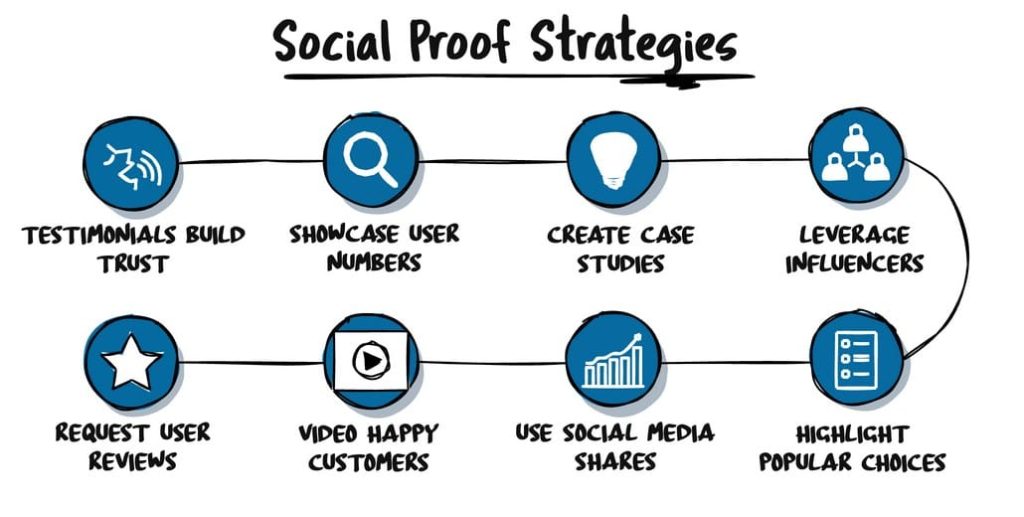
Influencers are acutely aware of this, and their strategies often revolve around manufacturing social proof. This brings us back to the "visibility game" paper, which you'll find draws a critical distinction.
[PDF] Playing the visibility game: How digital influencers and algorithms ...
This paper provides a powerful lens for understanding the two faces of social proof.
Return to the "Playing the game" section. First, read the subsection on "Relational influence." This describes generating authentic social proof through genuine relationships and creating high-quality content. Next, contrast this with the subsection on "Simulated influence." Note how tactics like bots and Follow/Unfollow (F/UF) are designed to create the appearance of popularity and status without the underlying substance. The goal is to signal popularity even without real connection.
Understanding this distinction is crucial. As a creator, you can ethically build social proof through relational strategies. As a user, you must be vigilant for simulated social proof, which is a hallmark of inauthentic accounts and manipulative actors.
3. Authority
The Principle: We are more likely to comply with requests from, and be persuaded by, individuals who are perceived as credible experts or authority figures. We trust a doctor's medical advice or a financial advisor's investment tips.
In the Digital World:
Authority is often signaled by expertise and credibility. In your niche, this could be a well-known boudoir photographer, a respected author on polyamory, or a major lingerie brand. If one of these authorities shares your work, their credibility is transferred to you, acting as a powerful endorsement. This is why "influencer marketing" works.
However, the signals of authority can be faked. A user might create a profile that falsely claims credentials or affiliations. This is where your vigilance is required to assess whether someone's authority is genuine or merely a performance.
4. Liking and 5. Unity
The Principle: We prefer to say "yes" to people we know and like. Liking is driven by factors like physical attractiveness, similarity, and compliments. Unity is a special, more powerful form of liking where we perceive someone as being of us—part of our tribe.
In the Digital World:
This is the foundation of online communities. In a hotwife or polyamory forum, a person who shares your values, uses the correct in-group terminology, and articulates a familiar struggle instantly becomes more credible and persuasive. They are "one of us." This is also why, as a creator of provocative content, compliments and messages from people who "get it" feel so validating—they affirm your shared identity.
Manipulators exploit this by a process called mirroring. They study your profile and language, then reflect it back to you to create an artificial sense of similarity and rapport. They signal they are part of your tribe to lower your defenses.
6. Scarcity
The Principle: We assign more value to opportunities that are less available. Things that are limited in number, available for a limited time, or are one-of-a-kind become more desirable.
In the Digital World:
This is a classic marketing tactic. You might use it ethically by offering a "limited edition" lingerie design that is only sold for one week. This creates urgency. Scarcity can also be about access. For example, "exclusive" online groups or communities that are difficult to join are often perceived as more valuable, a tactic known as gatekeeping.
7. Commitment and Consistency
The Principle: We have a deep psychological need to be consistent with what we have already said or done. Once we make a choice or take a stand, we encounter personal and interpersonal pressure to behave consistently with that commitment.
In the Digital World:
This is the principle that makes platforms "sticky." The Hook Model, which we saw in the last lesson, calls this the "Investment" phase.
How to Build Habit-Forming Products - Nir Eyal
Nir Eyal, author of Hooked, explains this final, crucial step of the model.
Please watch the segment on the Investment Phase, from the beginning of the section to where he discusses reputation. Pay close attention to how he defines investment as putting something into the product (time, data, content, followers, reputation) that makes it better with use and harder to leave.
Every photo you post, every follower you gain, every bit of your public reputation you build on a platform is an investment. You become committed to that persona and that platform. This can be used against you in a tactic called timeless betrayal, where someone digs up an old post and uses your commitment to a consistent public identity to attack you. It also explains why walking away from a large, established account feels so difficult—you are fighting against your own psychological need for consistency with your past investment.
A Unifying Theory: Costly Signalling
Your background in game theory and econometrics provides a unique lens through which to unify these principles: Costly Signalling Theory (CST). CST proposes that for a signal to be honest and reliable, it must be costly to send. In the animal kingdom, a peacock's large tail is a reliable signal of fitness because it's metabolically expensive to grow and makes it vulnerable to predators—a less fit peacock couldn't afford it.
In human communication, this "cost" is often reputational. Spreading truth and valuable information builds your reputation (a reward). Spreading lies risks damaging it (a cost). Social media fundamentally alters this cost-benefit analysis.
How online misinformation works: a costly signalling perspective
This paper provides a formal framework for understanding how the digital environment changes the incentives for truthful communication.
First, read the introduction to "Costly signalling theory" to grasp the core concept of production costs vs. social costs, and how the threat of reputational damage acts as a deterrent. Next, read "Costly signals in human communication" to see how this applies to reputational rewards and costs. Then, jump to the section "New communicative acts." Focus on how reposting is a 'cheap' signal that provides plausible deniability, lowering the cost of spreading misinformation. After that, read the section on "Gamification." This connects directly to the influencer "visibility game," explaining how platform metrics (likes, followers—i.e., social proof) can create non-epistemic goals that override the incentive for truthfulness. Finally, read the section "Opaque sources." This explains how anonymity and pseudonymity allow users to insulate reputational costs, making it cheaper to be deceptive.
In essence, many digital manipulation tactics are exploits that have emerged in an environment where the costs of dishonest signaling have been drastically reduced. Simulating social proof with bots, hiding behind anonymous accounts, and chasing likes over truth are all rational behaviors when the reputational deterrents are removed or re-weighted.
Conclusion
Today we've unpacked the psychological engine that drives influence and manipulation online. You now have a structured framework for identifying not just what people are doing, but why it works.
Here are the key takeaways:
- Universal Principles: Digital manipulation isn't new magic; it's the high-speed, scalable application of timeless principles of influence: Reciprocity, Social Proof, Authority, Liking/Unity, Scarcity, and Commitment/Consistency.
- Authentic vs. Simulated: For every principle, there is an authentic, relational use and a manipulative, simulated use. The former builds community; the latter games the system.
- The Cost of a Signal: Social media platforms have changed the reputational cost-benefit analysis of communication. By offering "cheap signals" (like reposts) and "opaque sources" (like anonymous accounts), they lower the cost of deception, making manipulative tactics more prevalent.
- Recognition is the First Defense: By learning to spot these principles in action, you can pause and question the powerful emotional pulls they create, giving you the agency to decide whether to comply.
In our next lesson, we will build directly on this foundation. We will focus on how to operationalize this knowledge to distinguish between authentic engagement and manipulative interaction in your specific communities, moving from theory to practical application.