Introduction
In our last two lessons, we established your defensive foundation. You now have a triage checklist for managing the immediate chaos of an online attack and a systematic protocol for documenting harassment to build a case. You've learned to "document first, act second." Today, we address the "act" part of that equation. The crucial question is no longer how to collect evidence, but what to do with it.
This lesson is designed to help you formulate a communication strategy for responding to character attacks, including criteria for when to engage versus when to remain silent. We will move from a reactive, emotional response to a calculated, strategic one. Given your background in operations research, you can think of this as designing a decision model. We will analyze inputs (the type of attack), apply a set of rules and heuristics, and determine the optimal output: engage, ignore, or escalate. By the end of this lesson, you will have a clear framework for making these critical communication decisions, protecting your emotional well-being and managing your public persona effectively.
The Response Triage: A Decision Framework
When under attack, the instinct is often to either fight back immediately or shut down completely. Neither is a strategy. A strategic approach requires a moment of assessment. Professionals in crisis communications use a tool called a "social media triage," which is essentially a decision tree for navigating online interactions.
Let's start by looking at a classic example of such a flowchart.
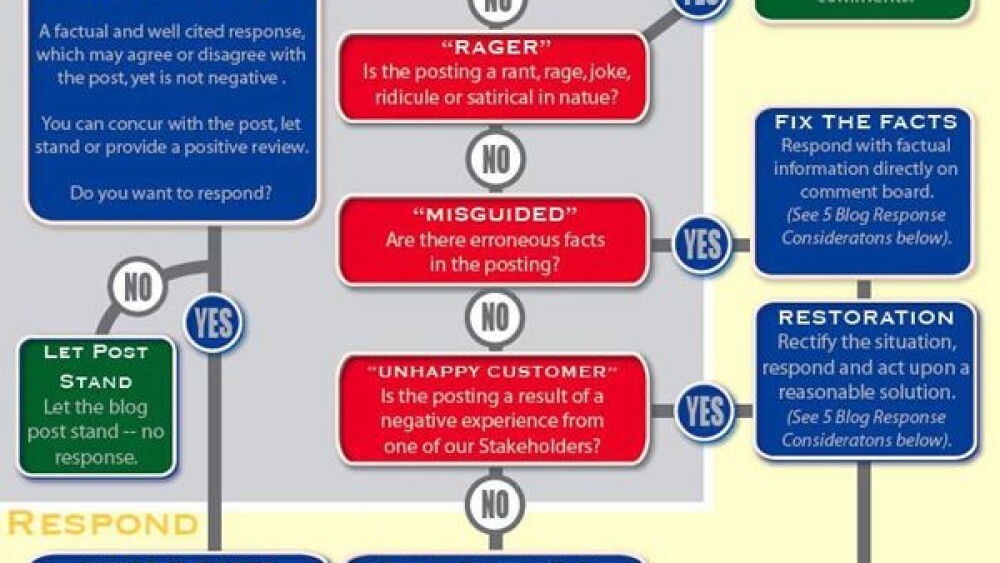
This flowchart transforms a chaotic situation into a logical process. It forces you to categorize the comment before you react. Is the person a "Rager" (a troll)? Are they "Misguided" and spreading false information? Or are they an "Unhappy Customer" (or in your case, a community member) with a legitimate issue? This initial classification is the most critical step in your strategy.
The blog post "Using A Social Media Triage To Plan Ahead" formally defines this concept and its value.
Using A Social Media Triage To Plan Ahead (Plus ...
This article breaks down the logic of a response triage. It explains why a systematic approach is superior to ad-hoc reactions and highlights the critical importance of tone. As you read, notice how it frames the triage as a planning tool that empowers you to act deliberately rather than reactively.
Read the article, starting from the introduction where it defines the social media triage. Pay close attention to these key takeaways: The section discussing the importance of tone and why public arguments are almost always a losing move. The crucial piece of advice that sometimes the best action is no action: "Sometimes it’s okay to step back and wait to see if your community steps in." The list of key factors to consider when conversing online: Transparency, Sourcing, Timeliness, and Influence.
Your Three Strategic Paths: Ignore, Correct, or Engage
Based on the triage model, your response to a character attack will fall into one of three main paths. The path you choose depends entirely on your initial assessment of the attacker's intent and the content of their message.
Path 1: Strategic Silence (The "Let Post Stand" / Ignore Path)
Deciding to remain silent is not a sign of weakness; it is a powerful strategic choice. It denies the attacker the engagement they crave and preserves your emotional energy for more productive efforts. This is your default path for certain types of attacks.
When to choose this path:
- The Attacker is a "Rager" or "Troll." The comment is pure vitriol, insult, or bait with no substance. They are not interested in dialogue. Engaging only fuels their fire and amplifies their message. In these cases, your strategy is: Block, Delete, Document.
- The Goal is Outrage Baiting. The comment is deliberately provocative, designed to lure you into a public fight for their own amusement or clout. Don't take the bait.
- The "Ratio" is Overwhelming. If a post has already been swarmed with negative comments, your lone voice of defense will be drowned out. A defensive reply at this stage can make you look worse and invite more dog-piling. It's often better to let the post die, document the harassment, and plan a follow-up post later that reasserts your narrative on your own terms.
- Your Community Has Your Back. As the UBC blog noted, sometimes your most powerful move is to wait and see if your allies and followers step in to defend you. This is a sign of a healthy community and their defense is often more credible to outsiders than your own.
Path 2: Strategic Correction (The "Fix the Facts" Path)
This path is not about winning an argument with the attacker. It is about correcting the public record for the benefit of the audience. You are speaking past the attacker to the silent majority of readers.
When to choose this path:
- The Attacker is "Misguided." They are spreading clear, objective falsehoods. For example, if someone comments on a post about your polyamorous lifestyle, "This is just institutionalized cheating," they are making a factual error about ethical non-monogamy.
- The Misinformation is Damaging. If the lie could harm your reputation, your business (e.g., your lingerie designs), or the communities you belong to, a correction is necessary.
How to execute this path:
- Be Swift and Succinct. Address the factual error clearly and without emotion.
- Do Not Engage Further. State the fact, then disengage. Do not get drawn into a debate.
- Example Response: To the "cheating" comment, you might reply: "Ethical non-monogamy is distinct from cheating as it's rooted in full transparency, communication, and consent from all parties. While it's a personal choice, it's important to use accurate definitions." Then, mute the conversation or block the user. You have corrected the record for everyone else who reads the thread.
Path 3: Strategic Engagement (The "Restoration" / "Boundary-Setting" Path)
This path is reserved for situations where dialogue is either necessary or strategically advantageous. It requires the most emotional labor and should be used selectively.
When to choose this path:
- The Attacker is an "Unhappy Stakeholder." A member of your community or a client expresses a legitimate grievance. The goal here is "Restoration"—to listen, validate, and resolve the issue. This is best done in private. A public reply could be: "Thank you for sharing your concern. I take this seriously. I'm sending you a DM so we can discuss this properly."
- The Attack is an Opportunity to Set a Boundary and State Your Values. This is where you stand up for yourself, not to win the attacker over, but to demonstrate your principles to your community. This is particularly relevant for attacks like slut-shaming, moral policing, or negging.
The experience of public figures who navigate similar spaces is invaluable here. Megan Barton-Hanson, who has a highly visible public profile related to her sexuality and career, provides a powerful perspective on handling these kinds of attacks.
Megan Barton-Hanson On How to Handle Slut-Shaming - VICE
This article is a masterclass in turning character attacks into opportunities for empowerment. Barton-Hanson shares her personal history with slut-shaming and offers a strategic and psychological framework for responding. Her context as a public figure in sex-positive spaces is directly applicable to the challenges you face as a lingerie designer and an advocate for alternative lifestyles.
Please read the following sections from her column: THINK ABOUT THE WIDER CONTEXT: Notice how she reframes the attack by considering the attacker's societal conditioning. This is a powerful tool for emotional regulation. TRYING TO GO ALONG WITH IT CAN DO MORE HARM THAN GOOD: This is a critical point about the danger of "owning" an insult versus standing up for yourself. NIP JUDGEMENTAL COMMENTS IN THE BUD: Pay attention to her critique of how tabloids frame her content. This is directly relevant to how you present your lingerie designs and how others might try to twist that presentation. THERE COMES A POINT WHERE YOU HAVE TO JUST DROP FRIENDS WHO AREN’T GETTING IT: This section reinforces the importance of curating your community and disengaging from those who are not respectful.
Crafting Your Engaged Response
When you decide to engage, the how is as important as the why. Drawing from Barton-Hanson's experience and our triage principles, here's how to craft an effective response:
- Reframe, Don't Defend. Instead of saying, "I'm not a slut," Barton-Hanson’s approach is to challenge the premise: "It’s my body and if that’s what makes me happy then let me live." When someone attacks your lingerie photos, don't defend your character. Reframe the conversation around your brand's values: female empowerment, celebrating the body, or the artistry of design.
- Use "I" Statements to Set Boundaries. "I don't subscribe to the idea that a woman's worth is tied to her modesty." "I am proud of the work I do in the polyamory community to promote ethical relationships." This is assertive, not aggressive.
- Maintain a Professional Tone. As the UBC blog warns, public arguments tarnish your brand. Your calm, principled response will stand in stark contrast to the attacker's vitriol, making it clear who is in control.
- Know When to Stop. The goal of strategic engagement is to make your point and assert your boundary—one, perhaps two comments, maximum. It is not to have the last word in a pointless back-and-forth. State your piece, then disengage. The silence that follows your final, powerful statement is part of the strategy.
Conclusion
You are now equipped with a complete, three-stage system for managing online attacks: immediate triage, systematic documentation, and strategic communication. By moving from emotional reaction to a deliberate decision-making process, you reclaim control.
Key Takeaways:
- A Communication Strategy is a Decision Tree: First, classify the attack (Troll, Misguided, Stakeholder), then choose a strategic path (Ignore, Correct, Engage).
- Strategic Silence is a Powerful Tool: Denying engagement to trolls and rage-baiters is often the winning move. It conserves your energy and starves them of the attention they seek.
- Correction is for the Audience, Not the Attacker: When you "Fix the Facts," you are correcting the public record. State the truth clearly and disengage.
- Strategic Engagement is for Boundary-Setting and Restoration: Use it to resolve legitimate issues with community members or to turn an attack into an opportunity to publicly affirm your values and principles.
- Your Response Defines You: A calm, principled, and strategic response, even in the face of ugliness, reinforces your authority and the integrity of your brand.
This lesson concludes our module on mass harassment. You've built a robust defensive toolkit. However, many attacks are not just random acts of rage; they can be part of coordinated and deceptive campaigns. In our next module, we will delve into the world of inauthentic actors. We'll begin by learning to identify catfishing, sock puppetry, and astroturfing—tactics used to manipulate you and your community from the shadows.