Welcome to your first lesson in electronics! Your goal is to gain a deep, foundational understanding of how electronic systems work, particularly for robotics and IoT applications. This course is designed to build that knowledge from the ground up, and today we'll start with the three most fundamental concepts in all of electricity: electric charge, voltage, and current.
Think of these as the basic grammar of electronics. Just as you can't write a program without understanding variables, data types, and operators, you can't build a circuit without a solid grasp of these principles. In this lesson, we will define each of these concepts and explore the crucial relationship between them.
What is Electricity? The Role of Charge
At its heart, electricity is about the movement of tiny particles. To understand this, we need to look at the structure of atoms.
How ELECTRICITY works - working principle
Let's begin with a short video from The Engineering Mindset that provides a great visual introduction to the atomic structure and the role of electrons.
Watch the segment from the beginning until about the explanation of conductors and insulators. Pay close attention to the concept of "valence" electrons and why they are key to conducting electricity.
As the video explained, atoms contain protons (+), neutrons (no charge), and electrons (-). The force between these charged particles is the source of all electrical phenomena. We can summarize the key ideas:
- Electric Charge (Q): A fundamental property of matter, much like mass. It comes in two types: positive and negative. Opposite charges attract, and like charges repel. The unit of charge is the coulomb (C). A single electron has a tiny negative charge of C.
- Conductors: Materials, typically metals like copper, where the outermost electrons are loosely bound. These electrons can move freely from atom to atom, forming a "swarm" or "sea" of electrons. This mobility is what allows electricity to flow.
- Insulators: Materials like glass or plastic where electrons are tightly bound to their atoms and cannot move easily. They are used to block the flow of electricity.
Your work in software engineering deals with manipulating bits—ones and zeros. In electronics, at a physical level, we are often manipulating the flow of these charged electrons to represent and process information.
Voltage: The Driving Force
So, we have these mobile electrons in a conductor. What makes them move in a particular direction? They need a "push," or a motivation to flow. This push is called voltage.
One of the best ways to build an intuition for voltage is to compare it to water pressure. Imagine two connected water tanks: if the water level is the same in both, nothing happens. But if one tank has a higher water level, the pressure difference will cause water to flow from the higher tank to the lower one.
Voltage is the electrical equivalent of this pressure difference. It's more formally known as electric potential difference. It represents the difference in electrical potential energy per unit of charge between two points.
Voltage and Current | Basic Concepts Of Electricity
The article "Voltage and Current" from All About Circuits provides an excellent explanation using the water reservoir analogy. It will help solidify your understanding of voltage as a form of potential energy.
Please read from the beginning of the article down to the end of the section "The Definition of Voltage". Focus on how the text develops the analogy between water pressure and electric potential. Note the key idea that voltage, like the height of the water, is always measured between two points.
The key takeaway is that voltage doesn't exist at a single point; it's a difference between two points. A source of voltage, like a battery, acts like a pump, creating a sustained potential difference. It does work to move charges to a higher potential energy state, giving them the "potential" to flow and do work elsewhere in a circuit (like lighting up an LED).
The unit of voltage is the volt (V). One volt is defined as the potential difference required to impart one joule of energy to one coulomb of charge ().
Current: The Flow of Charge
Once a voltage provides the push and there's a complete path for charges to move, we get electric current. Following our water analogy, if voltage is the pressure, current is the actual flow rate of the water.
Current is defined as the rate at which electric charge flows past a point in a circuit.
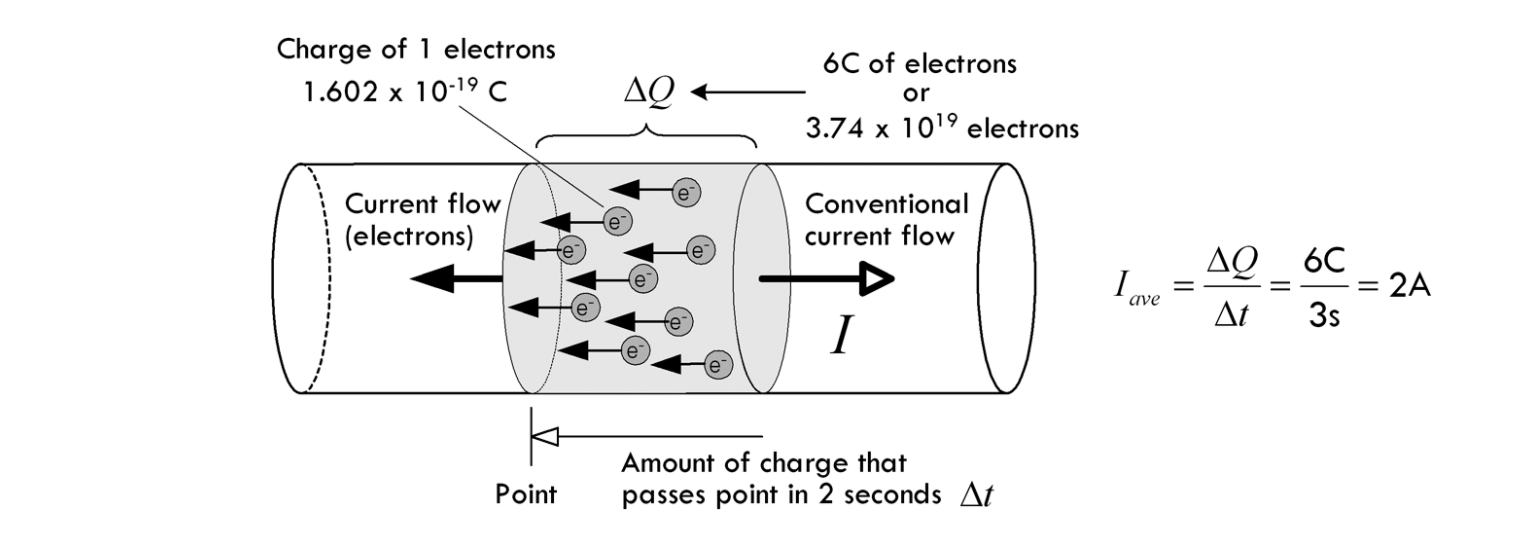
This diagram illustrates the flow of charge through a wire. Notice the distinction between the physical movement of electrons (electron flow) and the direction we define as "conventional current."
As the diagram shows, an important convention to understand is:
- Electron Flow: In a metal wire, it is the negatively charged electrons that physically move. They flow from the point of lower potential (negative terminal of a battery) to the point of higher potential (positive terminal).
- Conventional Current: For historical reasons, dating back to Benjamin Franklin, engineers define current as the direction that positive charge would flow. Therefore, conventional current is shown flowing from a higher potential (+) to a lower potential (-).
This might seem confusing, but it's just a convention. In circuit analysis, we almost always use conventional current. As long as you are consistent, all the math works out correctly. It's a layer of abstraction, something you are very familiar with in software development.
Current is measured in amperes (A), often shortened to "amps." One ampere is defined as the flow of one coulomb of charge per second ().
Given your background, you'll appreciate the more precise, calculus-based definition of instantaneous current, , as the derivative of charge, , with respect to time, :
Basic electrical quantities: current, voltage, power (article)
This Khan Academy article offers a concise summary of current and its definition.
Please read the sections titled "Current" and "A few remarks on current". Pay attention to the mathematical definition and the discussion of the sign convention.
The Relationship: Voltage Causes Current
Now let's put it all together. The relationship between charge, voltage, and current is fundamental:
A source of voltage creates an electric potential difference, which provides the energy to "push" charge. When there is a conductive path (a circuit), this push results in a flow of charge, which we call current.
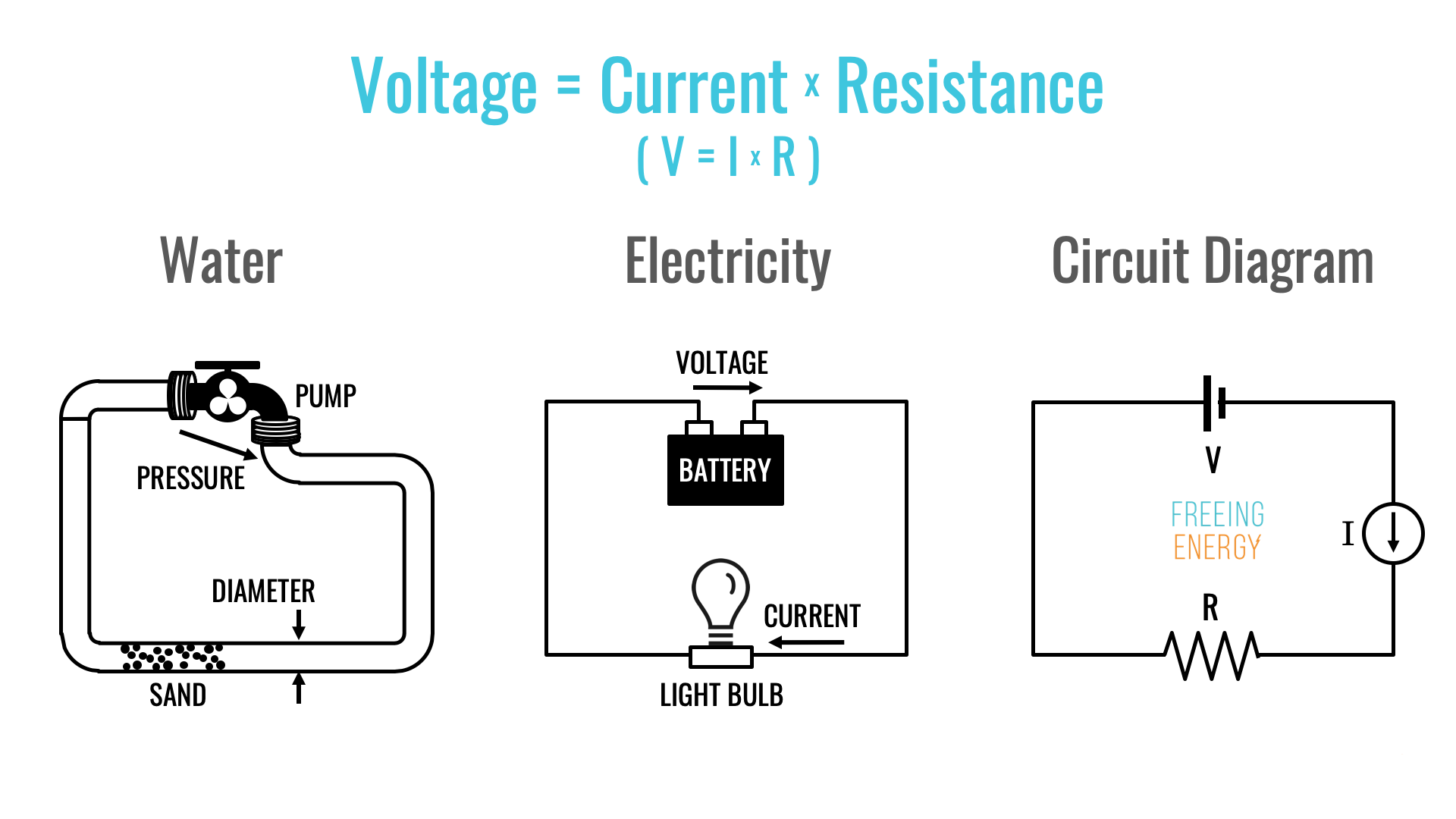
This image provides a fantastic summary, showing the water analogy, a simple electrical circuit, and the standard circuit diagram symbols side-by-side. It visually connects voltage (pressure), current (flow), and resistance (constriction).
Look at the "Electricity" and "Circuit Diagram" parts of the image. The battery (V) provides the voltage. This voltage pushes current (I) through the circuit, causing the light bulb to light up. The light bulb itself introduces a "constriction" to the flow, a concept called resistance (R), which we will explore in detail in our next lesson.
Without a voltage, there is no push, and no current flows. If you have a voltage source but the path is broken (an "open circuit"), no current can flow either—just like closing the valve in a water pipe stops the flow, no matter how high the pressure.
Key Takeaways
This first lesson has established the conceptual bedrock for the rest of the course. Here are the main points:
- Electric Charge (Q) is a fundamental property of matter, measured in coulombs (C). In most circuits, it's the electrons that move.
- Voltage (V) is the electric potential difference between two points, acting as the "pressure" or "push" that drives charge. It's measured in volts (V).
- Current (I) is the rate of flow of charge past a point. It's measured in amperes (A).
- The Relationship: A voltage source applied across a closed circuit causes a current of charge to flow.
Next Steps
You now have a mental model for the "what" and "why" of basic electricity. In the next lesson, we will quantify this relationship by introducing resistance and one of the most important laws in all of electronics: Ohm's Law. This will allow us to move from concepts to calculations, a crucial step toward designing and analyzing circuits.