Welcome to the first lesson of your course on becoming an effective engineering manager. Your goal is to transition from a Senior Telecommunication Engineer to a Lead Engineer, and this course is designed to equip you with the foundational skills for that journey.
This first module, "The Manager's Mindset," is all about making the crucial mental shift from being a top technical performer to being an effective leader of people. Today, we'll start at the very beginning by addressing a fundamental question: What is the real difference between being an individual contributor and a manager? Understanding this distinction is the bedrock upon which all other management skills are built.
The Great Fork in the Road: Two Distinct Paths
As a successful senior engineer, you've likely become a go-to expert for complex technical challenges. Career progression from this point isn't always linear. Many companies, particularly in tech and engineering, offer two parallel and equally valuable career tracks. Moving into management is not simply a promotion; it's a career change.
To get a clear overview of this concept, let's start with a short video from Google for Developers. It does an excellent job of debunking the myth that management is just the "next step up" from a senior technical role.
Individual contributor or manager: choosing your engineering path
Watch the first two minutes of "Individual contributor or manager: choosing your engineering path".
Pay close attention to the distinction made between the two roles. The video covers: The core idea that IC and manager are distinct, parallel tracks. The primary motivations and sources of satisfaction for someone on the IC path (hands-on problem-solving). The focus for someone on the engineering manager path (organizing work, growing others, and building the team).
The video's analogy of a chef versus a food connoisseur is helpful: they operate in the same domain, but their skills, goals, and daily activities are completely different.
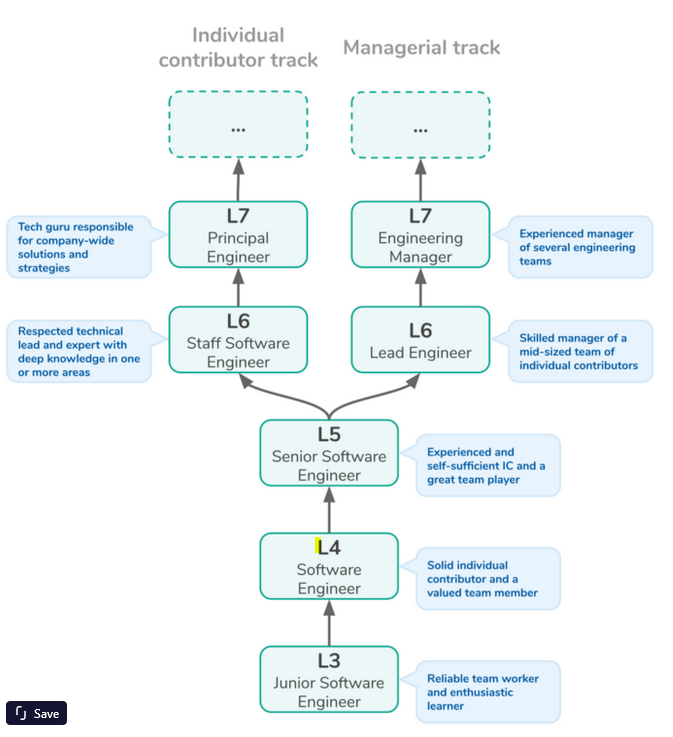
The following diagram illustrates what these parallel tracks often look like. As you can see, the Senior Engineer level is a common branching point.
Redefining Your Role and Responsibilities
As you step into the Lead Engineer role, your primary function begins to change. While you will still leverage your deep technical expertise, your main purpose shifts from doing the work to enabling the work of others.
To explore these different responsibilities in more detail, please read the first part of the following article from Splunk.
Individual Contributors vs Managers: Differences in Roles - Splunk
This article provides a solid definition of each role and the mindset shift required to move between them.
Please read the sections titled "Understanding the two roles" and "Career path from individual contributor to manager". As you read, focus on: The core responsibilities listed for Individual Contributors (ICs) versus those for Managers. The description of the mindset shift from personal achievement to team success.
As the article highlights, your focus will pivot from task execution to a broader set of responsibilities: setting goals, managing performance, and facilitating collaboration. Your experience mentoring junior engineers has already given you a taste of this, but as a manager, developing your team becomes a central part of your job, not just a side activity.
This transition from a technical expert to a people leader is one of the biggest challenges for new managers. The next video offers a practical perspective on this shift.
3 Things I Wish I Knew Before Becoming An Engineering Manager
Watch the first segment of "3 Things I Wish I Knew Before Becoming An Engineering Manager" from the Dev Leader channel.
This section, running from the beginning of the first point until the second, explains that the role of an engineering manager is fundamentally about people. The speaker discusses the importance of building trust and respect, and the energy required for this "peopling" aspect of the job.
A New Scorecard for Success
Perhaps the most significant and often disorienting change is how success is measured. As a senior engineer, your impact is direct and tangible: you solve a critical bug, design a robust system, or write efficient code. As a manager, your impact becomes indirect, measured by the achievements of your team.
This article from Platform Recruitment clearly outlines this change in the "scorecard" for success.
Blog - How do you move from senior engineer to engineering manager? | Platform Recruitment
This blog post is aimed at engineers considering the move to management and directly addresses the change in how performance is evaluated.
Please read the section "What actually changes when you move into engineering management?". Note the bulleted lists that contrast the success metrics for a senior engineer with those of an engineering manager.
To summarize the key distinction:
-
As a Senior IC, you succeed by:
- Solving complex technical problems personally.
- Delivering high-quality work and influencing technical design.
- Being a subject matter expert.
-
As a Lead Engineer, you will succeed by:
- Ensuring your team delivers on its goals.
- Developing the skills and careers of your team members.
- Effectively planning work, managing risks, and communicating progress.
- Creating an environment where your team can thrive.
This means your sense of accomplishment must also evolve. The satisfaction you once felt from closing a difficult ticket will now come from seeing a team member successfully navigate a challenge you helped prepare them for.
Let's return to the "3 Things I Wish I Knew" video, as the second point speaks directly to this psychological shift.
3 Things I Wish I Knew Before Becoming An Engineering Manager
Watch the second segment of the video.
This part covers the change in your "sense of accomplishment". Watch from the start of the second point to the beginning of the third. The speaker describes the transition from feeling fulfillment by building things yourself to feeling fulfillment by empowering others.
The Reality of Your New Role: The "Player-Coach"
Your role as a "Lead Engineer" often starts as a hybrid "player-coach." You are expected to lead the team but may also contribute technically, especially with a small team. However, a common pitfall is underestimating how quickly management responsibilities consume your time.
The final segment of the video you've been watching gives a candid take on how much time you'll actually have for coding. For a team of fewer than five, like yours will be, you might still be hands-on. But it's crucial to understand that as the team grows, your primary value is in leading, not in coding.
3 Things I Wish I Knew Before Becoming An Engineering Manager
Watch the third and final segment of the video.
This section, from the start of the third point to just before the outro, addresses the question: "Do engineering managers have time to code?". Pay attention to the rule of thumb he gives about team size.
Conclusion
In this lesson, we've established the foundational difference between an individual contributor and a manager. This is not just a change in title, but a fundamental shift in your role, your responsibilities, and how you measure your own success.
Here are the key takeaways:
- Distinct Paths: The IC and management tracks are parallel careers, not a linear progression. Management is a change of profession.
- From Doing to Enabling: Your primary focus shifts from your own technical output to maximizing the output and growth of your team.
- A New Definition of Success: Your success is no longer measured by your individual contributions, but by your team's performance, health, and development.
- Mindset is Key: Embracing this new identity as an enabler, coach, and leader is the most critical step in your transition.
Now that you have a clear picture of what this new role entails, we can begin to explore the common challenges new managers face. In our next lesson, we will examine one of the most frequent traps for new engineering leads: staying too involved in the technical details. We will also further refine the core responsibilities you'll be taking on.