Welcome back! In our last lesson, we developed a powerful intuition for matrices as operators that perform linear transformations on space, such as rotations, reflections, and shears. We saw that applying a matrix to a vector generally changes both its magnitude and its direction.
Today, we'll focus on special vectors that are, in a sense, "aligned" with a given matrix transformation. These vectors have their direction left unchanged—they are only stretched, shrunk, or reversed. These special vectors and their corresponding scaling factors are called eigenvectors and eigenvalues, respectively. Understanding them is the goal of this lesson: to define eigenvalues and eigenvectors and describe their geometric significance. This concept is not just a mathematical curiosity; it forms the basis for powerful techniques in computer vision and machine learning, like Principal Component Analysis (PCA) for dimensionality reduction.
1. The Core Idea: Invariant Directions
Imagine a matrix transforming a whole vector space. While most vectors are knocked off their original direction, some exceptional vectors might stay on their line through the origin. The transformation only scales them.
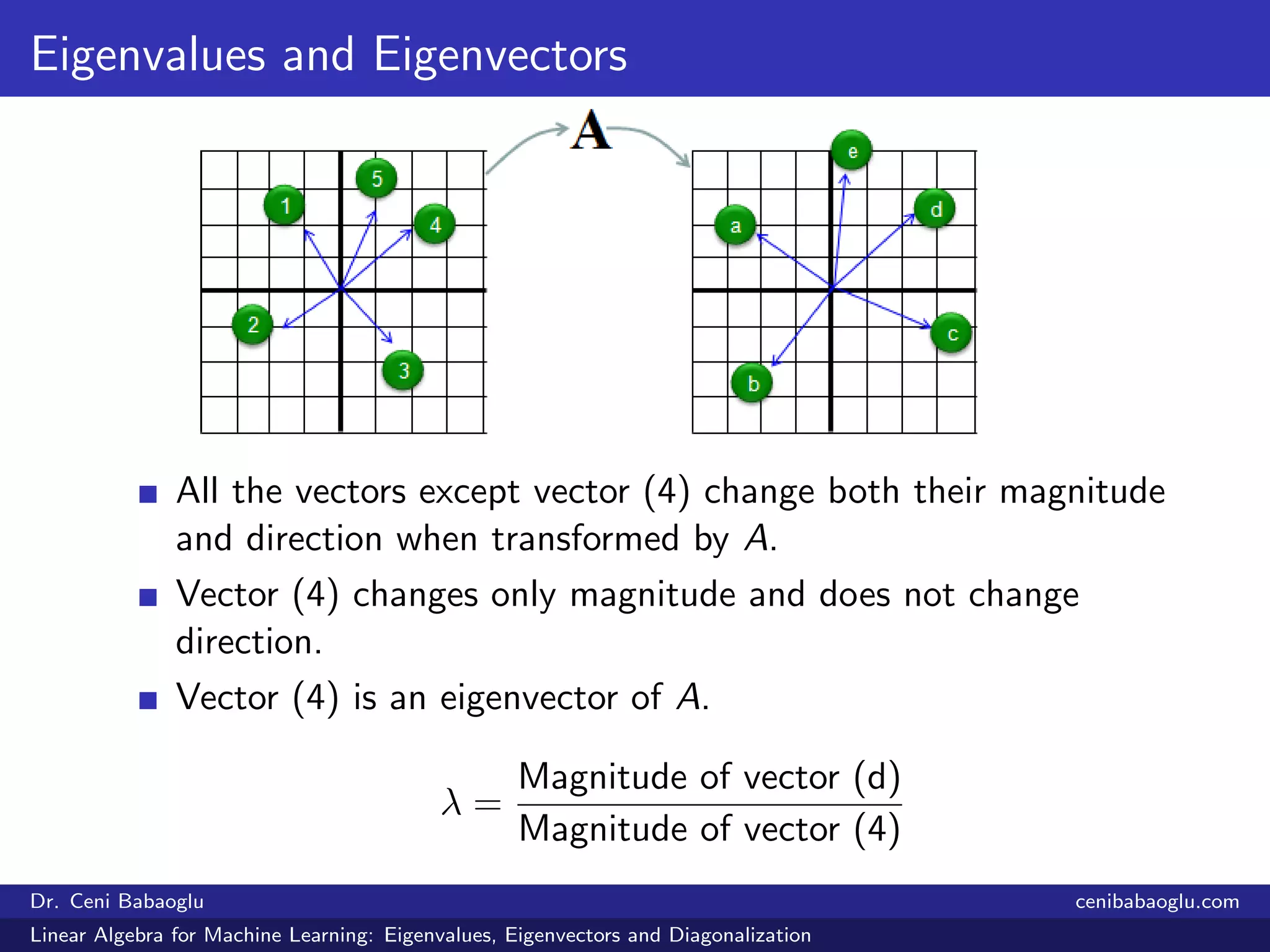
This simple geometric picture is the essence of eigenvalues and eigenvectors. The eigenvector points in a direction that is preserved by the matrix, and the eigenvalue tells us how much the vector is scaled along that direction.
2. Formal Definition of Eigenvalues and Eigenvectors
Let's translate this geometric idea into a precise mathematical statement.
The following resource from 'Interactive Linear Algebra' provides the formal definition of eigenvalues and eigenvectors. This is the fundamental equation that governs these concepts.
Please read the introductory paragraphs and the subsection 'Eigenvalues and Eigenvectors'. Focus on the definition box. Pay close attention to two key details: an eigenvector must be a nonzero vector, while an eigenvalue can be any scalar, including zero.
As you've just read, the relationship is captured by the single, elegant equation:
Where:
- is an square matrix.
- is a non-zero vector, called the eigenvector.
- (lambda) is a scalar, called the eigenvalue corresponding to .
This equation states that when the matrix acts on its eigenvector , the result is simply the original vector scaled by the eigenvalue . The word "eigen" is German for "own" or "self," which is fitting, as an eigenvector is a vector that is mapped to a scaled version of itself.
Verifying an Eigenvector
Given a matrix, a vector, and a potential eigenvalue, it's straightforward to check if they fit the definition. For example, let's test if is an eigenvector of .
First, we compute the left side of the equation, :
Now, we compare this result to the original vector . Is a scaled version of ? Yes, it is.
Since , we have confirmed that is an eigenvector of , and its corresponding eigenvalue is .
3. The Geometric Significance of Eigenvalues
The value of tells us exactly what happens to the eigenvector during the transformation:
- If , the eigenvector is stretched.
- If , the eigenvector is unchanged.
- If , the eigenvector is shrunk.
- If , the eigenvector is collapsed to the origin. This means eigenvectors with are in the nullspace of the matrix.
- If , the eigenvector's direction is reversed (and its length is scaled by ).
Let's explore this by revisiting some of the transformations from our last lesson. You can often identify eigenvectors and eigenvalues just by thinking about the geometry of the transformation.
The following sections from 'Interactive Linear Algebra' and the MIT textbook 'Introduction to Linear Algebra' provide excellent geometric examples. They analyze the eigenvectors and eigenvalues for common transformations like reflection and projection.
Read the subsection 'The Geometry of Eigenvectors and Eigenvalues'. Focus on the examples for Reflection and Projection. Try to visualize which vectors would maintain their direction in each case.
Chapter 6 Eigenvalues and Eigenvectors
This reading from the MIT textbook complements the previous one, reinforcing the geometric view for projection and reflection matrices.
Read 'Example 2' about the projection matrix and 'Example 3' about the reflection matrix. Notice how the geometric action of the matrix immediately reveals its eigenvalues.
Let's consolidate these ideas:
-
Projection: Consider the matrix , which projects vectors onto the x-axis.
- Any vector already on the x-axis, like , is unchanged by the projection. So, . These are eigenvectors with eigenvalue . The entire x-axis is a line of eigenvectors.
- Any vector on the y-axis, like , is squashed to the origin. So, . These are eigenvectors with eigenvalue .
-
Reflection: Consider the matrix , which reflects vectors across the x-axis.
- Any vector on the x-axis is unchanged. These are eigenvectors with .
- Any vector on the y-axis is reversed. These are eigenvectors with .
Test your understanding!
Consider a scaling matrix . What are its eigenvectors and corresponding eigenvalues? Describe the transformation in words.
Show answer
The matrix scales the x-direction by a factor of 3 and the y-direction by a factor of 0.5.
-
A vector on the x-axis, like , will be stretched by a factor of 3 to become . Its direction is unchanged. So, is an eigenvector with eigenvalue .
-
A vector on the y-axis, like , will be shrunk by a factor of 0.5 to become . Its direction is also unchanged. So, is an eigenvector with eigenvalue .
4. A Transformation Without Real Eigenvectors
Does every matrix have eigenvectors that we can draw in real space? Consider the 90-degree counter-clockwise rotation matrix from the last lesson: .
This transformation rotates every non-zero vector. No vector maintains its original direction. Therefore, this matrix has no real eigenvectors. This doesn't mean it has no eigenvectors at all, but that they involve complex numbers. This is an advanced point, but it's good to be aware of.
Chapter 6 Eigenvalues and Eigenvectors
The MIT textbook briefly discusses the case of imaginary eigenvalues using the 90-degree rotation matrix as an example. This will give you a more complete picture of the topic.
Read 'Example 5: The 90-degree rotation Q'. The key takeaway is that real matrices can have complex eigenvalues (in this case, i and -i), which correspond to transformations that don't have any invariant directions in real space.
Conclusion
In this lesson, we have focused on the what and why of eigenvalues and eigenvectors, grounding them in the geometric framework of linear transformations.
Key Takeaways:
- An eigenvector of a matrix is a non-zero vector whose direction is unchanged when multiplied by .
- An eigenvalue is the scalar factor by which the eigenvector is stretched, shrunk, or reversed.
- The defining relationship is .
- Geometrically, eigenvectors represent the "axes" of a transformation. The eigenvalue dictates the scaling along these axes.
- Simple geometric transformations like scaling, projection, and reflection have intuitive, real-valued eigenvectors and eigenvalues. Others, like rotation, may not have any real eigenvectors.
Preview of the Next Lesson:
We have successfully defined eigenvalues and eigenvectors and understood their geometric meaning. However, we haven't discussed a systematic way to find them for an arbitrary matrix. In the next lesson, we will learn the algebraic procedure to compute them by solving the "characteristic equation," . This will lead us to one of the most important matrix factorizations: eigendecomposition, which breaks a matrix down into its constituent eigenvectors and eigenvalues.