Hello, and welcome to our third lesson. In our previous session, we established the fundamental idioms for passing data into and out of functions in C++, focusing on safety and efficiency with references and const-correctness. We now have a solid foundation for how functions communicate.
This lesson addresses a closely related and equally critical question: how do we manage resources? In C++, a "resource" is any entity that must be acquired before use and released afterward, such as heap memory, file handles, network sockets, database connections, or mutex locks. Manual management of these resources is a notorious source of bugs, from memory leaks to deadlocked programs.
Today, we will explore Resource Acquisition Is Initialization (RAII), which is arguably the most important and foundational concept in modern C++. It's the C++ way of managing resources automatically, safely, and deterministically. By the end of this lesson, you will understand how to use stack-allocated objects and their destructors to guarantee that resources are always cleaned up correctly, even in the presence of errors and exceptions. This principle is the bedrock upon which much of C++'s safety and power is built.
The Fragility of Manual Resource Management
In many older APIs or C-style libraries, you are responsible for manually acquiring and releasing resources. For example, you might call fopen() to open a file and must remember to call fclose() later. Or in multithreaded code, you might call mutex.lock() and must ensure you call mutex.unlock() on every possible execution path.
This manual approach is extremely fragile. It's easy to forget to release a resource, especially in functions with multiple return paths or when exceptions can be thrown. Let's see just how quickly this can go wrong.
The following video provides an excellent walkthrough of this problem using a mutex, a synchronization primitive you will frequently encounter when writing high-performance, multithreaded code.
Back to Basics: RAII in C++ - Andre Kostur - CppCon 2022
This segment from Andre Kostur's "Back to Basics: RAII" talk at CppCon 2022 clearly illustrates the pitfalls of manual resource management.
Watch the section from the beginning up to the introduction of the problem. Pay close attention to how a simple function that locks a mutex becomes increasingly complex and bug-prone as we add error handling (return false) and exception handling (try-catch). This demonstrates why manual cleanup is not a scalable or robust strategy.
As you saw, a simple function required multiple unlock() calls and a try-catch block just to be correct. This code is verbose, hard to reason about, and easy to get wrong. If a future developer adds another early return, they might re-introduce the very bug we tried to fix. This approach is simply not sustainable. The resources mentioned—memory, files, and mutexes—are all critical, and leaking them can lead to program crashes, deadlocks, or exhaustion of system resources.
The RAII Solution: Binding Resources to Object Lifetime
C++ provides an elegant and powerful solution to this problem: Resource Acquisition Is Initialization (RAII). The name is a bit of a mouthful, but the principle is simple and profound:
Bind the lifetime of a resource to the lifetime of a stack-allocated object.
This is achieved by following a simple pattern:
- Acquire the resource in the object's constructor.
- Release the resource in the object's destructor.
The magic of this pattern comes from the guarantees C++ provides about object lifetimes. When a stack-allocated (local) object goes out of scope, its destructor is guaranteed to be called. This is true no matter how the scope is exited:
- By reaching the closing brace
}. - By an early
returnstatement. - By a
breakorcontinuestatement. - By an exception being thrown.
This deterministic destruction ensures our resource is always released correctly.

Let's see how RAII transforms the fragile mutex example into simple, robust code. The standard library provides an RAII wrapper for mutexes called std::lock_guard.
Back to Basics: RAII in C++ - Andre Kostur - CppCon 2022
This part of the same talk demonstrates the RAII principle in action and shows how std::lock_guard elegantly solves the mutex problem.
First, watch the section from object lifetimes to understand the core idea of tying resource management to constructors and destructors. Then, watch from the std::lock_guard example to see how the messy function from before becomes clean, safe, and simple. Notice how all the manual unlock() calls and the try-catch block disappear.
The difference is night and day. By creating a std::lock_guard object on the stack, we've handed off the responsibility of locking and unlocking the mutex to the C++ object model. The code is now not only simpler to read but also correct by construction.
This RAII pattern is ubiquitous in the C++ standard library. Classes like std::vector and std::string manage heap memory, std::fstream manages file handles, and std::jthread manages thread handles. They all acquire their respective resource in their constructor and release it in their destructor, freeing you from manual management.
For another clear explanation that focuses on memory, you can watch the following video.
Classes part 9 - Resource Acquisition is Initialization (RAII) Ep. 45
This video by Mike Shah provides a concise walkthrough of RAII, focusing on a custom Collection class that wraps a dynamically allocated array.
Watch the section from the introduction through the custom collection example. This demonstrates how RAII prevents memory leaks by ensuring delete[] is called automatically in the destructor.
Creating Your Own RAII Wrappers
The standard library provides RAII wrappers for common resources, but your goal of writing custom kernels means you'll often interact with C-style APIs that require manual resource management. A prime example is the CUDA API for GPU programming.
Let's say you want to allocate memory on a GPU. The CUDA C-API provides cudaMalloc() to allocate and cudaFree() to release it. A manual approach would look like this:
void process_on_gpu() {
    float* d_data; // d_ for 'device'
    size_t size = 1024 * sizeof(float);

    cudaError_t err_alloc = cudaMalloc(&d_data, size);
    if (err_alloc != cudaSuccess) { /* handle error */ return; }

    // ... do some work with d_data ...
    // If an error happens here, we might return early and leak GPU memory!

    cudaError_t err_free = cudaFree(d_data);
    if (err_free != cudaSuccess) { /* handle error */ }
}
This has all the same fragility we saw with the mutex. We can solve this by creating our own RAII wrapper.
The Art of Maintainable GPU Programming
This article on maintainable GPU code provides a perfect, practical example of a custom RAII wrapper for CUDA device memory.
Please read the section on RAII. It presents a DeviceBuffer class that encapsulates cudaMalloc and cudaFree.
The DeviceBuffer class from the article is a textbook example of RAII:
class DeviceBuffer {
public:
    DeviceBuffer(size_t size) {
        // Acquire resource in constructor
        cudaMalloc(&ptr_, size);
        // In a real implementation, you would add error checking here.
    }

    ~DeviceBuffer() {
        // Release resource in destructor
        cudaFree(ptr_);
    }

    void* data() const { return ptr_; }

private:
    void* ptr_;
};
By using this class, our GPU function becomes as simple and safe as the std::lock_guard example:
void process_on_gpu_raii() {
    size_t size = 1024 * sizeof(float);
    DeviceBuffer buffer(size); // Resource acquired

    // ... do some work with buffer.data() ...

    // No cudaFree call needed!
    // When 'buffer' goes out of scope, its destructor is called,
    // and the GPU memory is automatically freed.
} // <- buffer's destructor called here
A Critical Detail: Ownership and Copying
There is a subtle but dangerous bug lurking in our simple DeviceBuffer class. What happens if you copy it?
DeviceBuffer buffer1(size);
DeviceBuffer buffer2 = buffer1; // Uh oh.
The default behavior for a class copy is to perform a member-wise copy. This means buffer2.ptr_ will be a copy of buffer1.ptr_. Both objects now point to the same allocated GPU memory. This is called a shallow copy.
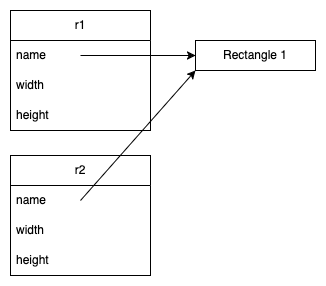
When buffer2 goes out of scope, its destructor will call cudaFree(ptr_). Then, when buffer1 goes out of scope, its destructor will also call cudaFree(ptr_) on the exact same pointer. Freeing memory that has already been freed results in undefined behavior, and will almost certainly crash your program. This is known as a double free error.
This happens because our DeviceBuffer doesn't have a clear ownership policy. Who is responsible for freeing the memory? Both objects think they are. To fix this, we must be explicit about the ownership semantics of our RAII class. We could:
- Disallow copying: Make the class non-copyable, enforcing unique ownership. Only one object can own the resource at a time.
- Implement deep copy: Make the copy constructor allocate new GPU memory and copy the contents.
- Implement shared ownership: Use reference counting to track how many objects are sharing the resource, and only free it when the last object is destroyed.
For now, the simplest and safest option is to disallow copying. In C++11 and later, you can do this by deleting the copy constructor and copy assignment operator:
class DeviceBuffer {
public:
    // ... constructor, destructor, etc. ...

    // Disallow copying
    DeviceBuffer(const DeviceBuffer&) = delete;
    DeviceBuffer& operator=(const DeviceBuffer&) = delete;

private:
    void* ptr_;
};
With this change, any attempt to copy a DeviceBuffer will result in a compile-time error, preventing the double-free bug entirely.
We've just scratched the surface of ownership semantics. The standard library provides powerful tools—smart pointers—that encapsulate these ownership policies for us.
Conclusion
In this lesson, you've learned about RAII, a cornerstone of modern C++. It's a simple yet powerful pattern that leverages C++'s deterministic object destruction to provide automatic and exception-safe resource management.
Here are the key takeaways:
- Manual resource management is fragile: It's prone to leaks and errors, especially in complex functions with multiple exit paths or exceptions.
- RAII binds resource lifetime to object lifetime: Resources are acquired in a constructor and released in a destructor.
- Destructors provide deterministic cleanup: C++ guarantees that destructors of stack objects are called when they go out of scope, ensuring resources are always released.
- You can build custom RAII wrappers: This is essential for working safely with C-style APIs like CUDA.
- Ownership is critical: Naively copying an RAII wrapper can lead to dangerous bugs like double-frees. You must define a clear ownership policy (e.g., by disallowing copies).
You now understand the core principle behind safe resource management in C++. In our next lesson, we will dive into the standard library's primary tools for implementing RAII for heap-allocated memory: std::unique_ptr and std::shared_ptr. These smart pointers formalize the ownership concepts we just touched upon, making memory management in C++ safe, easy, and explicit.