Introduction
In our last lesson, we focused on the transition trigger—the spark that ignites the latent friction in a scene and launches it into escalating tension. We saw how a character’s goal, when met with an obstacle, culminates in a specific action or inaction that makes the conflict unavoidable. Today, we will explore the next critical pivot in scene architecture: the turning point. This is the moment that breaks the tension's upward spiral and forces the scene toward its resolution.
Think of the tension beat as a system under increasing pressure. The turning point is the event that causes a phase transition—the point where the pressure either finds a release or causes a fracture, fundamentally altering the state of the system. For the scene to have meaning, it cannot simply end at peak conflict; it must change something. The turning point is that agent of change. By the end of this lesson, you will be able to precisely identify this pivotal moment and understand its function in moving a scene from a state of conflict to one of consequence.
The Anatomy of a Scene: From Action to Reaction
A powerful way to conceptualize scene structure is to divide it into two halves: the "scene" proper and the "sequel." The "scene" is the phase of action and conflict, where a character pursues a goal. The "sequel" is the phase of reaction and consequence, where the character processes the outcome of that pursuit. Our beats of friction and tension make up the "scene" half. The resolution beat constitutes the "sequel." The turning point is the bridge between them.
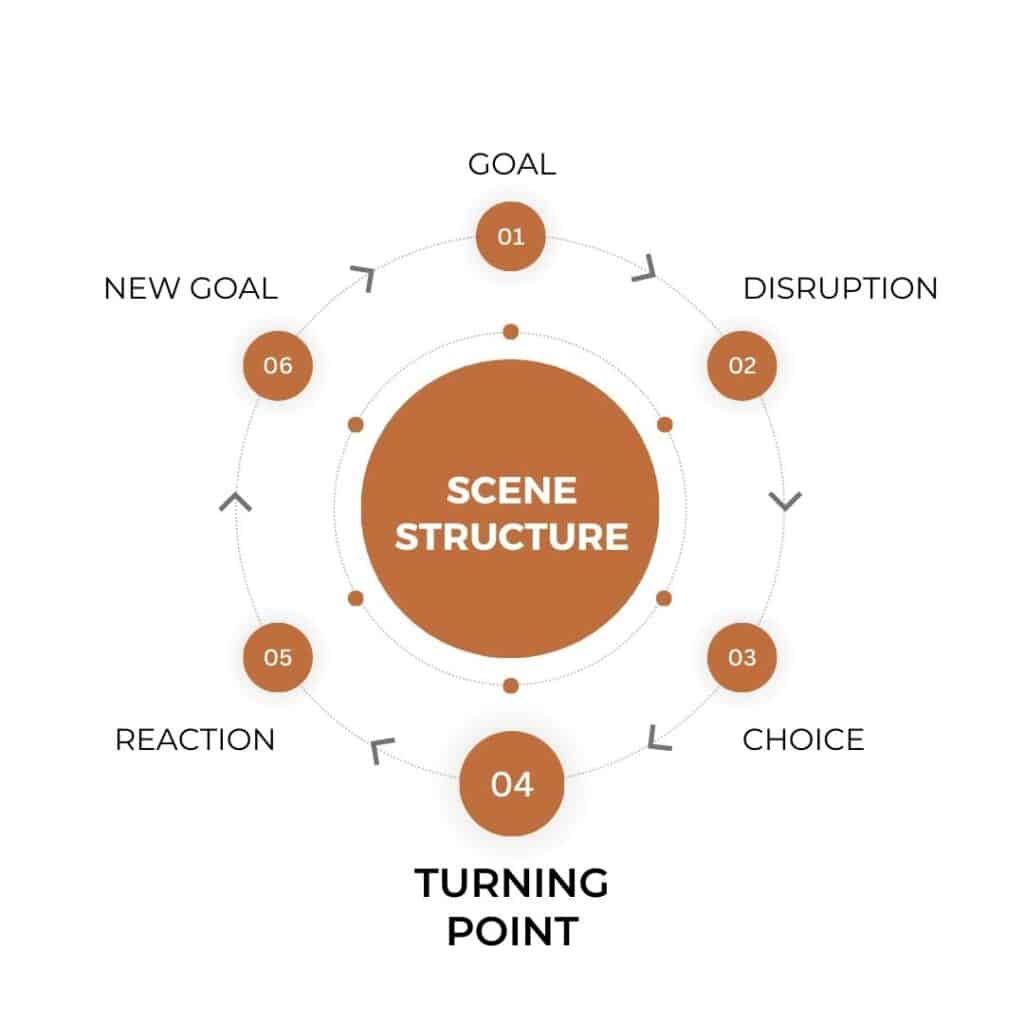
The diagram above places the turning point at the exact fulcrum between the active pursuit and the subsequent adjustment. It's the moment the struggle concludes and its consequences begin.
Let's deepen this model with a framework from author K.M. Weiland, who formalizes this action-reaction flow.
Scene Structure and Transitions in Big Scenes
This article clearly articulates the "scene" and "sequel" model, which provides a robust structure for understanding the turning point's function.
First, read the author's explanation of the two halves of scene structure: Scene (action) and Sequel (reaction). Next, pay close attention to the description of the scene outcome. Note the emphasis on a "disastrous flavor"—this outcome is the peak of the tension beat. Finally, read the breakdown of the sequel, which involves reaction, dilemma, and decision. The turning point is what precipitates this entire sequence.
As the reading highlights, the tension beat (the "scene" half) drives toward an outcome. This outcome is the turning point. It's the result of the character's struggle against the obstacle. More often than not, this result is not a clean victory. It might be:
- A "no, and furthermore...": The character fails to get their goal, and the situation gets worse.
- A "yes, but...": The character achieves their goal, but at an unforeseen and terrible cost.
- A stalemate: The conflict cannot be won and is instead shattered by an external force or a new piece of information.
Whatever its form, this outcome ends the struggle of the tension beat. The character is then forced to react to this new reality, face the dilemma it presents, and make a decision. This entire process—reaction, dilemma, decision—is the resolution, and it is kicked off by the turning point.
The Two Forms of a Turning Point
So, what does a turning point actually look like on the page? While its effects are complex, its form is usually one of two simple things: a revelation or an action.
This resource offers a sharp, practical definition of what constitutes a turning point, identifying it as the scene's climax.
Read the section that starts just after the charts, where the author defines the two fundamental types of turning points. Then, read the paragraph that distinguishes between the proaction and reaction phases of a scene. This reinforces how the turning point (or climax) separates the active pursuit of a goal from the processing of the outcome.
As Fawkes explains, a turning point fundamentally changes the direction of the story. This change is accomplished in one of two ways:
-
The Revelation Turning Point: The conflict is re-framed by a new piece of information. This revelation shatters the assumptions the characters were operating under. The tension dissipates because the entire basis for the conflict is shown to be false or incomplete. The emotional energy instantly transforms from anger or desperation into shock, guilt, or confusion.
- Example: "The secret you think I'm keeping? It's not an affair. It's a diagnosis."
-
The Action Turning Point: A character performs a decisive event that makes the current conflict irrelevant and creates a new, more serious situation. The action is so significant that it ends the argument and forces all characters to confront the consequences of that action instead.
- Example: In the middle of an argument about money, a character quietly places their wedding ring on the table and walks out.
In both cases, the original question of the tension beat (e.g., "Will you tell me the truth?") is rendered moot. The turning point replaces it with a new, more profound question that the resolution must address (e.g., "How could I have been so wrong?" or "What have I just done?").
Concrete Example: Pivoting from Tension to Resolution
Let's return to our vee relationship: Chloe (the independent lingerie designer), Alex (the financially transparent planner), and Sam (the compromising mediator).
In the last lesson, we saw how Alex could trigger the tension by confronting Chloe with a bank statement, demanding to know where their shared money was going. Let's assume the scene has escalated from there.
The Tension:
Alex, operating from a Competing conflict style, has accused Chloe of being reckless or dishonest. Chloe, feeling attacked, has gone into an Avoiding/Accommodating mode, refusing to explain while feeling deeply misunderstood. Sam’s attempts to find a Compromise have failed, making him seem like he’s taking Alex’s side. The argument has reached a peak. Voices are raised. Trust is fraying. The scene is at maximum tension.
Now, let's see two ways this tension can break via a turning point.
Example 1: The Revelation Turning Point
Alex stands over the coffee table, the bank statement trembling slightly in his hand. "This is just like your father, Chloe. Throwing money at foolish gambles. Is that what this is? Are you gambling again?"
The accusation hangs in the air. Sam opens his mouth to object, but Chloe's expression stops him. The anger drains from her face, replaced by a hollow, devastating calm. She looks not at Alex, but through him.
Her voice is a whisper. "The consultation fee... was for a fertility clinic." She finally meets Alex's eyes, then glances at Sam. "I wanted to see if we... if we could have a child. I wanted it to be a surprise."
The silence that follows is absolute. The premise of the entire conflict—financial betrayal—has just been obliterated and replaced by a revelation of profound hope and vulnerability. Alex’s accusation now feels monstrous. The scene has turned. The question is no longer "Where is the money?" but "How do we recover from this?"
- Analysis: This is a pure Revelation. The new information doesn't just end the fight; it inverts it. Chloe’s "crime" is reframed as an act of profound commitment to the vee. The scene now moves into resolution, where the characters must react to the emotional devastation of the false accusation and the implications of the news itself.
Example 2: The Action Turning Point
"I can't do this," Chloe says, her voice strained. She's backed away from Alex, closer to the door. "You don't trust me. Either of you." She glances at Sam, whose silence feels like a verdict.
Before either man can respond, she turns, walks into her office, and returns a moment later holding a large portfolio. She doesn’t open it. She doesn't explain. She simply drops it on the floor between them. It lands with a heavy, final thud.
"There's your answer," she says, her voice flat. "Do what you want with it."
She turns and walks out the front door, closing it softly behind her. Alex and Sam are left staring at the portfolio—the physical manifestation of a dream she kept secret—and the empty space where she just stood.
- Analysis: This is a decisive Action. Chloe ends the escalating tension not by explaining, but by taking three concrete steps: presenting the evidence, relinquishing control over it, and physically leaving. The action is the turning point. It answers Alex’s question about the money but does so in a way that creates a much larger problem: a profound breach of trust on all sides and the physical dissolution of their triad, however temporary. The fight is over. The resolution must now deal with its catastrophic fallout.
Conclusion
The turning point is the structural heart of a scene, the moment of climax that ensures the scene creates meaningful change. By ending the escalating tension and forcing a shift into a new emotional state, it gives the scene its purpose.
Here are the key takeaways from this lesson:
- The turning point is the outcome of the tension beat, serving as the pivot from the "scene" (action) to the "sequel" (reaction).
- It functions as the scene's climax, breaking the escalating conflict and initiating the resolution.
- It typically takes one of two forms: a Revelation (game-changing new information) or a decisive Action (a significant, irreversible event).
- The turning point's primary job is to replace the central question of the tension beat with a new, more profound question that the resolution must explore.
We have now defined the three core beats of a scene—friction, tension, and resolution—and identified the two critical pivot points that connect them: the transition trigger and the turning point. In our next lesson, we will put this all together by mapping this entire three-beat structure onto a complete romance scene, analyzing how these components work in concert to create a compelling emotional journey.