Welcome back. In our last lesson, we initiated the "Broken Promise Chain" by establishing its foundational friction. We saw how Leo's failure to uphold his promise to Chloe created an immediate, negative consequence for her, and a tangible, harmful fallout for Mark. The vee's emotional equilibrium is now disturbed. This initial event was the first domino.
Today, we transition from that initial point of impact to the sustained pressure of rising tension. Your learning outcome is to write the promise-breaker's cover-up attempt, which initiates a cascade of broken trust and escalates tension. This is the critical juncture where a single mistake metastasizes into a systemic problem. A simple failure becomes a complex deception, and the emotional stakes for all three characters begin to climb exponentially.
1. The Framework: The Anatomy of Escalation
In your work with causal analysis, you understand that an initial event can trigger a sequence of subsequent events, creating a chain reaction. A cover-up is precisely such a trigger in a relationship system. It is not a solution to the original problem (the broken promise); it is a new, more corrosive problem. The attempt to hide the failure introduces poison into the system: deliberate deception.
The Psychology of the Cover-Up
Why does the promise-breaker (Character A) choose to cover up their failure instead of admitting it? The motivation is rarely pure malice. It's more often a complex cocktail of self-preservation, shame, and misguided protection.
- Fear of Conflict: They want to avoid the inevitable anger or disappointment of their partner.
- Shame and Inadequacy: They are ashamed of their failure and cannot bear to admit it.
- Problem-Solving Arrogance: They believe they can "fix it" before anyone finds out, underestimating the consequences.
- Misguided Protection: They tell themselves they are sparing their partner's feelings by hiding the truth, a rationalization that frames a selfish act as a selfless one.
This internal motivation is the subtext that will drive the character's every word and action during the tension beat. The article "How to Use Subtext" provides an excellent framework for understanding this. The author notes, "Everything [the character] says and does is colored by this knowledge. This is the subtext."
The Cascade of Broken Trust
The cover-up initiates a cascade. Let's model it:
- Initial Event (E1): Character A breaks a promise to Character B. (This was our last lesson).
- Confrontation: Character B confronts Character A about the failure.
- Trigger Event (E2): Character A attempts a cover-up (a lie, a half-truth, a deflection).
- Cascade Begins:
- Corrosion of Trust (B): Character B is now faced with information that may not align with their perception of reality. Even if they tentatively accept the cover story, a seed of doubt is planted. Their trust is no longer solid; it has become corroded.
- Active Deception (A): Character A must now actively maintain the lie, creating immense internal tension and freighting all future interactions with the risk of exposure.
- Misinformation (C): Character C, the fallout-victim, is now given a distorted narrative by B (or even A). They begin operating on false premises, which may lead them to misjudge the situation, offer misplaced sympathy, or direct their frustration at the wrong target.
The tension in the scene comes from this web of deceit. The audience knows the truth, creating dramatic irony. The characters are navigating a minefield of unspoken truths and active lies. The most mundane conversation becomes fraught with danger.
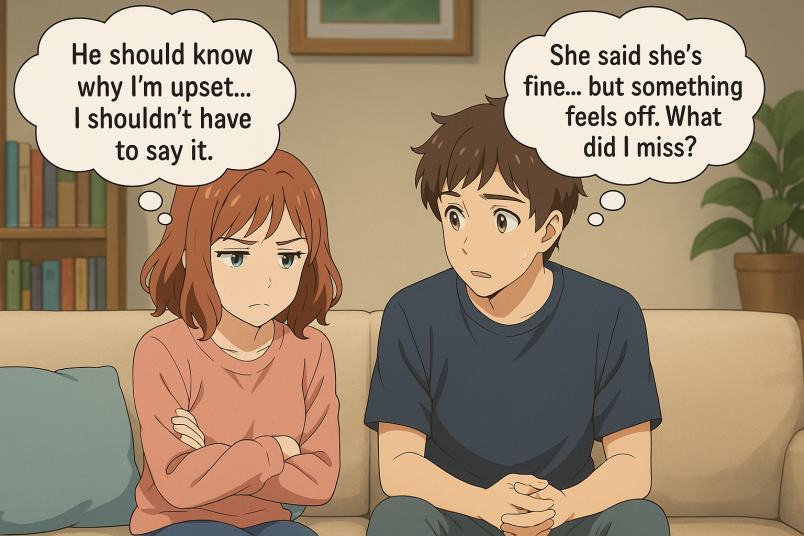
The image below, while depicting a classic heterosexual miscommunication, perfectly illustrates the core of this dynamic. Each character is trapped in their own internal monologue, operating on different assumptions. The woman's "I'm fine" is a form of cover-up, and the man's confusion is the direct result. In our scene, the cover-up will be more explicit, and the consequences will ripple out to a third person.
To fully grasp how to write this dynamic, we'll examine how subtext functions as the engine of tension.
How to Use Subtext and the Art of Dramatic Tension in Fiction
This article from Writer's Digest breaks down the mechanics of subtext, which is the lifeblood of a cover-up scene. It will give you practical tools for showing, not telling, the escalating tension.
First, read the section Know What Motivates. Pay close attention to how the character's hidden knowledge "colored" everything she said and did. This is the state your promise-breaker is now in. Next, read Embed Subtext. The example of the dinner conversation is key. The surface topic is neutral, but the unspoken truth underneath makes it tense. This is the model for the dialogue between your promise-breaker and the other characters. Finally, read Reveal Emotion Through Behavior. This section offers ways to externalize your promise-breaker's internal stress through non-verbal cues—the "tells" that hint at the lie.
2. The Psychology of Deception: A Deeper Dive
The act of maintaining a cover-up within an intimate triad is a profound psychological undertaking. It requires what one literary analysis calls an "art of self-division." The character must split themselves, performing one reality for their partners while living with another internally. The academic paper on Anaïs Nin's A Spy in the House of Love explores this concept in depth. While the context is adultery, the mechanics of deception are universal and highly applicable to our scene.
THE ART OF GUILT AND SELF-DIVISION: ANAÏS NIN'S A SPY IN ...
This scholarly article provides a sophisticated psychological portrait of a character engaged in long-term deception. It will help you understand the internal cost to your promise-breaker, which is a key component of escalating tension.
First, read the section in "The Versatile Actress" that begins Sabina's return. Note how she "tells him the truth but otherwise," constructing a plausible cover story around a kernel of reality. This is a far more effective cover-up than a simple denial. Next, read the passage that starts Guilt as poison. This highlights a crucial motivation: the deceiver often feels they must lie to protect the one they are hurting. This adds a tragic, complex layer to your promise-breaker's actions. Finally, read the section beginning the heroine realizes. The concept of the "disintegration of the ‘one’ Sabina" is powerful. The cover-up doesn't just damage the relationship; it damages the self, which is the ultimate source of escalating internal tension.
3. Concrete Example: The Cover-Up
Let's return to our vee: Leo (A), Chloe (B, the hinge), and Mark (C).
Chloe has just told Mark her weekend with him is off. She is hurt, furious, and deeply disappointed in Leo. The friction is established. Now, she confronts him. Leo, driven by shame and a desire to avoid a massive conflict, chooses to cover up.
The scene continues from Chloe’s point of view, using free indirect discourse to track her internal state as she collides with Leo's lie.
She found Leo in the living room, scrolling through his phone, a picture of placid innocence that sent a fresh spike of anger through her. The sound of her sharp, indrawn breath made him look up.
"Hey, you. All packed?" he asked, his smile easy. Too easy.
"I just got off the phone with Mr. Henderson," she said. The words were flat, cold stones dropping into the quiet space between them.
Leo’s smile didn’t vanish, but it froze. It was a subtle shift, a sudden tension in the muscles around his eyes that she wouldn't have noticed a year ago. Now, it was a flare in the dark. "Oh?" he said, his voice a careful, neutral pitch. "That old bastard. What's he complaining about now?"
"He's complaining that he's been leaving you messages all week and you haven't called him back once. He's complaining that he's initiating formal proceedings on Monday."
There it was. A flicker. Not of guilt, but something else. Annoyance? No. It was the look of a man calculating variables, running a simulation in his head. He promised. The words echoed in her mind, a bitter refrain.
He sighed, a performance of weary frustration. "Chloe, I know. I've been calling him. I left two messages on Tuesday and another yesterday morning. The man is impossible. He never picks up, and he clearly doesn't check his voicemail. I was going to go down to his office in person on Monday to sort it out." He leaned forward, his expression softening into one of earnest concern. "Honestly, I didn't want to tell you. I knew you'd get stressed, and it would ruin your weekend with Mark. I was handling it. I am handling it."
The explanation was so smooth. It was plausible. Henderson was an impossible man. And Leo’s motive—to protect her peace of mind—was a story she wanted desperately to believe. It was the story of the man she loved, the man who took care of things.
But it didn't feel true.
Henderson’s voice on the phone hadn’t been the voice of a man ignoring calls; it had been the voice of a man whose calls were being ignored. There was a difference. And Leo’s gaze, which was trying so hard to be open and reassuring, kept darting to the corner of the room, as if checking an escape route.
"So you did call him?" she asked, her voice smaller than she wanted it to be. A lifeline. Please just have been telling the truth.
"Of course I did," he said, his tone now gently wounded, as if she'd questioned his very integrity. "I promised you I would."
He was using the promise as proof. The weaponized promise. The tension in the room was no longer just anger. It was thick, murky, a fog of doubt. She didn't have proof he was lying, but her body knew. Her trust, which had been a solid thing an hour ago, was now a fractured pane of glass. She could see through it, but the cracks distorted everything.
She picked up her phone to text Mark. What could she say now? "Landlord issue, Leo's on it but the guy's a ghost." It was Leo's narrative. Speaking it would make her complicit in a lie she wasn't even sure of. But what was the alternative? “I think Leo is lying to me about the landlord he promised to deal with." That was an accusation that could break them.
The lie had cascaded. It was no longer just about the landlord. It was about her and Leo. And it was about Mark, who was now being fed a story—her story, Leo's story, a blended fiction—that kept him on the outside, his disappointment packaged and managed for him. The trust between all three of them was now compromised, hanging on a half-truth she couldn't prove was a whole lie.
Conclusion
In this lesson, we have moved the scene from friction into the heart of tension. You have seen how the promise-breaker's cover-up acts as the catalyst for a much deeper and more complex conflict, initiating a cascade of mistrust that poisons the entire vee dynamic.
Your key takeaways are:
- The Cover-Up is the Engine of Tension: It escalates a simple failure into a complex deception, raising the stakes for every character involved.
- Tension Lives in Subtext: The scene's power comes from the gap between what is said and what is true. Characters' dialogue, behavior, and internal thoughts are now in conflict.
- The Cascade is Systemic: A cover-up doesn't just damage trust between the two primary parties. It creates a web of misinformation and suspicion that tangles all three members of the vee, turning a dyadic problem into a systemic crisis.
The foundation of the relationship is now fractured. The characters are operating in a new, uncertain reality defined by Leo's lie.
In our next lesson, we will explore the consequences of this poisoned atmosphere. With trust compromised, how do the characters' actions change? We will tackle the next outcome: "Show how retaliation and suspicion create a chain reaction of broken trust among all three vee characters." We will see how this single cover-up now provokes reactions that threaten to unravel the triad completely.