Welcome back. In our previous lessons, we completed the architectural design of a scene, moving from the initial friction of mismatched goals, through the escalating pressure of tension, to a resolution that fundamentally reconfigures the emotional landscape of your triad. You now have a robust framework for the structure of a scene.
Today, we pivot from the what to the how. We will explore the critical choice of narrative voice, which governs how the reader perceives the events you've structured. This lesson addresses the first step in mastering that choice: learning to differentiate between the primary modes of third-person narration. Specifically, we'll distinguish between 3rd person limited, omniscient, and your preferred technique, free indirect discourse, to understand how each reveals a character's inner world. Mastering these tools is foundational to controlling the flow of information and emotional tone in your scenes.
The Spectrum of Narrative Distance
Before we can differentiate between specific points of view (POV), we must understand the underlying principle that governs them: narrative distance (also called psychic distance). This concept refers to the perceived space between the reader and the point-of-view character. Is the reader observing the character from afar, as if through a telescope, or are they nestled right inside the character's mind, experiencing their thoughts and feelings directly?
As an efficiency expert, you are accustomed to analyzing systems and identifying the key variables that can be adjusted to achieve a desired outcome. In narrative, distance is one such variable. By modulating it, you control the reader's emotional investment and their access to information.
for editors, proofreaders and writers - Louise Harnby
This article from the blog of editor Louise Harnby provides a concise and clear introduction to the concept of narrative distance and its relationship to different narrative styles.
Please read the first few sections of the article, starting from the top down to the end of the section "How is narrative distance related to narrative style?". Focus on the core definition of narrative distance and the list of common narrative styles that operate at different points along this spectrum.
The article lays out the fundamental idea: different narrative styles create different levels of intimacy. Let's place the main third-person POVs onto this spectrum.

1. Third-Person Omniscient
The omniscient narrator is the "all-knowing" storyteller. This POV operates at a wide narrative distance. The narrator stands outside and above the story, able to report on the actions, thoughts, and feelings of any character at any time. They can also provide information that no character knows.
- Focus: All characters (Broad)
- Closeness: Can be objective or subjective, but its ability to jump between heads inherently creates distance.
- Effect: Provides a god-like, panoramic view. It is useful for stories with large casts or complex plots where the reader needs to understand multiple perspectives simultaneously. However, this breadth can come at the cost of deep, sustained intimacy with any single character.
2. Third-Person Limited
Third-person limited, also known as close third, narrows the focus significantly. The narrator's knowledge is confined to what a single character (the POV character) experiences, thinks, and feels. If the POV character doesn't see it, hear it, or know it, the reader doesn't either.
- Focus: One character (Selective)
- Closeness: Subjective and intimate.
- Effect: This is the default for most contemporary romance. It anchors the reader to one character's emotional journey, fostering strong identification and empathy. It allows for suspense and surprise, as the reader only discovers information as the character does.
The Power of the Intimate Third: Free Indirect Discourse
You've mentioned that your writing already employs free indirect discourse. This technique is not a separate point of view, but rather a sophisticated and powerful tool that operates within third-person limited to close the narrative distance to its absolute minimum. It seamlessly blends the objective voice of the third-person narrator with the subjective thoughts and distinctive voice of the character, without using dialogue tags like "she thought" or formatting like italics.
To see it in action, this short video offers an excellent breakdown.
MINI LITERATURE MASTERCLASS: Free Indirect Speech
The "Tristan and the Classics" channel provides a clear, example-driven explanation of free indirect discourse, which you'll find very useful for codifying your intuitive use of it.
Please watch the following segments: First, get the core definition of the technique. Next, watch the segment that contrasts it with direct and indirect speech, which clarifies what makes it unique. Finally, see it applied in the Jane Austen example, which shows how it creates a fluid, intimate experience.
The video highlights how free indirect discourse (or free indirect speech) removes the "clutter" of attribution, allowing the reader to inhabit the character's perspective effortlessly. Now, let's analyze this effect with the precision of a controlled experiment.
for editors, proofreaders and writers - Louise Harnby
We'll return to Louise Harnby's blog to examine a brilliant set of comparative examples that isolate the variable of narrative distance. This provides exactly the kind of formulaic breakdown you appreciate.
First, read the clear definition under the heading What is free indirect speech?. Then, scroll down to the section titled "A closer look at narrative (psychic) distance." Carefully study the six examples provided, from Example 1 to Example 6. Pay close attention to the analysis that follows each one. This sequence moves from the most distant narration to the most intimate, demonstrating exactly how free indirect discourse (Example 5) achieves the intimacy of first-person (Example 6) within a third-person framework.
This sequence of examples makes the distinction palpable. Example 1 is pure omniscient/objective reporting. Examples 2-4 introduce the character's voice but keep it separate with tags or quotation marks. Example 5, using free indirect discourse, integrates the character's voice directly into the narrative: "Christ, had his intel been compromised again?" This is third-person narration that feels like first-person thought.
Free Indirect Discourse vs. Stream of Consciousness
You also mentioned using elements of stream of consciousness. It's vital to distinguish this from free indirect discourse, as they serve different purposes.
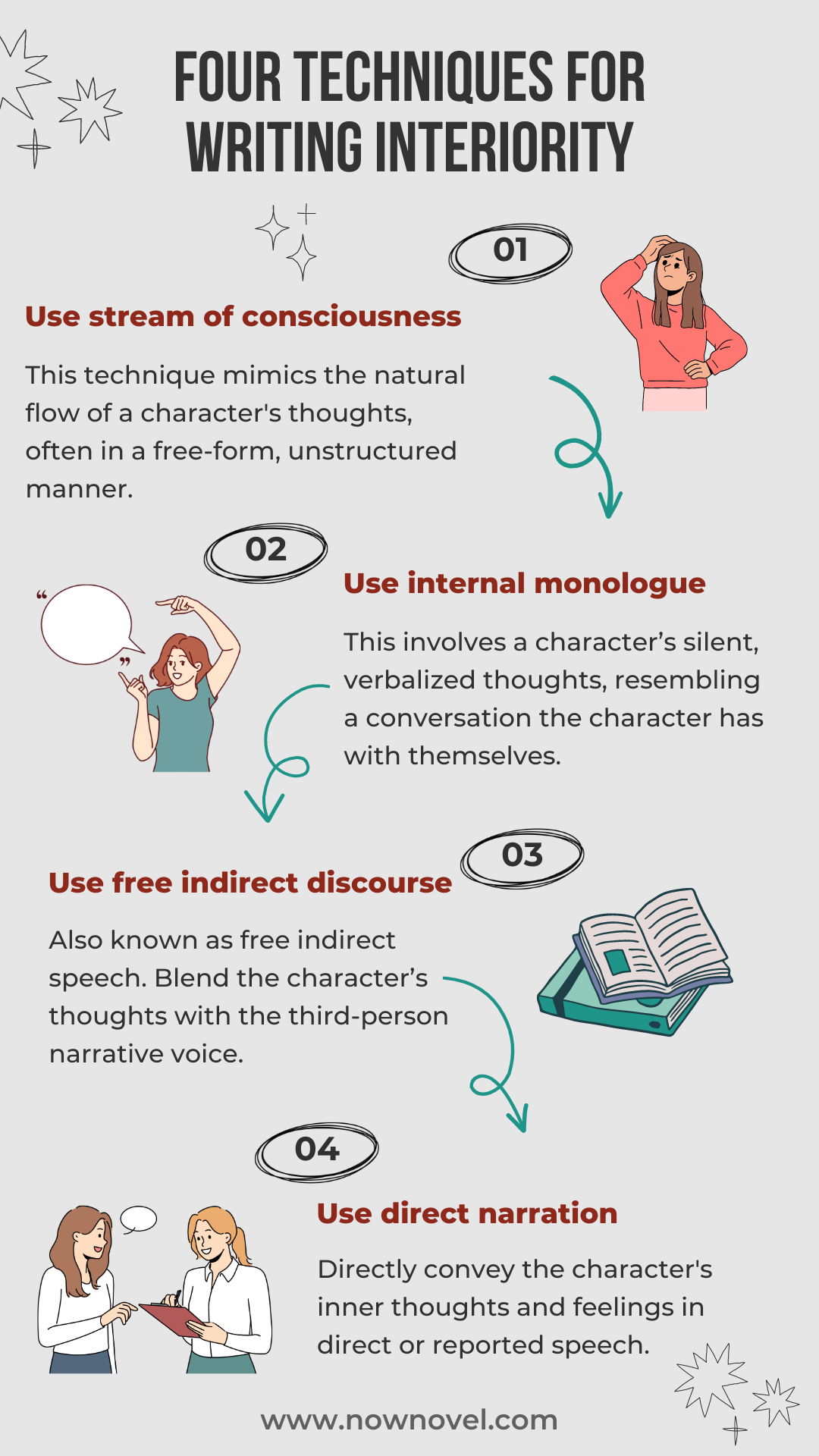
While both techniques grant access to a character's mind, they differ in their level of curation. Think of it in terms of data processing.
- Stream of Consciousness: This is the raw, unfiltered data feed of the mind. It includes every half-formed thought, sensory impression, and random association, presented as it occurs. It is dense and can be disorienting, aiming for psychological realism.
- Free Indirect Discourse: This is a processed, stylized presentation of thought. The author selects the specific thoughts and feelings relevant to the scene and presents them in the character's voice, but integrated into a coherent narrative structure. It offers intimacy without the cognitive load of true stream of consciousness.
This article makes the distinction very clearly.
What is Free Indirect Discourse? Writing the "Intimate 3rd Person"
This piece from Writers.com will help you formalize the difference between the two interiority techniques you use.
Please read the section titled FID vs. Stream of Consciousness. The key takeaway is that FID involves an "edited and stylized" transcription of thought, whereas stream of consciousness is "unfiltered and untranslated."
Application: A Moment in the Vee
Let's apply these distinctions to our triad: Maya (the hinge), Leo, and Evan. Imagine a simple moment: the three are in their living room, trying to decide where to go for their upcoming anniversary dinner.
1. Third-Person Omniscient Version:
Maya suggested Italian, hoping to please everyone. Leo, however, bristled internally; the last time they'd gone to that Italian place was before Evan, a time he jealously guarded as his and Maya's alone. Across the room, Evan felt a familiar wave of caution. He knew Leo was sensitive about his history with Maya, and the wrong restaurant choice could detonate the evening before it even began.
Notice: We have access to all three minds. We know Leo's jealousy and Evan's caution. The view is wide, but we are not deeply settled with any one character.
2. Third-Person Limited Version (Maya's POV):
"How about Italian?" Maya suggested, trying for a bright, easy tone. She saw Leo's shoulders tighten almost imperceptibly. He was staring at the bookshelf, his jaw set in a way that always meant he was displeased. On the other side of the room, Evan looked up from his phone, his expression unreadable, and simply said, "I'm good with whatever." Maya's stomach fluttered with anxiety. Something was wrong. She just didn't know what it was about Italian food that had set them both on edge.
Notice: We are locked inside Maya's perspective. We see what she sees (Leo's posture, Evan's neutral face) and feel what she feels (anxiety). We have to guess at the others' motives, just as she does.
3. Free Indirect Discourse (within Maya's 3rd Person Limited POV):
"How about Italian?" Maya suggested, trying for a bright, easy tone. Leo’s shoulders tightened. Oh no, not that again. Why did every decision have to feel like navigating a minefield? He was just staring at the bookshelf, his jaw set. On the other side of the room, Evan looked up from his phone with that neutral mask he wore. "I'm good with whatever." Of course he was. He was always good with whatever. It was a perfect way to never be wrong. A fresh wave of anxiety churned in her stomach. This was supposed to be a celebration.
Notice: The sentences in italics represent the character's thoughts blended into the narrative. "Oh no, not that again," and "This was supposed to be a celebration," are pure Maya, her voice and frustration coloring the narration, pulling us directly into her immediate experience.
Conclusion
Today, we've mapped the landscape of third-person narration, moving from a high-level overview to a granular analysis of specific techniques. This systematic approach provides a clear technical understanding to support your creative instincts.
Here are the key takeaways:
- Third-person narration operates on a spectrum of narrative distance, from the broad omniscient view to the focused limited view.
- Free Indirect Discourse is a powerful technique within third-person limited that closes narrative distance by blending the narrator's voice with the character's unfiltered thoughts and feelings.
- FID presents stylized, curated thoughts, distinguishing it from the raw, unfiltered mental feed of stream of consciousness.
- The choice of POV fundamentally changes the reader's experience, controlling what they know and whose emotional journey they share.
In our next lesson, we will build directly on this foundation. Now that you can clearly differentiate these narrative tools, we will focus on selecting the most effective POV to achieve specific effects in a scene, such as creating dramatic irony or enhancing emotional intimacy.