Introduction
In our last lesson, we focused on the architecture of a philosophy essay, establishing the crucial sequence of moving from exposition (presenting a philosopher's view) to analysis (presenting your own critique or interpretation). You learned how to structure your arguments dialectically, creating a logical journey for your reader.
Today, we will zoom in from the macro-structure of the essay to the micro-level of the sentence and paragraph. Our focus is on the specific tools you use to present the textual evidence that underpins your arguments. The learning outcome for this lesson is to apply techniques for quoting and paraphrasing sources to support a claim.
In philosophical writing, especially the exegetical work central to engaging with figures like Merleau-Ponty, your claims are only as strong as the evidence you provide. Just as a mathematical proof relies on axioms and previously established theorems, a philosophical argument relies on careful engagement with the primary text. Mastering quoting and paraphrasing is not merely a matter of citation style; it is the core practice of grounding your analysis in the philosopher's own work.
1. The Building Blocks of Evidence: Quoting and Paraphrasing
When you make a claim about what a philosopher argues, you must support it by referring to their text. The two primary methods for doing this are direct quotation and paraphrasing. Each has a distinct purpose and is appropriate in different contexts.
The image below offers a clear, systematic breakdown of the difference between the two.
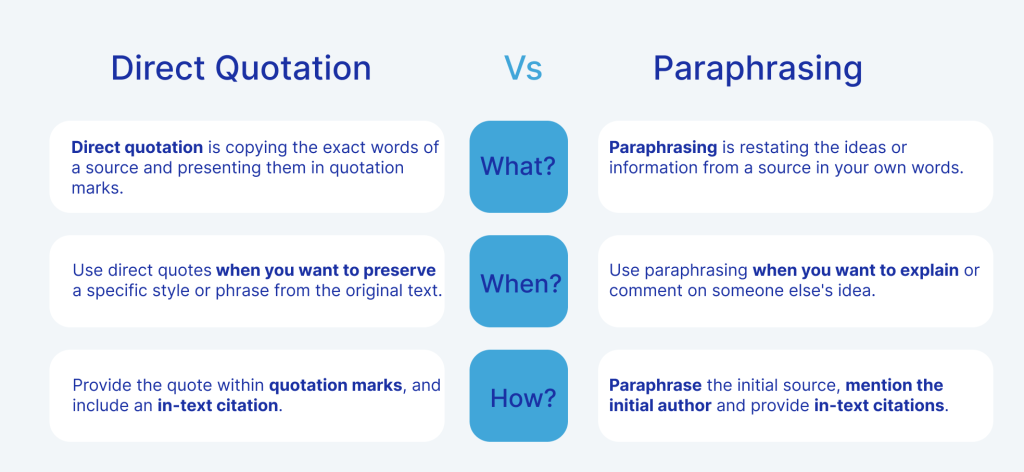
As you can see, the core difference lies in using the author's exact words (quoting) versus rephrasing their ideas in your own words (paraphrasing). The choice is not arbitrary; it depends on the specific argumentative work you need the source to do.
2. The Art of Paraphrasing: Demonstrating Understanding
Paraphrasing is your default tool for presenting a philosopher's views. When you successfully paraphrase a complex idea, you demonstrate to your reader (and to yourself) that you have moved beyond simply repeating the words on the page to genuinely grasping their meaning.
However, effective paraphrasing is a skill. It requires more than just changing a few words. The following video provides a clear, step-by-step method.
How to Paraphrase in 5 Easy Steps | Scribbr 🎓
The video 'How to Paraphrase in 5 Easy Steps' from Scribbr offers a practical guide to effective paraphrasing.
Watch from 00:18 to 03:00. Pay close attention to the five-step process and the four practical tips, such as changing sentence structure and using synonyms. This systematic approach is key to avoiding the common pitfalls of poor paraphrasing.
As the video illustrates, the goal is to fully internalize the original idea and then express it using your own conceptual and linguistic framework.
One of the most common errors is what's called "patchwriting" or a "close paraphrase," where you stick too closely to the original sentence structure and vocabulary. This not only fails to demonstrate understanding but can also inadvertently alter the author's meaning.
The following text provides a powerful example of a poor paraphrase versus a good one, showing precisely why the former fails.
[PDF] Guidelines on Writing a Philosophy Paper
To see the difference between a mechanical paraphrase and a truly insightful one, please read this section from Jim Pryor's 'Guidelines on Writing a Philosophy Paper'.
Please read the section titled 'Paraphrases'. It begins with an example from the philosopher David Hume. Focus on the two examples of paraphrasing provided and, more importantly, the author's explanation of why the first is weak and the second is strong. This will clarify the standard for good philosophical paraphrasing.
The key takeaway is that a good paraphrase is an act of interpretation and clarification; a bad paraphrase is a mechanical exercise in word replacement.
3. The Strategic Use of Quotations: Providing Proof
While paraphrasing is your workhorse, direct quotations are your surgical instrument. They should be used deliberately and for specific purposes. Over-quoting can drown out your own voice and suggest you haven't fully processed the material.
How to Write a Philosophy Paper
Let's watch a short clip that explains the general principle of using quotes sparingly.
Watch from 29:47 to 30:55. The speaker, Jeffrey Kaplan, makes the crucial point that paraphrasing demonstrates a greater degree of understanding than simply retyping someone's words.
So, if we should use them sparingly, when is it essential to quote? In philosophy, quoting is not merely for emphasis. It is your primary way of providing textual evidence for an exegetical claim. When your argument hinges on a precise turn of phrase or a specific formulation in the original text, you must present that text directly to the reader.
Some writing guides for philosophy even seem to contradict the "use sparingly" advice. This is because, in this discipline, quoting is a form of data presentation.
[PDF] Guide for Writing in Philosophy
This guide from Southwestern University highlights the essential role of quoting in philosophical exegesis.
Read the short paragraph within the 'Evidence in Philosophical Writing' section that begins 'These kinds of evidence in philosophical writing require that you extensively quote...'. Notice the reason given: philosophical texts often have a 'variety of possible meanings,' making your interpretation of the exact words crucial.
How do we resolve this? The synthesis is this:
- Paraphrase when explaining a philosopher's general position or summarizing an argument in your exposition.
- Quote when the specific words a philosopher uses are the very data you are analyzing.
Most importantly, a quotation should never stand alone. You must always frame it with your own analysis. This is often called the "quote sandwich":
- Top Slice (Introduction): Introduce the quote and explain its context. Why are you showing this to the reader?
- Filling (The Quote): Present the quote, correctly cited.
- Bottom Slice (Analysis): Explain what the quote says in your own words and, crucially, show how it supports the specific point you are making.
This final step—the analysis—is what turns a quotation from a passive piece of information into active evidence for your argument.
[PDF] Guidelines on Writing a Philosophy Paper
Let's return to Jim Pryor's guide for a clear explanation of this 'quote sandwich' principle.
Read the section titled 'Quotations'. Focus on the sentences: 'Quotations should never be used as a substitute for your own explanation. And when you do quote an author, you still have to explain what the quotation says in your own words.' This is the core principle of integrating quotes effectively.
4. Your Task: Quoting and Paraphrasing Merleau-Ponty
Let's apply these techniques to a passage from Merleau-Ponty's Phenomenology of Perception.
Passage:
To be a body, is to be tied to a certain world... our body is not primarily in space: it is of it. The space of my room is not for me a collection of points of which I can reconstruct the geometrical properties... It is a space reckoned starting from me as the zero point or degree zero of spatiality. I do not see it according to its exterior envelope, I live it from the inside; I am immersed in it. After all, the world is all around me, not in front of me.
Instructions:
Complete the two short tasks below.
Task 1: Supporting a Claim with a Quotation
Write a short paragraph that supports the following claim: "For Merleau-Ponty, lived space is fundamentally different from objective, geometric space because it is organized around the body's perspective."
Your paragraph should follow the "quote sandwich" model: introduce the idea, use a short, relevant quote from the passage above as evidence, and then analyze how the quote supports the claim.
Task 2: Paraphrasing the Central Idea
Write a short paragraph that paraphrases the central idea of the entire passage above. Your goal is to capture Merleau-Ponty's concept of the body's relationship to space in your own words, without using any direct quotes.
Sample Answer
Task 1 (Quoting) Example:
Merleau-Ponty fundamentally distinguishes the abstract space of geometry from the 'lived space' of our experience. He argues that we do not encounter the world as a neutral container of objects, but as a field oriented around our own bodily possibilities. For him, lived space is not something we observe from the outside; rather, it is a dimension we inhabit. As he puts it, space is "reckoned starting from me as the zero point or degree zero of spatiality." This concept of a 'degree zero' shows that for Merleau-Ponty, the body is not just another object located in space; it is the very center and origin from which all spatiality is structured and made meaningful.
Task 2 (Paraphrasing) Example:
According to Merleau-Ponty, the body's relationship to the world is one of inherent connection, not detached observation. He suggests that our primary way of being is not as a mind perceiving a separate physical space, but as a body that is itself a part of the spatial fabric. Instead of experiencing our surroundings as an objective grid of coordinates that we could measure, we live space from a first-person perspective. The body acts as the central anchor or origin point for our world, and we experience our environment as extending around us, something we are submerged in, rather than as a scene set out before us.
Conclusion
In this lesson, you've moved from the blueprint of an essay to the fine craft of its construction. You now have the tools to integrate textual evidence into your arguments with precision and purpose.
Key Takeaways:
- Paraphrasing demonstrates understanding. It is the default method for presenting a philosopher's ideas in your own analytical voice.
- Quoting provides proof. It is a strategic tool used to present the direct textual evidence your exegetical claims rely on.
- The "Quote Sandwich" is essential. Never let a quote stand alone. Always introduce it, present it, and—most importantly—analyze it.
- The choice between quoting and paraphrasing is an argumentative one, determined by the function the source needs to perform in your essay.
Preview of the Next Lesson:
Having covered the essay's macro-structure (sequencing arguments) and its micro-components (using evidence), we are now ready for the final stage of the writing process. In our next and final lesson of the course, we will focus on the crucial act of refinement. The learning outcome will be to revise a phenomenological essay for argumentative clarity, coherence, and scholarly rigor, ensuring your final written work is as strong and persuasive as possible.