Introduction
In our last lesson, you practiced the art of phenomenological description, using the example of learning a motor skill to trace the body's transformation from a clumsy object into an intelligent, world-inhabiting subject. This exercise demonstrated that our most fundamental way of being is as a body-subject, an "I can" that is already intertwined with a meaningful world.
This week, we begin our exploration of "The Fabric of Perceptual Experience." We will take the phenomenological lens you have sharpened and apply it to the most basic component of perception: sensation. Your learning outcome for this lesson is to explain how Merleau-Ponty rethinks the concept of 'sensation' beyond classical accounts.
We will deconstruct the traditional views that Merleau-Ponty challenges—namely, empiricism and intellectualism. You will see that both, in his view, are built upon a flawed foundation he calls the "prejudice of the objective world." By dismantling these accounts, we will clear the ground for his radical alternative: the idea that sensation is never a raw, meaningless jolt, but is from the very beginning a structured, meaningful, and embodied engagement with the world.
1. The "Classical Prejudices" and the Error of Sensation
Merleau-Ponty begins his analysis by arguing that classical philosophy and psychology make a fundamental error. Instead of describing perception as we actually experience it, they try to reconstruct it based on a pre-conceived idea of an "objective world" composed of determinate, measurable objects. This, he calls the "prejudice of the world" or the "experience error."
Starting from this prejudice, they invent a theoretical building block called "sensation" to bridge the gap between the objective world and our conscious experience. This theoretical "sensation" takes two distorted forms.
To understand this foundational critique, let's turn to a short video that introduces Merleau-Ponty's argument and the two classical views he targets.
The Context-Dependent Nature of Sensation | Phenomenology of Perception | Merleau-Ponty
This video, 'The Context-Dependent Nature of Sensation', outlines Merleau-Ponty's core argument. It explains how traditional views fail to account for the integrated and context-dependent nature of our actual perceptual experience.
Please watch from the beginning until 03:08. The first minute introduces the main thesis. The subsequent two minutes detail the two 'erroneous perspectives' on sensation that Merleau-Ponty critiques: Sensation as pure sensory data: The empiricist view (like Locke's) of meaningless 'atoms of experience'. Sensation as passively received qualities: The view that assumes a direct, perfect correlation between the object and our perception of it, with definite meanings.
As the video and Merleau-Ponty's work clarify, these two perspectives distort our understanding of perception.
- Empiricism treats sensation as a subjective impression. It's a meaningless "jolt" inside our consciousness. Merleau-Ponty argues this corresponds to nothing in our experience; even the most basic perception is already about relations and has a figure-ground structure.
- Intellectualism (or Rationalism) treats sensation as the reception of an objective quality. 'Red' is a property of the object that we passively receive. This view, Merleau-Ponty argues, builds perception out of the perceived, ignoring the ambiguity and context-dependency of our lived experience.
To see this argument presented with more academic rigor, the following paper explains how these classical accounts presuppose an "objective world" and distort the "pre-objective world" of our actual experience.
[PDF] Sensation in Merleau-Ponty and Husserl - UTCP
The paper 'Sensation in Merleau-Ponty and Husserl' provides a concise breakdown of Merleau-Ponty's critique of what he calls 'classical analyses'.
Please read the first three sections (pp. 49-51): Start with Section I, 'Introduction,' to grasp the overall project. Continue through Section II, 'Merleau-Ponty’s criticism of the classical concepts of sensation.' This section clearly defines the 'pre-objective world' versus the 'objective world'. Read the two subsections that follow, which correspond to the two distortions we've discussed: sensation as subjective 'impression' and sensation as objective 'quality'.
Both classical views, despite their differences, share a common root: they begin with a world of detached, fully determined objects and then try to explain how we perceive them, inventing the notion of 'pure sensation' as a necessary but fictional intermediary.
2. The Constancy Hypothesis and Its Failure
The "prejudice of the world" finds its most explicit scientific formulation in what is called the constancy hypothesis. This is the assumption that there is a constant, one-to-one correspondence between a given stimulus on a sense organ and the elementary perception it produces.
Merleau-Ponty argues that this hypothesis is consistently contradicted by our actual experience. The most powerful evidence against it comes from optical illusions.
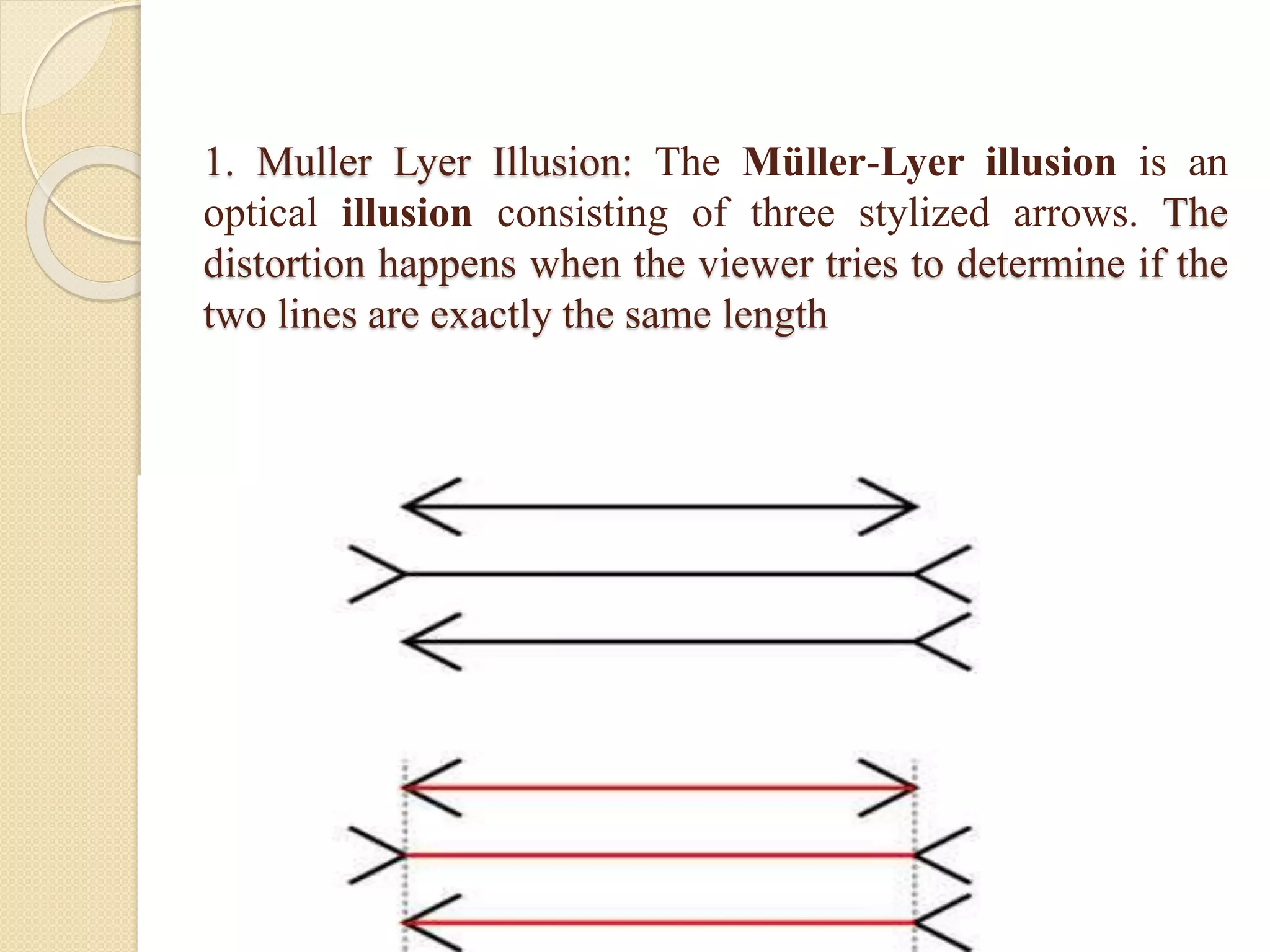
The video you started watching provides a clear visual demonstration of this point.
The Context-Dependent Nature of Sensation | Phenomenology of Perception | Merleau-Ponty
Let's return to the video 'The Context-Dependent Nature of Sensation' to see how illusions dismantle the constancy hypothesis.
Please watch the segment from 03:08 to 04:52. It uses the Ebbinghaus, Müller-Lyer, and color constancy illusions to show that context, not raw stimuli, determines what we perceive.
For Merleau-Ponty, these "illusions" are not errors of perception. Rather, they reveal the error of the constancy hypothesis itself. They show that perception is not a passive recording of stimuli but an active organization of a field. In the Müller-Lyer illusion, the lines are not perceived as 'equal' or 'unequal' in the geometric sense; for perception, they simply become 'different' because they are integrated into different wholes.
Now, let's engage with Merleau-Ponty's own words on this topic. Reading the primary text is essential for your goal of writing philosophically on these subjects.
[PDF] Phenomenology of Perception
The following is from the 'Sensation' chapter of Phenomenology of Perception. Here, Merleau-Ponty directly attacks the constancy hypothesis and the physiological assumptions behind it.
Please find the chapter titled 'Sensation' (it begins on page 25 of the text, but check the PDF page numbers). Read the subsection labeled '[c. Sensation as the immediate consequence of a stimulation.]'. This starts on page 29 of the text. Focus on his argument that the constancy hypothesis is a theoretical assumption that conflicts with the 'givens of consciousness.'
3. Merleau-Ponty's Alternative: Sensation as Meaningful and Structured
Having deconstructed the classical accounts, Merleau-Ponty offers his own revolutionary alternative. If sensation is not a meaningless atom of experience, what is it?
For Merleau-Ponty, sensation is:
- Always structured: The most basic perceptual unit is not a point of color but a figure on a background.
- Inherently meaningful: Perception is not about receiving raw data and then adding meaning. The meaning is already there in the perceptual field. Sensation is a "nascent logos" — a meaning in the process of being born.
- Context-dependent: A quality is never perceived in isolation. A patch of red is always the "wooly red" of a carpet, perceived in a particular light, as part of a whole room.
- Embodied and pre-objective: It is an active process of a body-subject engaging with a "pre-objective world," a world of vital significance, not a world of neutral, geometric objects.
The empiricist might try to save their theory by introducing concepts like association and memory to explain how meaningless sensations get bundled into meaningful objects. Merleau-Ponty argues this move fails because it is circular.
Merleau-Ponty’s Critique of Empiricism | Phenomenology of Perception
This next video, 'Merleau-Ponty’s Critique of Empiricism', explains why simply adding 'association' doesn't work. It shows that association and memory already presuppose the meaningful wholes they are meant to explain.
Please watch from 04:01 to 13:46. Pay attention to the central argument: 'for associations to happen there must already be an intrinsic unity and intelligibility of those perceived objects.' The video then illustrates this with several of Merleau-Ponty's examples (the ship appearing on the horizon, the hidden figure), which show that perception directly apprehends meaningful wholes.
The moment of recognition—seeing the mast and hull as a ship—is not an intellectual act of piecing together memories. It is a perceptual reorganization, a moment when our gaze "gets a hold" on the scene, responding to a question latent in the landscape.
Finally, let's read Merleau-Ponty's conclusion to his chapter on sensation, where he summarizes his own positive account.
[PDF] Phenomenology of Perception
This final reading from the primary text offers a powerful summary of Merleau-Ponty's re-conception of sensing.
Please read the final subsection of the 'Sensation' chapter, titled '[d. What is sensing?]' (starting on page 33 of the text). Notice his claim that the classical notion of sensation is a 'late product of thought turned toward objects' and that to understand sensing, we must explore the 'pre-objective domain' within ourselves.
Conclusion
In this lesson, we have fundamentally re-evaluated the concept of sensation. Moving beyond the classical accounts of empiricism and intellectualism, we have uncovered Merleau-Ponty's view of sensation as an already meaningful, structured, and embodied engagement with the world.
Key Takeaways:
- Classical accounts of sensation are built on the "prejudice of the objective world," attempting to construct perception from theoretical atoms rather than describing lived experience.
- This leads to two distortions: sensation as a purely subjective impression (empiricism) or as a passively received objective quality (intellectualism).
- The constancy hypothesis, the scientific version of this prejudice, is refuted by perceptual phenomena like optical illusions, which reveal the context-dependent nature of perception.
- For Merleau-Ponty, sensation is never a raw, isolated datum. It is always a structured figure-on-a-ground, an active and meaningful process rooted in our existence as a body-subject in a "pre-objective" world.
Preview of the Next Lesson:
Having established these general principles, we will next apply them to a specific and powerful case study: depth perception. You will analyze Merleau-Ponty's account of how we perceive depth, which serves as a profound challenge to classical optics and further demonstrates that space is not something we perceive in, but something we live and inhabit.