Introduction
Welcome to your next lesson. In our previous session, we performed a detailed analysis of the Schneider case. We saw how his pathological condition reveals a dissociation between the power to be solicited by a concrete situation and the power to project a field of possibilities for action. This led us to understand that in a healthy individual, these two powers are unified in what Merleau-Ponty calls motor intentionality, or the embodied "I can."
Schneider's fractured existence provides a stark contrast to a healthy, unified being-in-the-world. This raises the question: what does this healthy, unified relationship with our surroundings actually look like? Today's lesson will answer that by exploring one of Merleau-Ponty's most evocative concepts. Our learning outcome is to explain what it means for the body to 'inhabit' space and the world.
We will move from the idea of a body being merely in space—like a rock or a chair—to the distinctly human experience of inhabiting space and the world as a perceiving, acting subject.
1. From Objective Position to Lived Situation
The first step in understanding inhabitation is to grasp the distinction between two kinds of space. Classical thought, from physics to Cartesian philosophy, conceives of space as a universal, objective container—a kind of three-dimensional grid where every point is equivalent. In this positional space, a body is just an object located at a set of coordinates (x, y, z).
Phenomenology reveals a more fundamental, lived space. This is situational space, which is not neutral but is structured and oriented around our body's projects and abilities. It has a 'here' (where I am), a 'there' (where I am not), and directions like 'up', 'down', 'near', and 'far' that derive their meaning from my body's capacity to act.
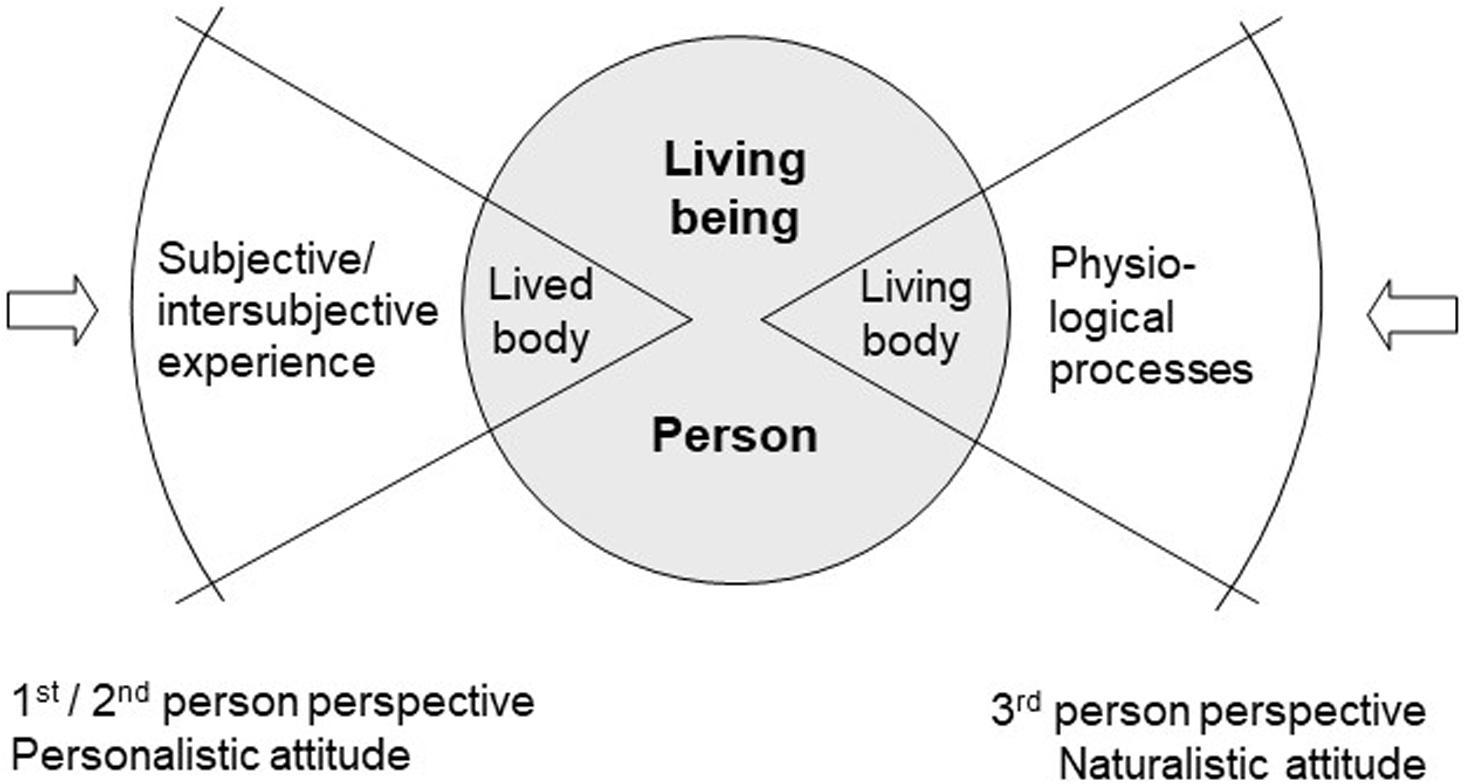
This distinction mirrors the one we've made before between the body as an object (Körper) and the lived body as subject (Leib).
To formalize this, let's turn to an academic analysis that, much like our last lesson, uses the Schneider case as its starting point.
[PDF] Merleau-Ponty's Phenomenology of Space - UTCP
The paper 'Merleau-Ponty's Phenomenology of Space' by Liu Shengli systematically lays out the distinction between objective, positional space and lived, situational space. It shows how Merleau-Ponty uses this 'spatial archaeology' to reveal the lived body.
Please read Section 2, 'The spatial archaeology of the lived body' (pages 134-136). Focus on how the author contrasts the 'spatiality of position' (objective space) with the 'spatiality of situation' (bodily space). Pay close attention to point (4) on page 136, which explicitly states that the fundamental relation is not 'a body in space' but a body that 'inhabits space'.
As the reading clarifies, the lived body is not simply in a pre-given, objective space. Rather, the body and its situational space are mutually constituting. The body's capacity for action gives meaning to space, and space provides the field for the body's action. This dynamic, reciprocal relationship is what Merleau-Ponty calls inhabitation.
2. The Meaning of Inhabitation: Transcendence and Incorporation
We now have a precise definition: to inhabit is not to occupy a position, but to be the center of a situation. Let's deepen this by examining what this entails. What does it mean to live this way?
The following reading from Caterina Di Fazio's paper provides a beautifully concise and powerful explanation.
[PDF] The free body Notes on Maurice Merleau-Ponty's phenomenology of ...
In her paper 'The free body,' Caterina Di Fazio provides a direct and elegant definition of what it means to inhabit space, connecting it to the concepts of possibility and transcendence.
Please read the two paragraphs on page 15 that begin with 'This abstract or virtual movement...' and 'To be situated in the world...'. Focus on the central definition of inhabiting the world and how it connects us via 'intentional threads' to a horizon of possibilities.
This passage is crucial. To inhabit the world means two things:
- Opening Virtual Space: We are not "imprisoned in the place and time we occupy." Through what Merleau-Ponty calls the "movement of transcendence," we take up our factual situation and open a "virtual space" of possibility. This is the power of projection we discussed in the last lesson—the ability to act not just in response to the actual, but in relation to the possible.
- Connection via "Intentional Threads": We are connected to landscapes and horizons that are not physically present. My desk is not just a collection of wood and metal at certain coordinates; it is part of a situation that includes the project I am working on, the room it's in, and the home that contains that room. These are the "intentional threads" that weave our lived world together.
This "inhabiting" extends our lived body beyond our skin. Through habit and action, we incorporate tools, objects, and places into our body schema.
The following video gives several excellent phenomenological descriptions of this process of incorporation.
Merleau-Ponty, Phenomenology of Perception 4: Temporality and Spatiality (Phenomenology Lecture 8)
Professor John Russon provides clear examples of how we come to inhabit things and places, effectively making them extensions of our own body.
Please watch from 58:47 to 1:12:37. Notice the key examples used to illustrate how our 'situational spatiality' expands: The blind person's cane. A child's bedroom and sense of personal space. The concept of 'home' as a place of comfort and familiarity. The distinction between qualitative closeness (intimacy) and quantitative distance (mathematical measurement).
As Russon's lecture illustrates, my home is not just a set of coordinates on a map; it is part of my "here." The route to my office, my friend's house, a familiar chair—these places become part of the space I inhabit. This lived space is structured by intimacy and familiarity, not by the indifferent metrics of objective, positional space.
3. The Bodily Dynamics of Inhabiting
How does this inhabitation work? Is it a conscious, intellectual process? Do we "calculate" our relationship to our home or our tools?
The Schneider case has already taught us the answer is no. Inhabitation is a practical, non-reflective, bodily form of knowledge. It is "knowledge in the hands."
Let's return to Professor Russon's lecture, where he connects these ideas back to the Schneider case to clarify the nature of this bodily knowledge.
Merleau-Ponty, Phenomenology of Perception 4: Temporality and Spatiality (Phenomenology Lecture 8)
This final clip brings our discussion full circle, using the Schneider case to distinguish the theoretical knowledge of positional space from the practical, bodily knowledge that constitutes our inhabitation of situational space.
Please watch from 1:17:24 to 1:27:32. Focus on the core argument: Schneider's case reveals the difference between theoretical cognition (which he lacks) and the non-reflective bodily responsiveness that allows him (and us) to navigate situational space. Notice the idea of movement as a 'call and response' with the situation.
This brings us back to the unity of solicitation and projection. To inhabit a space is to be in a constant, dynamic dialogue with it.
- The itch on my back summons my hand.
- The layout of my kitchen guides my movements as I prepare a meal.
- The familiar feel of a tool invites a certain kind of action.
This is not a theoretical process. My hand "knows" where my nose is without needing to consult a coordinate map. My body "knows" its way around my home without reflective thought. This practical understanding is the essence of inhabiting the world. We live in a world that solicits us, and we respond by projecting meaning and possibility, all through the medium of the lived body.
Conclusion
Today we have built a positive account of our being-in-the-world to contrast with the pathological state of a patient like Schneider. We have seen that to be a human subject is not merely to be in space, but to actively inhabit it.
Key Takeaways:
- Inhabiting vs. Being In: Objects are in a neutral, positional space. Lived bodies inhabit a meaningful, situational space that is oriented by their tasks and capacities.
- Incorporation: Through habit, we incorporate tools (the cane) and places (our home) into our body schema. The space we inhabit extends beyond our skin.
- Movement of Transcendence: To inhabit is to constantly transform a factual situation into a world of meaning and possibility. We are tied to the world by "intentional threads" that connect us to a horizon of what is possible, not just what is actual.
- Bodily Knowledge: Inhabitation is a non-reflective, practical form of knowledge—a "knowledge in the hands." It is a dynamic process of being solicited by the world and projecting meaning onto it, a constant "call and response" between the body and its environment.
Preview of the Next Lesson:
The concept of 'inhabiting the world' is a cornerstone of Merleau-Ponty's philosophy. It synthesizes his ideas about the lived body, perception, motility, and habit into a unified picture of human existence. In our next lesson, we will take this final step. The learning outcome will be to articulate the central thesis of the 'Phenomenology of Perception' as a synthesis of its key concepts. We will see how the idea of inhabiting the world helps express the book's ultimate claim about who we are.