Introduction
In our last lesson, we completed our high-level mapping of Merleau-Ponty's philosophy by situating him relative to Martin Heidegger. We saw that while Merleau-Ponty is deeply indebted to Heidegger's concepts of Being-in-the-world and the primacy of practical engagement, he departs critically by grounding these existential structures in the concrete reality of the lived body and the primacy of perception.
With this comprehensive understanding of Merleau-Ponty's project in Phenomenology of Perception now in place, our focus shifts from acquiring knowledge to applying it. Your stated goal is to write academic philosophy, and this lesson marks a pivotal step in that direction. The learning outcome for today is to construct a clear thesis statement for an academic essay on Merleau-Ponty's theory of the lived body.
Think of a thesis statement as the central theorem of your paper. It is the specific, contestable claim that the entire essay is dedicated to proving. The logical rigor you are familiar with from mathematics is directly applicable here: the thesis must be precise, and the subsequent arguments must follow from it and support it without ambiguity. This lesson will equip you with the principles to formulate such a statement and then guide you in applying them to Merleau-Ponty's work.
1. The Anatomy of a Philosophical Thesis
Before we can construct a thesis about Merleau-Ponty, we need to understand what makes a philosophical thesis effective. Unlike a simple statement of fact or a broad topic, a strong thesis is the engine of your entire paper.
A superb and detailed guide on this topic is Douglas Portmore's "Tips on Writing a Philosophy Paper." Please begin by studying the first section, which focuses exclusively on thesis statements.
Tips on Writing a Philosophy Paper
This guide provides an excellent, rigorous breakdown of what a thesis statement is and what it should accomplish in a philosophy paper.
Please read the first section, '1. Constructing a Thesis Statement'. Pay close attention to the list of characteristics a thesis should have and review the 'DOs and DON’Ts' examples carefully. This section ends just before the start of section '2. The Introduction'.
As Portmore's guide makes clear, a strong thesis statement must be:
- Specific and Narrow: It tackles a manageable question within the broader topic. "Merleau-Ponty's theory of the body" is a topic; "Merleau-Ponty's use of the Schneider case demonstrates the primacy of motor intentionality over abstract thought" is a thesis.
- Arguable (or "Interesting"): It must make a claim over which reasonable people could disagree. "The body is important for Merleau-Ponty" is a fact. "Merleau-Ponty's concept of the lived body successfully resolves the mind-body problem where Husserl's fails" is an arguable claim.
- A Claim about the Philosophy: It should address a philosophical issue, not a purely empirical one. "More people today suffer from phantom limb pain" is an empirical claim. "The phantom limb phenomenon reveals that the lived body is not a representation in the mind but an existential situation" is a philosophical claim.
- Hints at the Argument: A good thesis often gives the reader a roadmap for the paper. It suggests how you will prove your point.
This visual guide neatly summarizes the idea of a thesis as a combination of your main claim and the reasons that will support it.
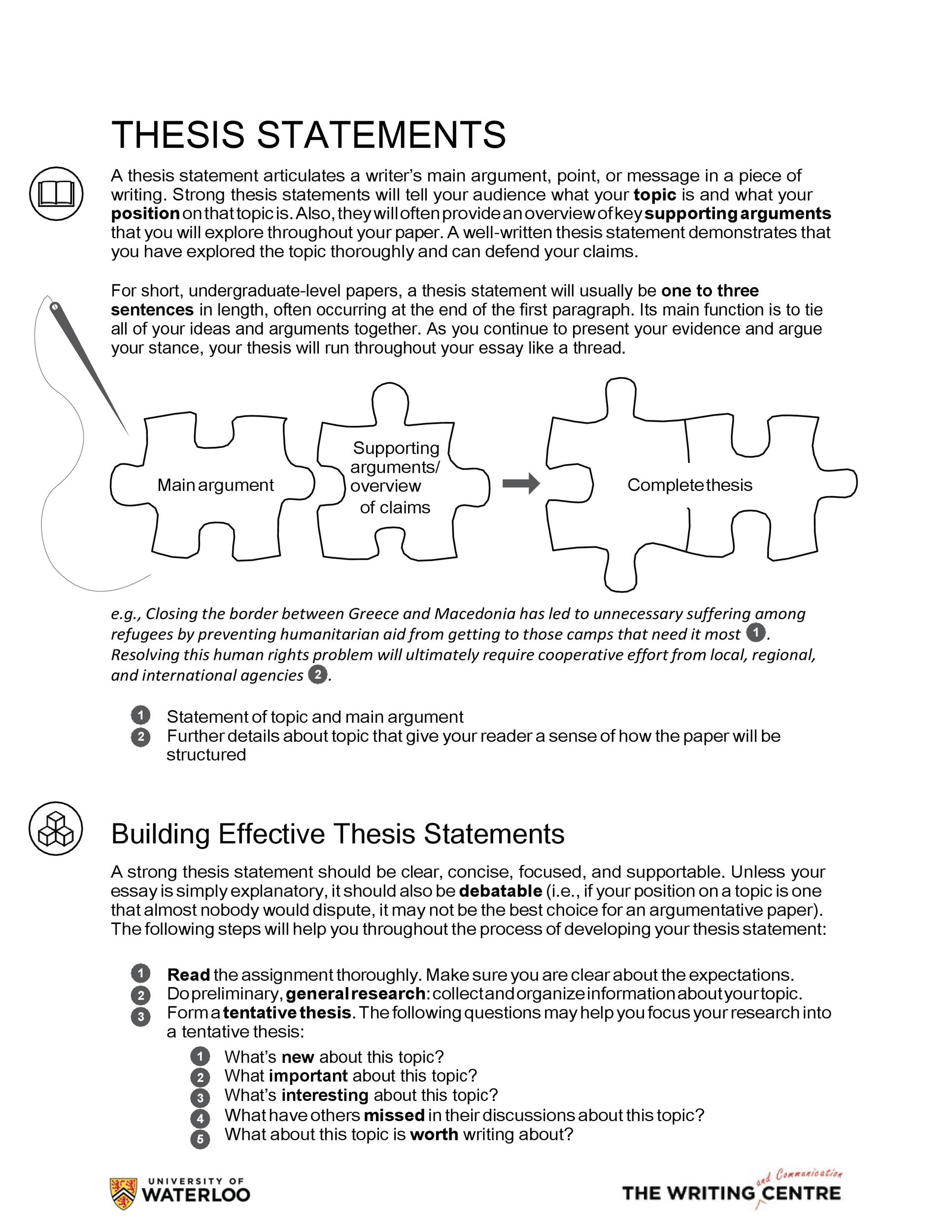
In essence, your paper exists to rationally persuade the reader that your thesis is true.
Guide for Writing a Philosophy Paper
This video reinforces the central role of the thesis. The author, Jeffrey Kaplan, makes the simple but crucial point that a standard philosophy paper consists of just two parts: a thesis and the argument for it.
Please watch from 01:24 to 04:54. Focus on the definition of the 'standard philosophy paper' and its core components.
2. Generating a Thesis: From Topic to Claim
Now, how do we generate a specific, arguable claim about Merleau-Ponty's theory of the lived body? A thesis often arises from asking a critical question about the material. It typically falls into one of a few categories.
Let's use Taylor Carman's paper, "The Body in Husserl and Merleau-Ponty," as a model. This is an example of a sophisticated academic argument.
The Body in Husserl and Merleau-Ponty
This scholarly article presents a complex, thesis-driven argument about the philosophies of Husserl and Merleau-Ponty. We will use it as a case study to see how a professional philosopher builds a claim.
First, read the introduction (the first four paragraphs on the first page). Then, read the conclusion (the final three paragraphs of the paper). Your goal is to identify Carman's central thesis. What is the core, arguable claim he is making about the difference between Husserl and Merleau-Ponty on the body?
Carman's central thesis could be articulated like this:
"Although Merleau-Ponty's phenomenology of the body was inspired by Husserl, I will argue that it represents a radical departure. Specifically, Husserl's account remains caught in a conceptual dualism where the body is a quasi-object 'had' by a transcendental ego, whereas for Merleau-Ponty, the body is the primordial subject of perception, a primitive structure of experience that precedes the subject-object split."
Notice how this thesis is specific, highly arguable, and sets up a clear comparative structure for the paper. It is a perfect example of a Comparative Thesis.
Based on this model, here are some common types of philosophical theses you can construct about Merleau-Ponty:
-
Interpretive Thesis: Argues for a particular understanding of a difficult concept.
- Example: "I will argue that Merleau-Ponty's 'body schema' should not be understood as a static representation, but as a dynamic system of motor equivalences that constitutes our primordial access to the world."
-
Comparative Thesis: Argues for a specific relationship (of debt, departure, or superiority) between two thinkers.
- Example (Carman's): "I will argue that Merleau-Ponty's theory of the lived body succeeds where Husserl's fails because it overcomes the residual Cartesian dualism present in Husserl's account of the body as a mere 'bearer of sensations'."
-
Critical Thesis: Identifies a flaw, limitation, or internal contradiction in the philosopher's argument.
- Example: "While Merleau-Ponty's use of the phantom limb case effectively critiques intellectualism, I will argue that it problematically conflates the 'habitual body' with the 'current body,' creating an ambiguity his theory cannot resolve."
-
Defense Thesis: Defends the philosopher against a known or potential objection.
- Example: "I will argue that the common criticism that Merleau-Ponty's 'motor intentionality' is just a form of behaviorism is mistaken. By analyzing his account of habit, I will show that motor intentionality is an irreducibly experiential and meaningful engagement with the world."
3. Workshop: Constructing Your Thesis
Now it's your turn to practice. The goal here is not to write a perfect, final thesis, but to practice the skill of formulating a clear, arguable claim based on the concepts we've studied.
Drawing on your knowledge of Merleau-Ponty's theory of the lived body, please choose one of the prompts below and construct a full thesis statement. Try to make it as specific and arguable as you can, following the principles from the Portmore guide.
Prompt 1 (Interpretive/Critical): The Schneider Case
You have studied the case of Schneider, the brain-injured soldier who could perform "concrete" but not "abstract" movements. Merleau-Ponty uses this case as powerful evidence for his theories. Formulate a thesis statement that makes a specific claim about the philosophical significance of this case study.
Prompt 2 (Comparative): The 'I Can' vs. the 'I Think'
Merleau-Ponty famously claims that consciousness is primarily an "I can," not an "I think." This is a direct challenge to the Cartesian tradition. Formulate a thesis statement that argues how Merleau-Ponty's concept of the lived body establishes the primacy of the "I can."
Prompt 3 (Synthesis): The Body as Subject
A central theme of Phenomenology of Perception is that the body is the subject of perception, not its object. Synthesizing the concepts of the body schema, motor intentionality, and the distinction between the lived body (Leib) and objective body (Körper), formulate a thesis that explains what it means for the body to be a "subject."
Take some time to draft your thesis statement. Remember to aim for a claim that you could imagine defending over the course of a 5-10 page paper.
(After you provide your draft, I will give you feedback based on the criteria we've discussed.)
Conclusion
Today, we've transitioned from understanding Merleau-Ponty's philosophy to using it as the raw material for constructing your own philosophical arguments. The thesis statement is the single most important sentence in an academic essay, serving as the claim you set out to prove.
Key Takeaways:
- A strong philosophical thesis is specific, narrow, arguable, and previews the structure of your argument.
- It is not a statement of fact or a broad topic, but a precise claim that requires rational persuasion and defense against objections.
- Theses can be generated by making interpretive, comparative, critical, or defensive claims about the philosopher's work.
Preview of the Next Lesson:
Having learned how to formulate a thesis, the logical next step is to build an argument around it. However, before we delve into essay structure, we will broaden our scope from the individual lived body to the social world. In our next lesson, we will begin Module 8 by exploring one of Merleau-Ponty's most fascinating topics: how we encounter and understand others. Our learning outcome will be to explain Merleau-Ponty's account of how we perceive other subjects through 'intercorporeality'.