Introduction
In our last lesson, we made a crucial distinction between the empirical ego (the self as a person in the world) and the transcendental ego (the pure subject of consciousness revealed by the epoché). We established that the transcendental ego isn't an object in the world, but rather the fundamental condition for any world to appear to us at all.
This naturally leads to the question: What does this transcendental ego, or transcendental subjectivity, actually do? Today's lesson will answer that question directly. Our learning outcome is to explain the role of transcendental subjectivity in constituting the meaning of objects.
The term "constitute" is the centerpiece of today's lesson. In phenomenology, it does not mean "to create out of nothing." Instead, it refers to the active, structuring, and meaning-giving process through which consciousness synthesizes our experiences, allowing objects to appear to us as the coherent, unified, and meaningful things they are. We will explore how transcendental subjectivity is the ultimate source of this meaning-making activity.
1. Intentionality as a Meaning-Giving Act
We've previously defined intentionality as the "aboutness" or "directedness" of consciousness. But for Husserl, this is not a passive act of a mental camera pointing at a pre-existing, fully-formed world. It is an active process that shapes how the object is experienced. Consciousness doesn't just receive information; it constitutes, constructs, and gives meaning to its objects.
The following video lecture provides an excellent, detailed account of intentionality as an active process.
A History of Philosophy | 70 Husserl and Heidegger
In this segment from his 'History of Philosophy' series, Dr. Arthur Holmes explains how Husserl moves beyond a passive view of consciousness. He describes the intentional act in three powerful ways that are central to our lesson.
Please watch the segment from 18:42 to 27:48. As you watch, focus on the three key descriptions of what the intentional act does: It is a constitutive act: It makes the object an object for me. It is a constructive act: It pulls together the whole situation and its relationships. It is a meaning-giving act: It imparts meaning to the object.
As the video explains, the subject-object relationship is not a relation between two separate, independent entities. There is no object (as an object-of-experience) without a subject for whom it is an object, and no subject without an object toward which it is directed. The intentional act is the "hyphen" that binds them together. This binding is not static; it is a dynamic process of "making the object present," "constituting the object for me," and "giving it meaning."
This is the core function of transcendental subjectivity. It is the active, anonymous source of the intentional acts that bestow sense and structure on the world.
2. The Structure of Constitution: Noesis and Noema
How exactly does this constitution of meaning work? We can clarify this by revisiting the noesis-noema correlation we discussed in the first module.
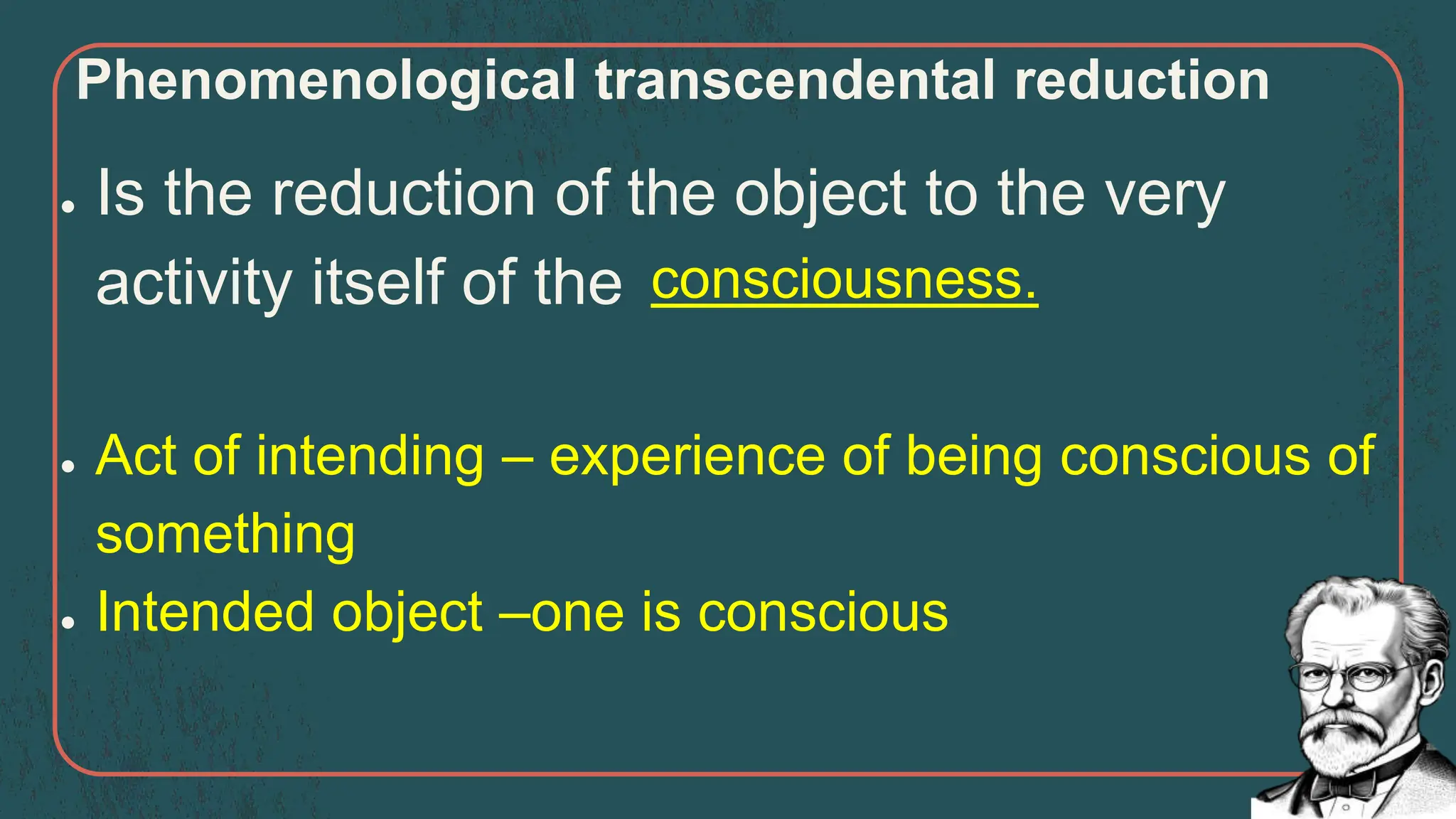
- Noesis: The real (reell), immanent components of the conscious act itself—the "how" of intending (e.g., perceiving, remembering, desiring).
- Noema: The ideal, objective correlate of the act—the object as it is intended (e.g., the perceived house, the remembered melody, the desired outcome).
Constitution is the process where the noetic acts of consciousness give rise to the unified noematic sense of the object. The "object" of our experience is precisely this constituted noematic unity.
The next video clip clarifies this relationship, defining an "object" in the phenomenological sense as a product of the ego's constituting activity.
Transcendental Experience & the Splitting of the Ego | Husserl | Cartesian Meditations
This clip from 'Singularity as Sublimity' clearly defines a phenomenological 'object' not as a thing-in-itself, but as a 'unified conscious experience' that is the result of the ego's activity. This directly links the noesis-noema structure to our topic.
Please watch from 15:49 to 19:10. Pay close attention to the definition of an 'object' around the 18:34 mark. The key takeaway is the statement that these constituted objects 'always Mark a unified Act of the ego'.
As the video argues, an object is "the unified conscious experience of my ever-shifting Flux of interconnected subjective processes." The crucial insight here is that the unity and identity of the object (e.g., experiencing this as one and the same house from many different angles) is not a property of a mind-independent thing, but an achievement of a synthesis performed by transcendental subjectivity.
3. The Result: Transcendental Idealism
This philosophical position—that the meaning, structure, and validity of any object of experience is inseparable from the constituting activity of transcendental subjectivity—is what Husserl calls transcendental idealism.
This is a term that requires careful handling. It is not:
- Subjective Idealism (like Berkeley's): The claim that objects are nothing but ideas in a mind. Husserl is clear that a material thing is not itself an experience.
- Metaphysical Idealism: The claim that the ultimate "stuff" of the universe is mental.
Instead, Husserl's transcendental idealism is a claim about the correlation between mind and world. An object cannot have being or meaning for us apart from the conscious acts that constitute it as such.
The following text from the Stanford Encyclopedia of Philosophy provides a rigorous explanation of this concept.
Edmund Husserl - Stanford Encyclopedia of Philosophy
Dr. Dan Zahavi, a leading Husserl scholar, wrote the entry on Husserl for the Stanford Encyclopedia of Philosophy. This excerpt clarifies the complex relationship between the phenomenological method, constitution, and transcendental idealism.
Please read the section titled '3. The transcendental turn'. Your focus should be on the following points: The paragraph beginning 'Strictly speaking, the epoché...'. Notice how the purpose of the reduction is to make the 'correlation between constituting subjectivity and constituted objectivity intelligible'. The two paragraphs following, which describe phenomenology as the 'final gestalt' of transcendental philosophy. Pay attention to the characterization of subjectivity as 'the locus of all objective formations of sense and validity'. \nThis will clarify that constitution is the central problem of phenomenology.
As the text highlights, the entire phenomenological method (epoché and reduction) is designed to bring this correlational structure into view. By bracketing our naive belief in a mind-independent world, we can finally see the world as a phenomenon—that is, as a correlate of the constituting consciousness that gives it sense. Transcendental subjectivity is, therefore, the "locus of all objective formations of sense and validity." Without it, there could be no objectivity for us at all.
This is a "Copernican Turn" similar to Kant's: instead of assuming consciousness conforms to objects, we investigate how objects must conform to the structures of consciousness in order to be known. For Husserl, this structure is the constituting power of intentionality.
Conclusion
Today, we have explored the primary function of the transcendental ego, or transcendental subjectivity: the constitution of meaning. We have seen that this is the active, dynamic process by which the world and the objects within it come to appear to us as coherent, unified, and meaningful.
Key Takeaways:
- Transcendental subjectivity is not passive; its intentional acts are constitutive, actively giving meaning and structure to experience.
- "To constitute" means to bestow sense and unity, not to create from nothing. It is a meaning-giving act.
- This process is structured by the noesis-noema correlation: the intentional act (noesis) synthesizes experience to form a unified object-as-meant (noema).
- A phenomenological "object" is this constituted unity, an achievement of the ego's synthesizing activity.
- This leads to Husserl's position of transcendental idealism: the idea that the meaning and being of the world are inseparably correlated with the constituting acts of consciousness. Subjectivity is the "locus of all objective formations of sense."
Preview of the Next Lesson:
Now that we understand what constitution is, we can ask: upon what ground does it operate? We don't constitute the world from a pure void. We are always already in a world that is "pre-given." In our next lesson, we will begin exploring Husserl's concept of the lifeworld (Lebenswelt), the pre-theoretical, taken-for-granted world that serves as the ultimate foundation for all our cognitive and scientific constituting activities.