Bonjour ! I hope you are having a great day.
In our last two lessons, we learned how to use articles: definite articles (le, la, les) for specific things and indefinite articles (un, une, des) for non-specific things. You learned that des is the plural article, used for more than one item.
Today, we will build directly on that knowledge. Our goal is to form the plural of regular and common irregular nouns. This means learning how to change the noun itself when it goes from singular to plural (e.g., from livre to livres). Mastering this is essential for constructing correct sentences and, importantly for your goals, for understanding what you hear, as the spoken cues for plurals can be subtle in French.
1. The General Rule: Add an -s
The most common rule for making a noun plural in French is simple: you add an -s to the end of the singular noun. This is very similar to English.
un livre(a book) →des livre**s**(books)une table(a table) →des table**s**(tables)un client(a client) →des client**s**(clients)
A Crucial Point on Pronunciation:
In most cases, this final -s is silent. You do not pronounce it. The main way you know a noun is plural when listening is by hearing the plural article des instead of un or une.
Let's watch a short video that explains this fundamental rule and its effect on pronunciation.
🇫🇷 🄿🄻🅄🅁🄸🄴🄻 des noms - Comment trouver le pluriel d'un nom - leçon de grammaire en français facile
The video 'Pluriel des noms' from the channel 'podcast francais facile' clearly explains the general rule and the importance of the article's sound.
Watch from 00:56 to 02:22. Pay close attention to how the speaker demonstrates that 'chat' and 'chats' sound the same. Also, notice the 'liaison' he mentions with words starting with a vowel, like 'des amis' (where the 's' of 'des' is pronounced like a 'z'). This is very important for your listening skills.
As the video showed, the article (un vs. des) is your primary clue that a noun is plural in spoken French.
2. Nouns That Do Not Change
The next rule is also quite simple. If a singular noun already ends in -s, -x, or -z, you do not add anything. The singular and plural forms are identical.
un pay**s**(a country) →des pay**s**(countries)une voi**x**(a voice) →des voi**x**(voices)un ne**z**(a nose) →des ne**z**(noses)
Again, you only know it's plural because of the article des.
Plurals in French: A full guide on how to form le pluriel en ...
Let's review this rule with a few more examples from the LingoCulture guide, 'Plurals in French'.
Read the short section titled 'French nouns ending in -s, -x, -z: no change'. Notice the examples like 'un cours' / 'des cours' and 'un prix' / 'des prix'.
Test your understanding!
Make the following singular nouns plural. Remember to change the article too!
un stylo(a pen)une chaise(a chair)un fils(a son)un choix(a choice)
Show answer
des stylo**s**des chaise**s**des fil**s**(no change to the noun)des choi**x**(no change to the noun)
3. Irregular Plurals: Endings with -x and -aux
Now we get into the more irregular patterns. Many of these involve changing the ending to -x or -aux. While these are "irregular," they follow predictable patterns.
Nouns ending in -eau, -au, -eu → add -x
un bat**eau**(a boat) →des bateau**x**un chap**eau**(a hat) →des chapeau**x**un j**eu**(a game) →des jeu**x**
The final -x is also silent.
Nouns ending in -al → change to -aux
This is a very common and important pattern. The ending -al is replaced with -aux. This is one of the few plural forms where the sound changes significantly.
un journ**al**(a newspaper) →des journ**aux**un anim**al**(an animal) →des anim**aux**un hôpit**al**(a hospital) →des hôpit**aux**
Listen to the difference: journal (jour-nal) vs. journaux (jour-no). Recognizing this change is key for listening comprehension.
Nouns ending in -ou
Most nouns ending in -ou follow the general rule (add -s).
un tr**ou**(a hole) →des trou**s**
However, there are seven common exceptions that take an -x. You should memorize these as they are used frequently.
bijou(jewel) →bijou**x**caillou(pebble) →caillou**x**chou(cabbage) →chou**x**genou(knee) →genou**x**hibou(owl) →hibou**x**joujou(toy) →joujou**x**pou(louse) →pou**x**
Let's watch a video that covers all these patterns with clear examples and pronunciation.
🇫🇷 🄿🄻🅄🅁🄸🄴🄻 des noms - Comment trouver le pluriel d'un nom - leçon de grammaire en français facile
Let's return to the 'Pluriel des noms' video. The speaker does an excellent job explaining these irregular patterns.
Watch from 02:44 to 09:14. This covers: Nouns ending in -eau, -au, -eu (02:44) The important -al → -aux rule (04:23) The -ou rule with its seven exceptions (07:13) Listen carefully to the pronunciation.
4. Highly Irregular Nouns
Finally, a few very common nouns have completely irregular plurals that you simply need to memorize. The most important one is:
un **œil**(an eye) →des **yeux**(eyes)
Another one you might encounter:
Monsieur(Mr. / Sir) →**Messieurs**(Gentlemen)Madame(Mrs. / Ma'am) →**Mesdames**(Ladies)
5. Summary of Rules
That was a lot of information! It can be helpful to see all the rules together in one place. This image provides a great visual summary of everything we've covered.
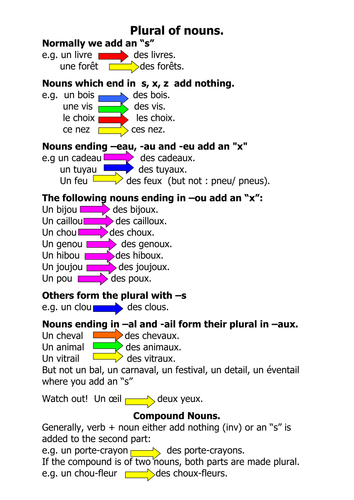
Feel free to save this image for future reference.
Final Practice!
Choose the correct plural form for each noun.
un bureau(an office)
a) des bureaus
b) des bureaux
c) des bureauun travail(a job)
a) des travails
b) des travail
c) des travauxun festival(a festival) - Hint: This is an exception!
a) des festivals
b) des festivaux
c) des festivalun genou(a knee) - Hint: Another exception!
a) des genous
b) des genoux
c) des genou
Show answer
- b) des bureaux (Rule: nouns ending in -eau take an -x)
- c) des travaux (This is an irregular noun ending in -ail that follows the -aux pattern.
Travailis very common, so it's good to learn.) - a) des festivals (Rule: -al → -aux, but
festivalis one of the common exceptions that just takes an -s.) - b) des genoux (Rule: -ou usually takes -s, but
genouis one of the seven exceptions that takes an -x.)
Conclusion
Great job today! You've learned the essential rules for making French nouns plural. While there are several patterns and exceptions, focusing on the main ones will cover the vast majority of situations you'll encounter.
Key Takeaways:
- The general rule is to add a silent -s.
- Nouns ending in -s, -x, -z do not change.
- Nouns ending in -eau, -au, -eu usually take an -x.
- The ending -al most often changes to -aux, and this change is audible.
- Memorize the seven -ou exceptions that take an -x and the highly irregular plural of
œil(yeux). - In speaking, the article (
des) is often the biggest clue that you're hearing a plural noun.
In our next lesson, we will cover partitive articles (du, de la, des). This will help us talk about uncountable things (like water or coffee) or parts of a whole, which will contrast nicely with the countable plural items we discussed today.
À la prochaine ! (Until next time!)