Bonjour !
In our last lesson, we learned how to make and respond to polite requests using the conditional, with key phrases like Je voudrais... and Pourriez-vous...?. This was about asking for actions or things.
Today, we'll shift from asking to expressing. Our learning outcome is to express preferences and opinions using verbs like aimer, préférer, and penser que. This is a vital skill for your goal of working in customer service, as it allows you to understand a customer's tastes, discuss options, and share your perspective clearly and politely.
We will break this down into three parts:
- Expressing likes and dislikes.
- Stating a preference.
- Giving your opinion.
1. Expressing Likes and Dislikes (J'aime, J'adore, Je déteste)
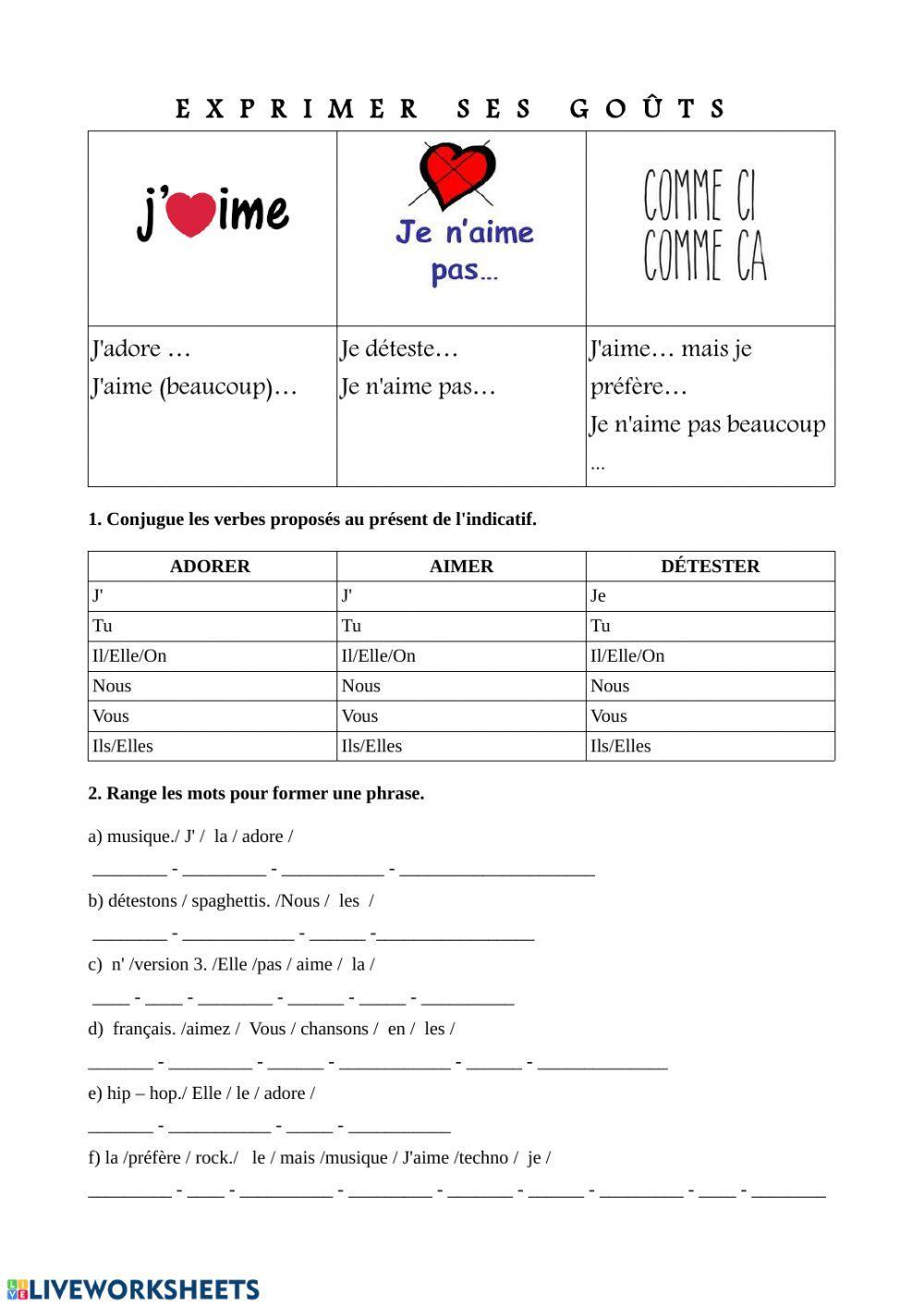
Let's begin with the most fundamental way to express your feelings about something: saying whether you like it or not. The main verbs for this are aimer (to like/love), adorer (to adore/love), and détester (to hate/detest).
To get started, watch this clear video explanation.
Giving your opinion in French - beginner Level
The video 'Giving your opinion in French - beginner Level' by Clearly French provides a great introduction to the key verbs for expressing likes and dislikes.
Watch from 00:11 to 03:08. Pay close attention to the examples for 'j'aime', 'j'adore', and their negative forms 'je n'aime pas' and 'je déteste'. Also, notice the use of 'du tout' to add emphasis.
Here is a summary of the key structures:
-
To express a positive feeling:
J'aime...: I like... (J'aime le chocolat.)J'aime bien...: I like... (often used for things or platonic liking of people). This is a very common, friendly expression.J'aime bien ce film.J'adore...: I love... / I adore... (stronger thanj'aime).J'adore la musique classique.
-
To express a negative feeling:
Je n'aime pas...: I don't like... (Je n'aime pas les épinards.)Je n'aime pas du tout...: I don't like... at all. (Je n'aime pas du tout conduire la nuit.)Je déteste...: I hate... (Je déteste être en retard.)
Important Note: After these verbs, you generally use a definite article (le, la, les) when talking about something in general. For example, J'aime **le** sport (I like sports).
Practice Time!
Let's reinforce this with a quick exercise. Look at the image below. It provides a great summary and asks you to practice forming sentences.
2. Expressing a Preference (Je préfère)
Expressing a like or dislike is good, but often you need to state a choice between options. This is where the verb préférer (to prefer) is essential.
You can use it in a few ways:
Je préfère + [noun]: I prefer + [noun].Je préfère le thé.(I prefer tea.)
Je préfère + [infinitive verb]: I prefer + [verb].Je préfère rester à la maison.(I prefer to stay at home.)
Je préfère + [A] + à/plutôt que + [B]: I prefer A to/rather than B.Je préfère le thé au café.(I prefer tea to coffee.)Je préfère voyager en train plutôt qu'en avion.(I prefer to travel by train rather than by plane.)
Let's look at a few more examples to solidify this.
Exprimer son avis en français : 50 expressions essentielles ...
The article 'Exprimer son avis en français' from Nathalie FLE has a useful section on preferences. It provides clear examples and highlights a common grammar mistake to avoid.
Read the section titled 'Exprimer une préférence'. Focus on the examples using 'Je préfère'. Pay special attention to the grammar note: you say 'Je préfère partir' and NOT 'Je préfère de partir'.
Test your understanding!
A colleague asks for your preference for a team lunch. How would you say "I prefer Italian restaurants to fast-food restaurants"?
Show answer
You could say: Je préfère les restaurants italiens aux fast-foods. (Note: à + les becomes aux).
3. Giving Your Opinion (Je pense que, Je trouve que)
Now we move from feelings and preferences to structured opinions. In a professional context, being able to say "I think that..." is fundamental. The most common ways to do this are with penser que (to think that), trouver que (to find that), and à mon avis (in my opinion).
This next video explains these expressions and their nuances very well.
Donner son opinion en français
This video from 'Français avec Pierre' is excellent for understanding how to give a structured opinion, which is very useful in professional settings.
Watch from 03:11 to 04:39. Focus on how the verbs 'penser', 'croire', and 'trouver' are used to form opinions. Notice that they are almost always followed by 'que'.
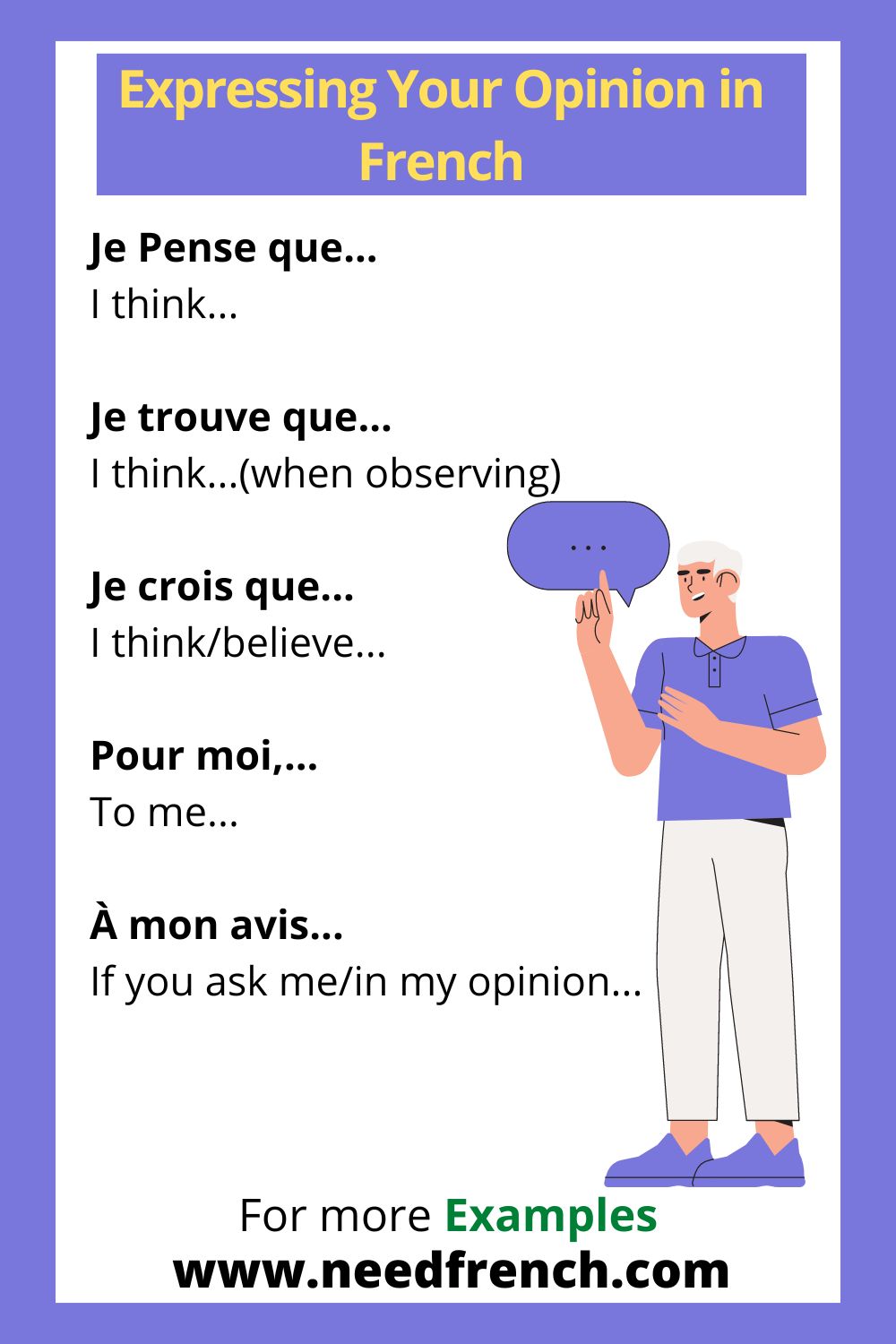
Here are the key phrases, summarized in this handy visual guide.
Let's break them down:
Je pense que...: "I think that..."- This is the most standard and versatile way to express an opinion.
Je pense que c'est une bonne idée.(I think that it's a good idea.)
Je trouve que...: "I find that..." or "I think that..."- This is often used to give an opinion based on a direct observation or feeling. It’s less about a deep belief and more about a personal judgment.
Je trouve que ce logiciel est très efficace.(I find this software to be very effective.)
À mon avis...: "In my opinion..."- This phrase is perfect for clearly flagging that what you're about to say is your personal viewpoint.
À mon avis, nous devrions confirmer avec le client.(In my opinion, we should confirm with the client.)
A quick scenario
Imagine a customer is unhappy with a product. You need to assess the situation.
- Customer:
Ce produit ne fonctionne pas bien.(This product doesn't work well.) - You (after looking at it):
Je trouve que le problème est simple à résoudre.(I find that the problem is simple to solve.) - You (proposing a solution):
Je pense que nous pouvons le réparer rapidement.(I think that we can repair it quickly.)
Final Challenge!
You are in a team meeting discussing a new marketing campaign. Your colleague presents an idea. How would you express the following?
- A positive opinion: You think the idea is excellent. (Use
Je trouve que...) - A suggestion: In your opinion, the budget is too small. (Use
À mon avis...)
Show answer
Je trouve que cette idée est excellente.À mon avis, le budget est trop petit.
Conclusion
Excellent work today! You have learned how to go beyond simple statements and start sharing your personality and thoughts in French.
Key Takeaways:
- Likes/Dislikes: Use
j'aime,j'adore, andje détestewith definite articles (le,la,les) for generalities. - Preferences: Use
Je préfèrefollowed by a noun or an infinitive verb to state a choice. - Opinions: Use
Je pense que...,Je trouve que..., andÀ mon avis...to structure and present your thoughts, a crucial skill for professional discussions.
In our next lesson, we will learn about advanced negation (ne...rien, ne...jamais, ne...plus). This will allow you to give even more nuanced answers when expressing your opinions and preferences, such as saying "I never go to the cinema" or "There is nothing I like about it."
À bientôt