Bonjour !
In our last lesson, we mastered advanced negation with ne...jamais, ne...plus, and ne...rien. This completed our core grammar modules, giving you the solid foundation you wanted before focusing on professional skills.
Today, we begin a new and exciting module: "Essential Listening Skills for Phone Calls." This marks our shift toward the practical communication skills needed for your goal of working in a call center.
Our learning outcome for this lesson is to recite and recognize the letters of the French alphabet, especially in a phone context. While this might seem basic, it's one of the most critical skills for professional communication. You'll constantly need to spell names, email addresses, and reference numbers accurately. Getting this right is the first step to sounding professional and being efficient on the phone.
1. Learning the French Alphabet
The French alphabet uses the same 26 letters as English, but their names are often pronounced differently. Mastering these pronunciations is key to both spelling words yourself (recite) and understanding others when they spell for you (recognize).
Let's start by listening to the entire alphabet. This video will give you a great first exposure to the sounds and rhythm.
The French alphabet for beginners | French pronunciation course | Lesson 1/55
Watch this video from 'The perfect French with Dylane' to hear each letter of the alphabet pronounced clearly, along with an example word.
First, watch from 00:44 to 02:12 to hear each letter and its example. Then, watch from 02:12 to 03:59 and try to repeat each letter out loud after the speaker. This will help you start memorizing the sounds.
Now that you have a general idea, let's practice more methodically. Some letters can be tricky, especially those that sound similar to each other, like 'g' / 'j' or 'b' / 'p'.
This webpage provides individual audio recordings for every letter. It's an excellent tool for focused practice.
French Alphabet Sounds & Audio Pronunciation
Use this article from French Today to practice each letter's pronunciation individually.
Scroll down to the section titled 'French Alphabet Recording – Letter by letter'. Click on each letter to hear its name and repeat it. Do this several times for letters you find difficult. Pay special attention to G, J, E, U, and Y.
Here is a table for quick reference, based on the Duolingo guide.
| Letter | Letter name |
|---|---|
| A | a |
| B | bé |
| C | cé |
| D | dé |
| E | e |
| F | effe |
| G | gé |
| H | ache |
| I | i |
| J | ji |
| K | ka |
| L | elle |
| M | emme |
| N | enne |
| O | o |
| P | pé |
| Q | qu |
| R | erre |
| S | esse |
| T | té |
| U | u |
| V | vé |
| W | double vé |
| X | ixe |
| Y | i grec |
| Z | zède |
2. Spelling in a Professional Context
On a phone call, simply saying the letters might not be enough due to background noise or bad connections. To avoid mistakes, it's standard practice in French to use a reference word, often a name. You might say: "A comme Alain, B comme Bernard..." ("A as in Alain, B as in Bernard...").
This is especially important for letters that sound alike, such as:
- B (
bé) and P (pé) - D (
dé) and T (té) - G (
gé) and J (ji) - M (
emme) and N (enne)
There is a standard list used in many professional environments, similar to the NATO phonetic alphabet in English (Alpha, Bravo, Charlie). This is a fantastic tool for a call center role.
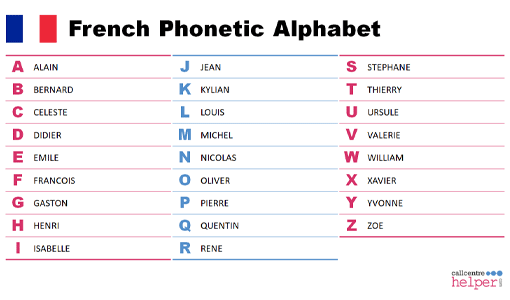
To ask someone to spell a word, you can say:
Pouvez-vous épeler, s'il vous plaît ?(Can you spell, please?)Comment ça s'écrit ?(How is that written?)
To say that you are going to spell something, you can say:
Je vous l'épelle.(I'll spell it for you.)
Test your understanding!
Imagine a client's name is Marc. How would you spell it out loud using the phonetic alphabet from the image above to be perfectly clear?
Show answer
You would say: "M comme Marcel, A comme Alain, R comme Robert, C comme Cécile."
3. Listening Practice: Recognizing Spelled Words
Now let's test your recognition skills. This is exactly what you'll need to do when a customer spells their name or a reference number for you.
In the following video, the presenter will spell out five words. Listen carefully and write down the letters for each word. Don't worry about knowing the word's meaning; just focus on identifying the letters correctly.
French lesson: spelling exercise
This video from Language City is a practical spelling exercise. Get a pen and paper ready!
Watch the video from 00:26 to 02:46. The presenter will spell five words. Write down the letters you hear for each one. He repeats each spelling twice. After you have written down your five answers, continue watching from 02:46 to the end to check your work. How many did you get right?
How did you do? This exercise is challenging even for advanced students, so don't be discouraged. The key is to practice until the sound of each letter is instantly recognizable. Re-watch the video and review the alphabet chart if you had any trouble.
Conclusion
Excellent work today! You've taken a crucial first step into the world of professional French communication. Mastering the alphabet is not just about memorization; it's a practical skill that builds confidence and ensures accuracy in your future role.
Key Takeaways:
- The French alphabet has 26 letters, but many have different names and pronunciations than in English.
- In a professional phone context, spelling is essential for names, emails, and reference numbers.
- To avoid confusion, use a phonetic alphabet or reference words:
M comme Marcel. - Key phrases like
Pouvez-vous épeler ?are used to ask for spelling.
In our next lesson, we will build directly on this skill. You will learn to identify key information (names, numbers, dates) in slow, clear spoken French. Now that you can recognize individual letters, we will move on to recognizing whole words and numbers within a sentence.
À bientôt