Bonjour ! Welcome back to your French course.
In our last lesson, you learned how to use modal verbs to form statements expressing ability, desire, and obligation, such as Je peux vérifier votre compte (I can check your account). Today, we'll learn how to turn those statements into questions.
This lesson focuses on a fundamental communication skill: forming yes/no questions using intonation and the phrase est-ce que. This is essential for your goal of working in a call center, where you'll constantly need to ask for confirmation and information from clients (e.g., "Can you spell your name?", "Do you have a reference number?").
By the end of this lesson, you will be able to ask simple questions that can be answered with "oui" (yes) or "non" (no), moving you from making statements to having basic conversations.
1. Types of Questions: Closed vs. Open
In French, as in English, there are two main types of questions. For this lesson, we are focusing on closed questions (questions fermées).
A closed question is one that can be answered with a simple "yes" or "no". For example:
- "Do you speak French?" (Yes/No)
- "Is the customer on the line?" (Yes/No)
An open question requires a more detailed answer, using question words like "who", "what", "where", etc. We will cover those in a future lesson.
Let's begin with the simplest and most common way to ask a closed question in spoken French.
2. Method 1: Raising Your Intonation
The most frequent way French speakers ask questions in casual conversation is by taking a regular statement and simply raising the pitch of their voice at the end. The word order doesn't change at all.
-
Statement:
Tu parles français.(You speak French.) -
Question:
Tu parles français ?(Do you speak French? — with a rising tone) -
Statement:
Vous avez un stylo.(You have a pen.) -
Question:
Vous avez un stylo ?(Do you have a pen? — with a rising tone)
This method is very common in everyday speech but is considered informal. It's perfect for talking with friends or in relaxed situations.
To see and hear this in action, let's watch a short video clip.
How To Ask a Yes-No Question In French // French Grammar Course // Lesson 23 🇫🇷
The instructor in this video from 'The perfect French with Dylane' explains this first method very clearly.
Watch from 00:52 to 01:44. Notice how she uses the same sentence but changes her intonation to turn it into a question. This is the most common method in spoken French.
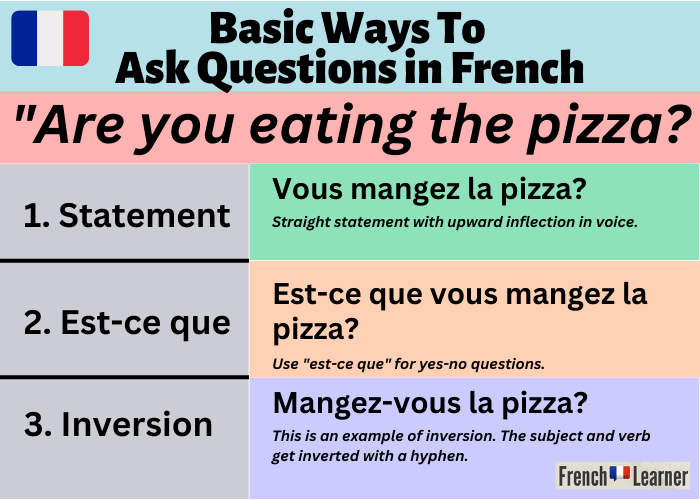
This image provides a great visual summary of the three ways to ask a question, starting with intonation.
Test your understanding!
Turn the following statements into questions using only your intonation. Try saying them out loud.
Vous travaillez dans le marketing.(You work in marketing.)Il aime le café.(He likes coffee.)Nous pouvons commencer.(We can start.)
Show answer
Vous travaillez dans le marketing ?Il aime le café ?Nous pouvons commencer ?
Remember, the only difference is the rising sound of your voice at the end of the sentence.
3. Method 2: Using Est-ce que
While intonation is easy, it can sometimes be unclear if you don't get the tone just right. A more standard and universally understood way to ask a yes/no question is to use the phrase est-ce que.
Think of est-ce que as a question marker. You place it at the beginning of a regular statement to turn it into a question. It literally means "is it that...", but in practice, it functions like "Do you...?" or "Are you...?" in English. The best part is that the word order of the sentence that follows remains exactly the same.
Structure: Est-ce que + [Subject] + [Verb] + ... ?
Let's apply this to our previous examples:
-
Statement:
Tu parles français. -
Question:
**Est-ce que** tu parles français ?(Do you speak French?) -
Statement:
Vous avez un stylo. -
Question:
**Est-ce que** vous avez un stylo ?(Do you have a pen?)
This method is considered "standard" French (langage courant). It's perfect for almost any situation, whether spoken or written, formal or informal. It is a reliable and clear way to ask a question.
Learn How to Ask Questions in French - A1 [with Alicia]
This video from 'lingoni FRENCH' does an excellent job of explaining how to use this 'fixed expression'.
Watch from the beginning to 03:55. The presenter shows how to add 'est-ce que' to the beginning of affirmative sentences without changing anything else. This is the key takeaway.
An Important Detail: Elision with est-ce qu'
Remember the elision rule we saw with articles? The same applies here. If the word following est-ce que starts with a vowel sound (a, e, i, o, u, h), que becomes qu'.
Est-ce que+il aime le café.→**Est-ce qu'**il aime le café ?(Does he like coffee?)Est-ce que+elle est prête.→**Est-ce qu'**elle est prête ?(Is she ready?)
This is purely for pronunciation, to make the sentence flow better.
Putting It All Together: A Summary
Let's read a short article that neatly summarizes the two methods we've learned and briefly introduces a third, more formal one.
This article from 'Français avec Pierre' clearly outlines the different ways to ask closed questions and notes their level of formality.
Please read the first section titled '1. Les questions fermées'. It reviews questions with intonation and 'est-ce que', and also mentions the third method, inversion ('Allez-vous...?'), which is used in formal language.
As the article mentions, there is a third way: inversion. This involves swapping the verb and the subject pronoun (e.g., Parlez-vous français ?). This is the most formal way and is mostly used in professional writing or very formal speech. For now, it's good to recognize it, but focus on mastering intonation and est-ce que.
Test your understanding!
Let's practice transforming a statement using both methods. Take the sentence: Vous voulez une confirmation. (You want a confirmation.)
- How would you ask this question using intonation?
- How would you ask this question using
est-ce que?
Show answer
- Intonation:
Vous voulez une confirmation ?(with a rising voice at the end) Est-ce que:Est-ce que vous voulez une confirmation ?
Conclusion
Excellent work today! You have now learned the two most important ways to ask yes/no questions in French, a crucial skill for any conversation.
Key Takeaways:
- Closed questions (
questions fermées) are questions that can be answered with "yes" or "no". - Method 1 (Informal): Use a statement and raise your intonation at the end. (e.g.,
Tu es prêt ?) - Method 2 (Standard): Add
est-ce queto the beginning of a statement. (e.g.,Est-ce que tu es prêt ?) - Remember to use the elision
est-ce qu'before a vowel sound. (e.g.,Est-ce qu'il est là ?)
Now that you can form statements and ask simple questions, the next logical step is to learn how to form negative sentences. In our next lesson, we will focus on using ne...pas to say "no" or express that something is not the case.
À bientôt