Bonjour! I hope you are ready to start a new topic.
In our last lesson, we wrapped up our module on nouns and articles by learning how to use partitive articles (du, de la, des). This gave you the tools to talk about what things are. Now, we begin a new module that focuses on verbs, which describe actions.
To use verbs correctly, you first need to know who or what is performing the action. This is the job of subject pronouns. Today's lesson is dedicated to our learning outcome: Use subject pronouns (je, tu, il/elle, nous, vous, ils/elles) correctly. These are the fundamental building blocks for constructing sentences, and mastering them is essential before we can start using verbs like 'être' (to be) and 'avoir' (to have).
1. What Are Subject Pronouns?
In French, we call them les pronoms personnels sujets. Their job is simple: they replace the subject of a sentence (a person, place, or thing) to tell us who is performing the verb's action.
For example, instead of saying "The client speaks. The client is happy," you would say, "The client speaks. He is happy." The word "He" is a subject pronoun.
Here is a quick overview of the French subject pronouns.
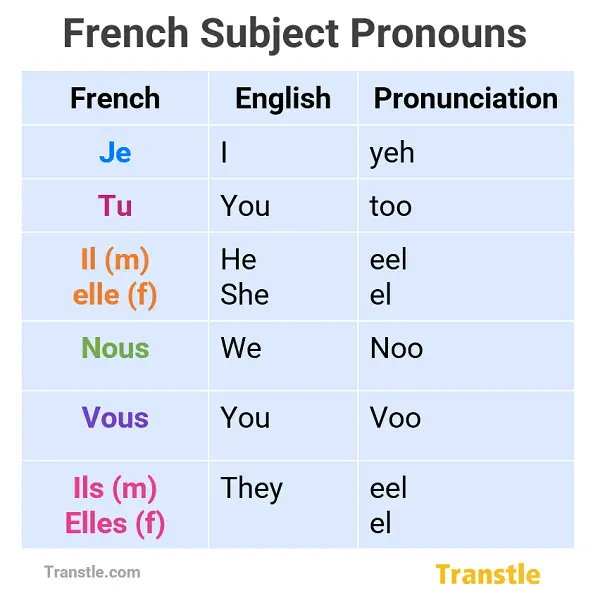
The main reason we use pronouns is to make our language more fluid and avoid repeating the same noun over and over. Since your native language is Arabic, you might find this first video helpful. It explains the concept of pronouns in French, with explanations in Arabic.
تعلم الفرنسية من الصفر! les pronoms personnels *للمبتدئين*
Let's watch a part of the video 'تعلم الفرنسية من الصفر! les pronoms personnels' from 'قناة كوثر التعليمية'. This section clearly demonstrates why pronouns are used to avoid repetition, using examples.
Watch from 12:35 to 15:55. The presenter will explain that pronouns are used 'pour éviter la répétition' (to avoid repetition) and will show you how 'Karim' can be replaced by 'il' (he) and 'le train' (the train) can also be replaced by 'il' (it).
As you saw, pronouns are essential for natural-sounding sentences. Let's break them down into two groups: singular and plural.
2. The Singular Pronouns: One Person or Thing
These pronouns refer to a single subject.
-
je(I): The first-person singular. It's used when you talk about yourself.- If the verb that follows starts with a vowel or a silent 'h',
jebecomesj'. This is called an elision, which we discussed in Module 1. - Example:
je parle(I speak) butj'aime(I love).
- If the verb that follows starts with a vowel or a silent 'h',
-
tu(you): The second-person singular. It's used to address one person informally – a friend, a family member, or a peer. We'll discuss this more later.- Example:
tu es mon ami(you are my friend).
- Example:
-
il(he, it): The third-person singular, masculine. It refers to a male person or a masculine noun.- Example:
Paul est ici. **Il** attend.(Paul is here. He is waiting.) - Example:
Le livre est sur la table. **Il** est ouvert.(The book is on the table. It is open.)
- Example:
-
elle(she, it): The third-person singular, feminine. It refers to a female person or a feminine noun.- Example:
Marie est ici. **Elle** attend.(Marie is here. She is waiting.) - Example:
La voiture est dans la rue. **Elle** est rouge.(The car is in the street. It is red.)
- Example:
Notice that in French, unlike English, there is no neutral pronoun for "it". Every object has a gender (masculine or feminine), so you must use il or elle to replace it.
3. The Plural Pronouns: More Than One
These pronouns refer to a group of subjects.
-
nous(we): The first-person plural. It's used for any group of people that includes you ("you and I," "they and I").- Example:
Mon ami et moi, **nous** travaillons ensemble.(My friend and I, we work together.)
- Example:
-
vous(you): The second-person plural. This is the pronoun you use when speaking to more than one person. It doesn't matter if the situation is formal or informal.- Example (to a group of friends):
**Vous** allez au cinéma ce soir ?(Are you going to the cinema tonight?)
- Example (to a group of friends):
-
ils(they): The third-person plural, masculine. It's used for a group of men or for a mixed group of men and women. This is an important rule: even if there are 99 women and only 1 man, the pronoun isils. It is also used for a group of all-masculine nouns.- Example:
Paul et David sont ici. **Ils** attendent.(Paul and David are here. They are waiting.) - Example:
Paul et Marie sont ici. **Ils** attendent.(Paul and Marie are here. They are waiting.)
- Example:
-
elles(they): The third-person plural, feminine. It's used only for a group of all women or all-feminine nouns.- Example:
Marie et Sophie sont ici. **Elles** attendent.(Marie and Sophie are here. They are waiting.)
- Example:
Test your understanding!
What pronoun would you use to replace the subject in bold?
- Le garçon joue au football. (The boy plays football.)
- La voiture est rapide. (The car is fast.)
- Les étudiants et les étudiantes sont dans la classe. (The male and female students are in the class.)
- Sophie et moi parlons français. (Sophie and I speak French.)
Show answer
il(Le garçon is masculine singular)elle(La voiture is feminine singular)ils(This is a mixed-gender group)nous(Any group including 'moi' becomes 'nous')
4. A Crucial Distinction for Your Goal: tu vs. vous
For your goal of working in a call center, understanding the difference between tu and vous is absolutely critical for politeness and professionalism.
In English, we only have "you." In French, the choice between tu and vous depends on your relationship with the person you are speaking to.
-
tuis the informal singular. Use it with one person you know well (friend, family member, child, close colleague). -
voushas two main uses:- The plural "you". Use it when talking to any group of 2 or more people, regardless of formality.
- The formal singular "you". Use it when talking to one person you need to show respect to: a client, a manager, an older person, or a stranger.
In a professional context like a call center, you will almost always use vous when speaking to a client. Using tu would be considered unprofessional and possibly rude.

To explore this vital topic further, please read the following section from the LingoCulture blog.
French subject pronouns: Everything you need to know
The article 'French subject pronouns: Everything you need to know' has an excellent section that breaks down the difference between 'tu' and 'vous'.
Please read the entire section titled 'Second-person: You in French'. It clearly explains the three contexts: 'Tu' for informal singular, 'Vous' for formal singular, and 'Vous' for plural.
Test your professional French!
Which pronoun, tu or vous, should you use in these scenarios?
- You are answering the phone and speaking to a new client.
- You are talking to your close friend during your lunch break.
- You are in a meeting presenting to your manager and a colleague.
- You are speaking to your boss one-on-one.
Show answer
vous(This is a formal, professional interaction with a stranger/client.)tu(This is an informal conversation with a friend.)vous(You are addressing more than one person.)vous(You are addressing an authority figure, which requires a formal tone.)
Conclusion
Très bien ! You have just learned one of the most fundamental parts of French grammar. Knowing who is doing the action is the first step to building any sentence.
Key Takeaways:
- Subject pronouns (
je, tu, il, elle, nous, vous, ils, elles) replace the subject of a sentence. - The singular pronouns are
je, tu, il, elle. - The plural pronouns are
nous, vous, ils, elles. - Gender is important:
ilis for masculine,elleis for feminine. For a mixed-gender group, always useils. - The
tuvs.vousdistinction is crucial for politeness. In a professional setting, always usevouswhen addressing clients or superiors.
This lesson is the first step in our module on core verbs. Now that you can correctly identify the subject, you are ready for our next lesson, where we will learn how to conjugate the two most important verbs in French: 'être' (to be) and 'avoir' (to have) in the present tense.
À bientôt