Здравствуйте! Welcome back.
In our last lesson, we tackled the fundamental distinction between идти (going one way on foot) and ходить (going habitually or back-and-forth on foot). You learned that in Russian, the nature of the movement—whether it's a single, ongoing trip or a repeated/general action—is key.
Today, we're going to build directly on that knowledge. We'll apply the exact same logic to a new pair of verbs. Our goal is to distinguish between the unidirectional verb 'ехать' and the multidirectional verb 'ездить', which both mean 'to go by transport'. Since you've already mastered the underlying concept, this lesson will focus on applying it to a new context.
1. The Same System, a Different Vehicle
As you know, Russian verbs of motion are organized into pairs. Let's refresh our memory and see where our new verbs fit in.
Russian Verbs of Motion - Russian From Russia
The article 'Russian Verbs of Motion' from Russian From Russia provides a very clear overview table. Let's use it to situate our new verbs.
In the article, find the table under the heading '8 Most Common Verbs of Motion'. Notice how 'ехать / ездить' is the second pair, right after 'идти / ходить'. This table neatly organizes the system.
The system is beautifully logical. Last lesson was about going on foot. Today is about going by transport (car, bus, train, bike, etc.).
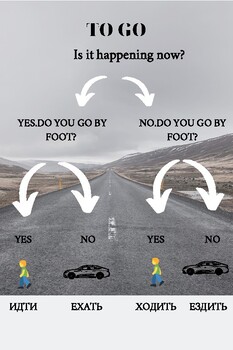
- Ехать (yékhat') is for a single, one-way trip by transport, usually happening now. It's the transport equivalent of идти.
- Ездить (yézdit') is for habitual trips, round trips, or general travel by transport. It's the transport equivalent of ходить.
This simple flowchart is a great mental model for choosing the right verb. Notice how it's the same decision process as before, just with a different outcome for "by transport".
Now, let's look at a concrete example that's relevant to you as a student.

2. Conjugations and Usage in Context
Now that the core concept is clear, let's learn the verb forms and see them in action. Ехать and ездить are different verbs and have their own unique conjugation patterns.
The following video from the "Russian with Julie" channel is an excellent, comprehensive guide. We will watch it in sections.
First, let's learn the present tense conjugations and the fundamental difference between the verbs.
Ехать / Ездить. To go. Russian verbs of motion
This first segment of the video 'Ехать / Ездить. To go' will introduce the verbs and their present tense forms.
Watch from the beginning (00:00) to 02:03. Pay close attention to the pronunciation of the conjugated forms for both verbs. The presenter clearly lays out the conjugation tables for 'ехать' and 'ездить'.
For your reference, here are those all-important conjugations:
| Pronoun | Ехать (Unidirectional) | Ездить (Multidirectional) |
|---|---|---|
| я (I) | е́ду | е́зжу |
| ты (you, inf.) | е́дешь | е́здишь |
| он/она/оно | е́дет | е́здит |
| мы (we) | е́дем | е́здим |
| вы (you, for./pl.) | е́дете | е́здите |
| они (they) | е́дут | е́здят |
Note the ж/зд consonant mutation in я езжу / ты ездишь. This is a common pattern in second-conjugation verbs.
Now, let's continue with the same video to see how these verbs are used to talk about the present, future, and past. The logic remains the same: one-time vs. habitual.
Ехать / Ездить. To go. Russian verbs of motion
This longer segment of the video explains how the unidirectional/multidirectional distinction applies across different tenses and situations.
Watch from 02:03 to 10:14. The presenter will cover: Present tense: 'I am driving to work now' (еду) vs. 'I go to different shops' (езжу). (02:03 - 05:27) Future tense: 'This summer we are going to the sea' (едем, a single planned trip) vs. 'Every summer we go to the sea' (ездим, a habit). (05:27 - 07:36) Past tense: 'Yesterday I was driving to the cinema' (ехал, one-way action in progress) vs. 'Last year I went to the dacha every weekend' (ездила, a habitual round trip). (07:36 - 10:14)
Here's a summary of the rules, mirroring what we learned for идти/ходить:
When to use ездить (multidirectional):
- Habitual actions: Actions that happen regularly.
Каждое лето мы **ездим** на море.(Every summer we go to the sea.)
- Round trips: You went somewhere and came back.
Вчера я **ездил** в Москву.(Yesterday I went to Moscow [and came back].)
- General ability/preference: The ability or liking to travel by transport.
Он не умеет **ездить** на велосипеде.(He doesn't know how to ride a bicycle.)Я люблю **ездить** в горы.(I like to travel to the mountains.)
When to use ехать (unidirectional):
- An action in progress right now:
- Что ты делаешь? - Я **еду** домой.(- What are you doing? - I'm going home.)
- A single, specific trip (present or future):
Завтра мы **едем** в Петербург.(Tomorrow we are going to Petersburg.)
- An action in progress when something else happened (past tense):
Когда я **ехал** на работу, пошёл дождь.(When I was going to work, it started to rain.)
3. Practice
Let's put your knowledge to the test. The final part of the video you just watched contains some excellent practice exercises.
Ехать / Ездить. To go. Russian verbs of motion
Now, watch the exercise section of the same video. Try to fill in the blank yourself before the presenter gives the answer.
Watch from 11:01 to 14:10. This is a fill-in-the-blanks quiz. Pause the video at the beginning of each question and decide whether you would use a form of 'ехать' or 'ездить'.
Let's try one of the key examples from that exercise here. Choose the correct verb form.
Dialogue:
- Куда ты ________? (Where are you going?)
- Я ________ в бассейн. (I'm going to the pool.)
Follow-up question:
- Как часто ты ________ в бассейн? (How often do you go to the pool?)
Response:
- Я ________ в бассейн каждую субботу. (I go to the pool every Saturday.)
Check your answers here:
- Куда ты едешь? (The question is about right now, a single trip.)
- Я еду в бассейн. (The answer is about right now.)
- Как часто ты ездишь в бассейн? (The question is about a habit, 'how often'.)
- Я езжу в бассейн каждую субботу. (The answer is about a habit, 'every Saturday'.)
Conclusion
Отлично! You've successfully extended your knowledge of verbs of motion to include travel by transport. By understanding this core system of unidirectional vs. multidirectional verbs, you've unlocked a huge part of everyday Russian conversation.
Key Takeaways:
- The logic for ехать / ездить is identical to идти / ходить.
- Ехать is for a single, one-way trip by transport that is happening now or is planned for a specific time.
- Ездить is for habitual travel, round trips, or discussing the general ability/preference for travelling by transport.
Preview of the next lesson:
Now that you can correctly say how you are going somewhere, you'll need to know what to say when you get there! In our next lesson, we will learn how to give and follow simple directions using 'прямо' (straight), 'налево' (left), and 'направо' (right).